
By Ulysses Cornelius. Educational market analysis, not financial advice.
Direct answer: Prediction markets trade a defined event outcome. Stocks represent company ownership, spot crypto represents a digital asset, and futures provide standardized exposure to an asset or index. Arbitrage, market making, technical analysis, and news trading appear across all of them, but prediction-market results depend far more on contract wording, probability estimates, deadlines, and settlement rules.
Sources and platform documentation were checked at 9:55 a.m. ET on September 10, 2026. The prices in this guide are hypothetical.
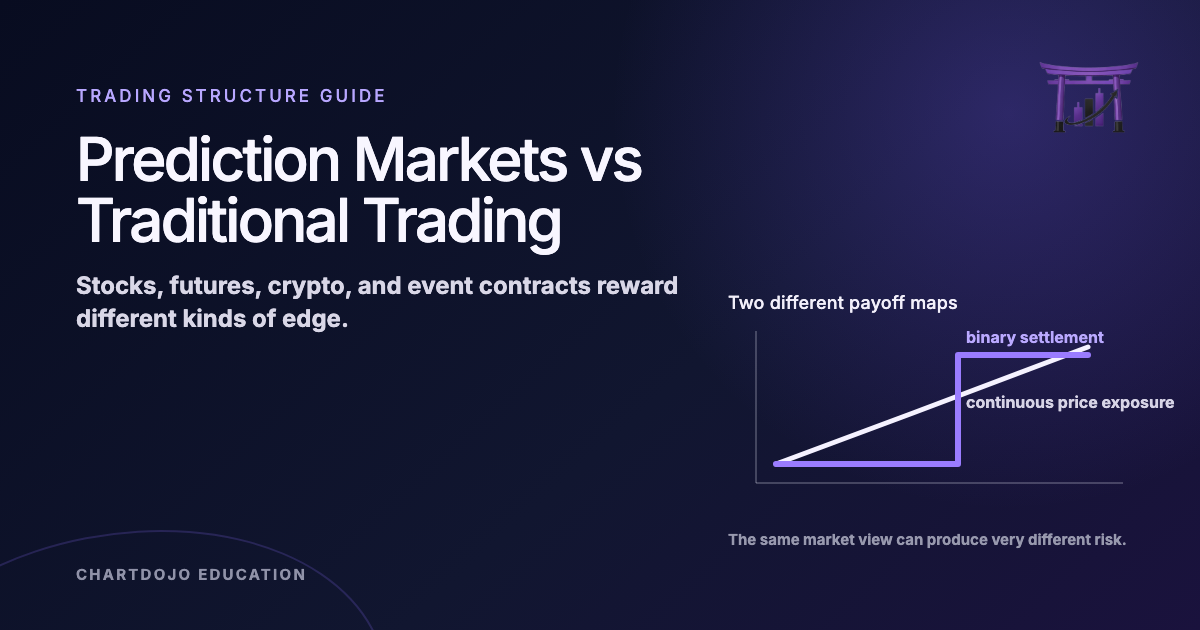
Feature graphic: Original ChartDojo illustration comparing continuous price exposure with binary settlement.
TL;DR
- Stocks are ownership claims. Futures are standardized derivatives. Spot crypto is a digital asset. Prediction-market contracts pay according to a defined event.
- Traditional asset prices can keep moving without a binary endpoint. Many prediction contracts settle at a fixed amount, commonly $1 or $0.
- Arbitrage exists in both worlds, but a prediction-market spread is only defensible when wording, deadlines, resolution sources, fees, and fills match.
- News trading, market making, relative-value trading, and chart analysis can transfer to prediction markets, but each method must account for resolution risk.
- The strongest transferable edge is process: define the thesis, size the risk, plan execution, and review the decision separately from the outcome.
What is actually being traded?
A stock is an equity claim on a corporation. The SEC's Investor.gov definition of stock describes it as an ownership position and a proportional claim on corporate assets and profits. A stock has no scheduled binary resolution. Its price can respond to earnings, cash flows, interest rates, positioning, and expectations for years.
A futures contract is an agreement to buy or sell a specified quantity of a commodity or financial instrument at a set price on a future date. Investor.gov's commodity guide notes that exchange-traded futures use standardized sizes, expirations, and centralized clearing. Traders use futures for commodities such as oil and gold, stock indexes, interest rates, currencies, and crypto. An index itself is a calculation, so traders usually gain exposure through a future, option, exchange-traded fund, or another instrument.
Spot crypto trading transfers ownership or custody exposure to a digital asset such as bitcoin or ether. FINRA defines a crypto asset as an asset issued or transferred through distributed-ledger or blockchain technology. Crypto futures and perpetual contracts are different: they are derivatives whose value follows the underlying asset and may introduce margin, funding, and liquidation risk.
A prediction market trades a claim tied to an event. The CFTC's prediction-market explainer says event contracts are often yes-no products with a fixed payout and expiration. The price reflects the market's perceived probability, but the listed rules determine the payout. Some event contracts can be structured legally as swaps or futures, so “event contract” and “futures contract” are not always mutually exclusive legal labels. For a trader, the practical distinction is the payoff: an event outcome versus continuous exposure to an underlying price.
Prediction markets vs stocks, futures and crypto
| Market | What the position represents | Typical payoff | Risk that matters most |
|---|---|---|---|
| Stocks | Ownership in a company | Open-ended gain or loss as the share price moves | Company fundamentals, valuation, market regime, and liquidity |
| Commodity or index futures | A standardized derivative on an underlying asset or benchmark | Mostly linear price exposure, often with margin | Leverage, basis, expiry, roll, and liquidation |
| Spot crypto | A digital asset or a custody claim through a venue | Open-ended price exposure | Volatility, custody, venue, network, and liquidity |
| Prediction markets | A defined event outcome | Often a bounded payout such as $1 or $0 | Forecast error, wording, deadline, resolution, and thin books |
The familiar surface can hide these differences. A central limit order book still has bids, asks, spreads, depth, and limit orders. Candlestick charts can still show trend and volatility. Yet the terminal value behaves differently. A stock can recover after a bad quarter. A bitcoin position can remain open after a Friday close. A binary contract settles when its defined event is resolved, even if the broader narrative continues.
How does arbitrage differ across these markets?
Arbitrage seeks to capture inconsistent prices for equivalent or tightly linked payoffs. The word equivalent is the hard part in every market.
Traditional asset arbitrage
Traditional arbitrage often links an asset to a derivative or to the same asset on another venue. A cash-and-carry trade may buy spot exposure and sell an expensive future. Index arbitrage may compare a futures price with the value of the underlying stock basket or a related exchange-traded fund. Crypto traders may compare spot, dated futures, perpetual contracts, or prices across exchanges.
Those trades still contain costs and constraints. Financing, borrow availability, margin, funding rates, custody, transfer time, taxes, and tracking error can consume the visible spread. A price relationship can also remain distorted longer than the trader can finance it.
Prediction-market arbitrage
A simple prediction-market candidate appears when complementary outcomes cost less than their common payout. Suppose one venue offers YES at $0.46 and another offers NO at $0.51. The pair costs $0.97 and appears to offer a $0.03 gross spread:
gross spread = $1.00 - $0.46 - $0.51 = $0.03
The arithmetic is not the trade. Both orders must fill at the intended size. Fees and slippage must stay below the spread. The questions, measurement periods, time zones, resolution sources, cancellation rules, and dispute procedures must also match. Otherwise the pair has basis risk and may not offset.
Prediction markets also permit logical-consistency trades. If several contracts describe mutually exclusive and collectively exhaustive outcomes, their prices should be consistent with a total probability of 100%. A mispriced set can create a candidate spread. Execution is more complex because every required leg must fill and each rulebook must define the outcome set in the same way.
For a full contract-equivalence worksheet, use ChartDojo's prediction-market arbitrage guide.
Cross-market trades are usually relative value, not pure arbitrage
A contract asking whether bitcoin will finish above a threshold can be compared with spot bitcoin, options, or futures. A contract on a Federal Reserve decision can be compared with rates futures. That does not make the positions identical. The event contract may use one observation time and one resolution source, while the financial derivative tracks a continuous price or an average over a period.
These combinations can hedge part of an exposure or express relative value, but they usually retain basis risk. Calling them arbitrage overstates certainty.
What other prediction-market strategies resemble traditional trading?
- Fundamental or news trading: Stock traders analyze earnings and filings. Commodity traders track supply, weather, and inventories. Prediction-market traders estimate how a verified fact changes the probability of the exact listed event.
- Market making: A trader posts bids and offers to earn the spread. In an event market, stale quotes can become dangerous when a decisive fact arrives, and inventory can settle at zero.
- Technical and order-flow trading: Trend, support, resistance, volume, and depth can help with timing. A new fact or a rule clarification can invalidate the chart immediately. The prediction-market technical analysis guide explains that boundary.
- Relative-value trading: Traders compare related contracts, such as a national election outcome and state-level outcomes, or an inflation threshold and a rate decision. Correlation is not equivalence, so hidden concentration matters.
- Hedging: A business or investor may use an event contract to offset a defined real-world risk. The CFTC gives the example of a citrus farmer hedging freeze risk. The hedge can still be incomplete if the contract payout does not match the actual loss.
Worked example: one bitcoin view, three instruments
Assume a trader believes bitcoin will finish above a stated threshold at 4:00 p.m. ET on Friday. The view can be expressed in several ways, but the positions are not interchangeable.
- Buy spot bitcoin. Profit and loss follow the asset's price continuously. There is no automatic Friday settlement, and the trader remains exposed after the deadline unless the position is closed.
- Buy a bitcoin future or perpetual. Profit and loss still respond to price changes, but margin, contract size, expiry or funding, and liquidation rules shape the trade.
- Buy a YES event contract. A $0.42 contract may pay $1 if the stated threshold and observation rule are satisfied, or $0 if they are not. The most that a fully paid long can lose is its purchase cost plus applicable fees, but the trader can be directionally right about bitcoin and still lose if the price misses the exact deadline or the rule uses a different reference index.
The event contract converts a continuous price thesis into a bounded, deadline-specific payoff. That can simplify maximum-loss planning. It also concentrates risk into one observation and one rule set.
Which trading skills transfer to prediction markets?
The best skills transfer cleanly because they concern decision quality rather than instrument labels:
- Write the thesis and invalidation condition before entry.
- Use executable bids and asks, not a midpoint that cannot be traded.
- Size by maximum loss and total correlated exposure.
- Separate forecasting error from execution error.
- Review whether the process was sound, even when the outcome was profitable.
Prediction-market traders also need skills that traditional chart work may not teach: reading resolution language, comparing source agencies, tracking information timestamps, and measuring probability calibration. ChartDojo does not currently claim direct prediction-market execution integration. Its clearest role is helping traders practice chart reading, replay decisions, journal rules, and review behavior across stocks, futures, and crypto with a more disciplined process.
Potential positives vs negatives
Potential positives: Prediction contracts can express a precise question with a visible deadline and a bounded payout. They make probability disagreement tradable and can offer direct hedges for risks that are awkward to express through stocks or futures. Their order books also make news reactions and collective expectations easier to observe.
Potential negatives: A simple payoff does not mean a simple trade. Thin depth, wide spreads, fees, partial fills, locked capital, venue access, and resolution disputes can erase an apparent edge. Binary settlement also punishes near misses. A forecast can be broadly correct while the contract still settles against the trader.
Traditional assets have their own hazards, especially leverage and liquidation in futures or crypto derivatives. The relevant question is not which market is safer in the abstract. It is whether the instrument's payoff matches the thesis, time horizon, and risk limit.
What could happen from here
Prediction markets become a complementary trading layer: Traders use event contracts for discrete catalysts while keeping stocks, futures, options, and crypto for continuous exposure. Deeper books and clearer rules would support this path.
Cross-market strategies expand: More traders compare event prices with financial derivatives, polling, economic data, and other forecasting markets. This may improve price efficiency, but most combinations will remain relative-value trades rather than riskless arbitrage.
Market structure remains fragmented: Different contracts, access rules, fee schedules, and resolution procedures keep spreads difficult to capture at scale. Persistent wording mismatches or settlement disputes would strengthen this case.
What traders should watch next
- The exact asset, event, threshold, observation time, and resolution source.
- Whether the payoff is continuous, leveraged, or fixed at settlement.
- Order-book depth at the intended size, not only the displayed price.
- Fees, funding, margin, borrow, transfer time, and capital lock-up.
- Correlation between contracts that depend on the same underlying event.
If event-contract mechanics are new, start with how to trade prediction markets. Then use the prediction-market arbitrage checklist to compare executable prices, depth, and contract rules.
FAQ
Are prediction markets the same as futures?
No. Both can be derivatives and some event contracts can be structured as futures, but a conventional future usually provides price exposure to an asset or benchmark. A prediction contract pays according to a defined event and its settlement rules.
Can technical analysis be used in prediction markets?
Yes, charts and order flow can help with timing, trend, and liquidity. They cannot override new information or the contract's resolution language.
Is prediction-market arbitrage risk free?
No. The mathematical spread can be positive while fees, slippage, partial fills, transfer delays, contract mismatches, or different settlement results produce a loss.
Can prediction markets hedge stocks, futures, or crypto?
They can hedge a specific event linked to those markets, but the protection is often incomplete. The event payout, deadline, and source must match the financial exposure closely enough to reduce rather than add basis risk.
Sources
- CFTC: Understanding Prediction Markets and Event Contracts
- Investor.gov: Stock definition
- Investor.gov: Commodities and futures
- FINRA: Crypto Assets Overview
- Kalshi API: Market fields, prices, and settlement rules
- Polymarket: Prices and Order Book
- Polymarket: Market Resolution
Build real skills, not bad habits. Practice technical setups across stocks, futures, and crypto, record the decision behind each trade, and review it with AI-powered feedback. Start a free ChartDojo trial.