
By Ulysses Cornelius. Educational market analysis, not financial advice. Platform documentation was checked as of 8:10 a.m. ET on September 5, 2026. The prices and costs in the worked example are hypothetical.
TL;DR
- Compare executable asks, not displayed midpoints.
- Confirm that both contracts use the same question, deadline, resolution source, and edge-case rules.
- Subtract every trading cost before calling a price gap an arbitrage spread.
- Plan for one leg to fill while the other remains open.
Direct answer: Prediction market arbitrage is the attempt to buy complementary outcomes for less than their common settlement value. A quoted gap is only a candidate. It becomes a defensible trade after the contracts match, both orders can fill at the intended size, fees are included, and the settlement and access rules do not create a hidden mismatch.
Prediction market arbitrage: when is a spread real?
A binary event contract usually pays $1 for the winning outcome and $0 for the losing outcome. If two venues list truly equivalent contracts, a trader might buy YES on one venue and NO on the other. The pair should return $1 if both platforms settle consistently.
The first test is simple:
gross spread = $1.00 - YES ask - NO ask
An ask is the lowest displayed price at which a seller is offering a contract. It is the relevant starting price for a purchase. A midpoint, last trade, or headline probability may be impossible to execute.
The word equivalent carries most of the risk. Two markets can describe the same event yet use different deadlines, source agencies, recount treatment, or cancellation rules. Read the listed terms before comparing prices. The CFTC prediction-market explainer describes event contracts as fixed-payout products, while each venue's own rules control its contracts.
How prediction market arbitrage works
Start by copying both market questions into one decision record. Then compare each contract line by line. The wording must identify the same event. The measurement period and cutoff must match. The settlement sources should either be identical or have a clearly documented relationship.
Next, inspect the order books. Polymarket's order-book documentation advises traders to check depth before trading size. Depth is the quantity available at each price. A one-cent gap on one contract is not a 100-contract opportunity if only one contract is offered at that price.
Order type matters too. A limit order sets the worst price you will accept, but it may fill in part or not at all. A marketable order can fill faster, though it may trade through several price levels. This creates slippage, the difference between the expected price and the average execution price.
Fees complete the pre-trade calculation. Kalshi's fee guide says costs can differ by market and points users to the current fee schedule. Polymarket's order documentation tells developers to account for applicable platform and builder fees when calculating order amounts. Check the live schedules on both venues rather than carrying an old rate into a new trade.
Worked example: the net-spread worksheet
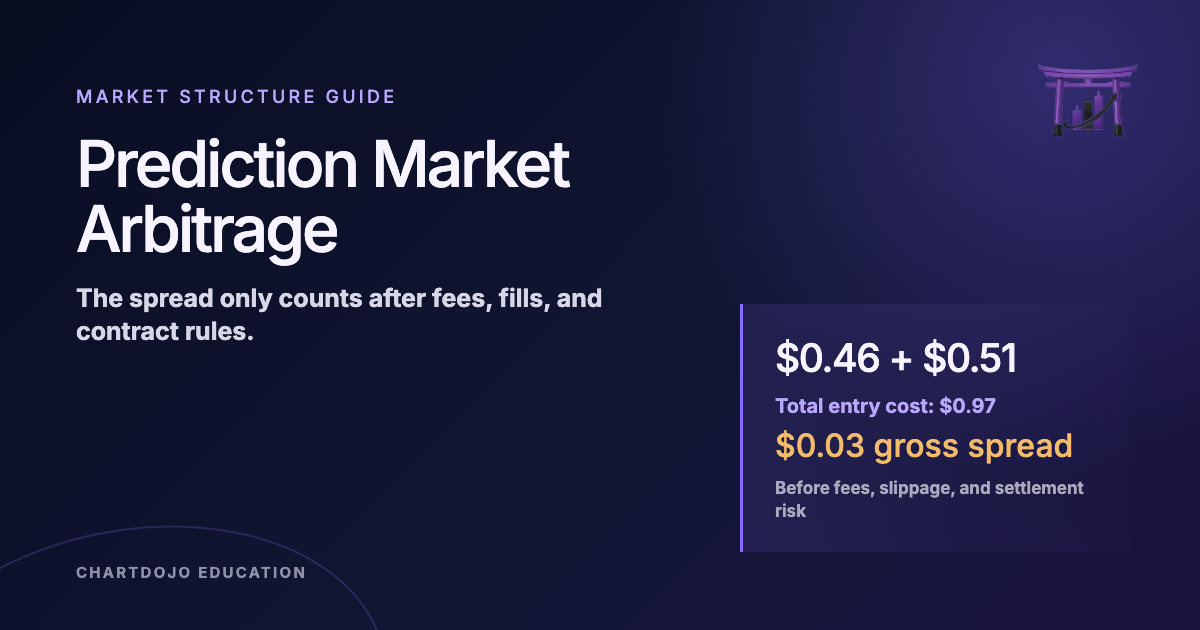
Suppose Venue A offers YES at $0.46 and Venue B offers NO at $0.51. The pair costs $0.97 before trading costs. If the contracts are equivalent and settle consistently, the gross spread is $0.03 per matched pair.
Now fill in the worksheet:
- YES ask: $0.46
- NO ask: $0.51
- Gross entry cost: $0.97
- Estimated fees across both legs: $0.012
- Estimated slippage: $0.006
- Funding or withdrawal cost allocated per pair: $0.002
- Net expected spread: $1.00 - $0.97 - $0.012 - $0.006 - $0.002 = $0.010
The apparent three-cent gap has fallen to one cent. A small change in either ask can remove it. If the NO order fills at $0.51 but the YES ask rises to $0.49 before the second order executes, the pair costs $1.00 before fees. The trader then owns an unpaired position or must accept a negative spread to close the exposure.
This example also assumes the $1 settlement values offset each other. That assumption fails if the venues resolve differently. Polymarket's resolution guide says predefined market rules govern settlement. Compare those rules with the other venue's terms, including dispute procedures and payout timing.
Contract-equivalence checklist
- Same event, threshold, and measurement period
- Same timezone and cutoff
- Compatible resolution sources
- Matching treatment of postponements, corrections, and recounts
- Clear rules for ambiguous or unavailable source data
- Legal access to both venues from your jurisdiction
If any item is unresolved, treat the gap as a directional pair trade with basis risk. Basis risk means the two positions may not offset as expected.
Potential positives vs negatives
Potential positives
A well-matched pair can reduce dependence on forecasting the event correctly. The worksheet also forces attention onto prices that can be traded, which is more useful than comparing attractive-looking midpoints.
The method rewards discipline. It asks for rule reading, cost estimates, order-size checks, and an exit plan before capital is committed. Those habits can improve execution even when the trader rejects the opportunity.
Potential negatives
Execution is rarely simultaneous for a manual trader. Partial fills can leave an open position during a fast market. Thin books may also make the posted spread available only at trivial size.
Capital can remain locked until settlement, and transfers between venues may take longer than the spread lasts. Account restrictions, position limits, stablecoin conversion costs, or withdrawal delays can change the result. Different rulebooks create the largest structural danger because both sides can lose their intended offset.
What could happen from here
Base case: small gaps disappear after costs
Most apparent opportunities fail the worksheet once executable prices and fees are included. Evidence for this case is a net spread near zero at the intended size. It weakens when both books show enough depth and the post-cost spread remains positive across several price levels.
Better conditions: matching rules and deeper books
The method becomes more practical when contract language is identical, both venues publish clear fee data, and limit orders can fill without chasing. This case is confirmed by stable depth and consistent settlement terms. It weakens if a clarification notice changes one contract's meaning.
Worse conditions: one-leg and settlement risk
A fast repricing can fill one order and strand the other. A later dispute can also expose differences that looked minor at entry. This case is confirmed by widening spreads, missing depth, or conflicting source rules. It is reduced only when the second leg fills within the planned limit and the rule comparison remains sound.
What traders should watch next
- Both asks and the quantity available at each price
- The live fee schedule for the exact contract category
- Order status after every partial fill
- Rule changes or clarification notices
- Payout timing and capital lock-up
- Jurisdiction, funding, and withdrawal limits
For the broader workflow around probability estimates and execution, read How to Trade Prediction Markets. Legal access can change, so the Kalshi Supreme Court petition guide provides useful procedural context. Traders comparing product labels should also note that Polymarket perpetual futures are separate leveraged derivatives, not event contracts.
FAQ
Is prediction market arbitrage guaranteed?
No. A locked spread can exist in the arithmetic, but actual results depend on matched contract rules, completed fills, current fees, and consistent settlement. Until those conditions are checked, the gap is only a candidate.
Why can YES plus NO cost less than $1?
Prices may differ because traders, liquidity, access, and information arrive unevenly across venues. The difference can persist briefly, but a visible quote does not show how much size is available or whether both orders will fill.
What is the biggest risk in cross-platform arbitrage?
A contract mismatch can break the intended offset even when both trades execute. One-leg exposure is the more immediate risk because the open side can move before the second order fills.
Sources
- CFTC: Understanding Prediction Markets and Event Contracts
- Kalshi Help Center: Fees
- Polymarket Documentation: Prices and Order Book
- Polymarket Documentation: Place Orders
- Polymarket Documentation: Market Resolution
This article is educational and is not financial advice.
Build real skills, not bad habits. Practice contract checks and execution decisions with AI-powered feedback, then start a free ChartDojo trial.