
By Ulysses Cornelius. Educational market analysis, not financial advice. Platform documentation and regulatory references were checked as of 8:10 a.m. ET on September 4, 2026. The worked numbers below are hypothetical, not live market odds.
TL;DR
- Read the full contract and resolution rules before looking at price.
- Build your own probability estimate, then compare it with the price you can actually trade.
- Account for spreads, fees, slippage, and the chance that your order fills only in part.
- Define maximum loss and exit conditions before submitting an order.
- Review the forecast and the execution separately after the market settles.
Direct answer: To trade prediction markets, choose a contract you can legally access, read its exact resolution rules, estimate the outcome probability from reliable sources, compare that estimate with the executable price, include trading costs, size the position by maximum loss, use a limit order when practical, and record why you would exit or revise the forecast.
How to trade prediction markets step by step
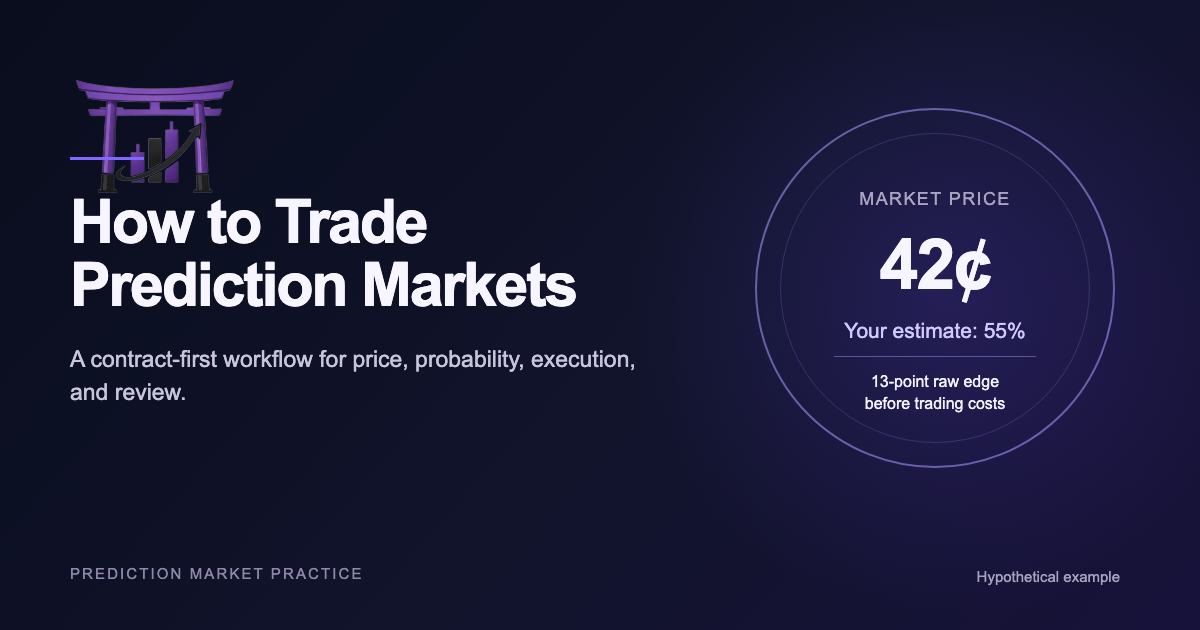
A prediction-market contract pays according to a specified event. Many binary contracts settle at $1 for the winning side and $0 for the losing side. A price of 42 cents is often read as a 42% market-implied probability, but it is the price traders currently accept. It is not proof that the true probability is 42%.
The Commodity Futures Trading Commission's prediction-market guide explains that customer bids and asks create market-driven prices on regulated venues. The bid is the best displayed price a buyer will pay. The ask is the lowest displayed price a seller will accept. Their difference is the bid-ask spread.
- Confirm access. Check whether the platform and contract are available in your jurisdiction. Product access can differ by location and contract type.
- Read the contract. Copy the question, deadline, resolution source, and edge cases into your decision notes. The headline is not enough.
- Start with a base rate. A base rate is the frequency of similar outcomes in a relevant historical group. Use it as a starting point before adding event-specific evidence.
- Score the evidence. Prefer primary documents and named reporting. Record publication times so an old headline does not receive the same weight as a fresh filing.
- Estimate probability. Write one number or a narrow range. If you cannot defend the estimate without referring to the market price, you do not yet have an independent view.
- Compare with an executable price. Use the ask for a purchase and the bid for a sale. A displayed midpoint may not be available to you.
- Set size and exit rules. Cap the amount you can lose. Decide which new facts would change the estimate and when you would close before settlement.
- Review the process. After resolution, grade source quality, calibration, order choice, and rule interpretation. A profitable trade can still reflect a weak decision.
How the mechanism works
Suppose a YES contract has a 40-cent bid and a 42-cent ask. Buying at 42 cents costs $0.42 per contract before fees. If YES settles at $1, the gross profit is $0.58. If NO wins, the contract settles at $0 and the full $0.42 is lost.
An order book lists open bids and asks at different prices and quantities. Polymarket's order-book documentation gives a clear example of why the midpoint can differ from the actual purchase or sale price. Kalshi's limit-order guide explains that a trader can set a maximum purchase price instead of accepting the best available ask.
A limit order controls price, but it does not ensure a fill. A marketable order is more likely to execute immediately, yet it may sweep through several price levels when depth is thin. That difference is slippage: the gap between the expected execution price and the average price actually received.
Resolution risk belongs in the trade plan too. The market title is a summary. The rules decide the winner. Polymarket's resolution documentation states that predefined market rules govern settlement. Other venues use their own listed sources and procedures, so check the rules on the exact contract you intend to trade.
Worked example: price, probability, and maximum loss
Consider a hypothetical contract asking whether an economic report will exceed a stated threshold by a fixed date. The YES ask is 42 cents. Your research produces a 55% estimate.
The raw expected value per YES contract before fees is:
estimated probability - purchase price = $0.55 - $0.42 = $0.13
That 13-cent figure is a model output, not a promised return. It can disappear if the estimate is wrong, the rules are misunderstood, or execution costs are high.
- Fifty YES contracts cost $21 before fees.
- If YES wins, the gross payout is $50 and gross profit is $29.
- If NO wins, the maximum contract loss is $21, plus any applicable fees.
Now test the estimate rather than admiring the arithmetic. What historical sample supports 55%? Which scheduled release could change it? Does the official resolution source use the same definition as your data? Can 50 contracts fill at 42 cents, or is only a small quantity offered there?
A simple pre-trade rule might cap loss at $25, reject any fill above 44 cents, and require a fresh estimate after the source releases new information. At 44 cents, the raw gap shrinks to 11 percentage points. If the estimate falls to 43%, the planned advantage has vanished before fees.
Potential positives vs negatives
Potential positives
Event contracts define the outcome and settlement date in advance. The maximum contract loss is visible at entry for a fully paid long position. Prices can also make disagreement measurable: a trader can compare a personal forecast with the current order book instead of relying on a vague conviction.
Limit orders give direct control over the worst acceptable entry price. Short-dated markets also create frequent opportunities to test calibration, meaning whether events assigned a 60% chance happen about 60% of the time across a large sample.
Potential negatives
Thin depth can turn a small theoretical advantage into a poor fill. Fees vary by venue and sometimes by market. Rules may contain definitions that differ from ordinary language, while clarifications or disputes can delay settlement.
Forecasts can share hidden exposure. Five contracts about the same election, inflation release, or court decision are not five independent ideas. They may all lose when one assumption fails. Access, funding, and withdrawal conditions add operational risk that probability math alone cannot capture.
What could happen from here
Base case
The method works best as a filter. Most contracts are passed over because the estimate is weak or the executable price leaves too little room after costs. The process is confirmed when decision notes show consistent rule reading and fewer impulse entries. It is invalidated if trades still begin with a price chart and a story is added afterward.
Upside case for the method
Clear contract wording, deeper books, and better primary-source coverage make the estimate easier to test. The trader builds a large enough forecast sample to measure calibration and learns which topics deserve attention. This case weakens when apparent gains come from a few concentrated outcomes rather than repeatable decisions.
Downside case for the method
Spreads widen, access rules change, or the contract relies on an ambiguous resolution source. Expected value turns negative after fees and fill risk. The correct action may be no trade. This case is invalidated when depth improves, the venue clarifies settlement terms, and the revised price again leaves a defensible margin.
What traders should watch next
- The exact bid, ask, and available quantity at the planned order size.
- Official platform fee schedules, which can change and may differ by contract.
- The named resolution source and any clarification notice.
- Source timestamps around scheduled data releases, court filings, elections, or policy decisions.
- Correlation across open positions that depend on the same underlying event.
For current legal context, read ChartDojo's guide to New Jersey's Supreme Court petition over Kalshi sports contracts. For product-risk context, see the report on Polymarket's separate perpetual-futures launch. Perpetual futures and event contracts have different payoff structures, so do not treat them as interchangeable.
FAQ
Are prediction-market prices probabilities?
A binary contract price is commonly interpreted as a market-implied probability. A 42-cent price suggests roughly 42%, but the price may be affected by spreads, depth, fees, position limits, and the participants active at that moment.
Can you sell before settlement?
Many contracts can be sold before resolution if there is a willing counterparty and the venue permits it. The exit price may be worse than the displayed midpoint, especially in a thin order book.
What is the biggest beginner mistake?
Trading the topic instead of the contract. A trader can predict the real-world event correctly and still lose because the listed question used a different deadline, threshold, source, or definition.
Sources
- CFTC: Understanding Prediction Markets and Event Contracts
- Kalshi Help Center: Limit Orders
- Polymarket Documentation: Prices and Order Book
- Polymarket Documentation: Market Resolution
This article is educational and is not financial advice.
Build real skills, not bad habits. Practice evidence-based decisions with AI-powered feedback and start a free ChartDojo trial.