
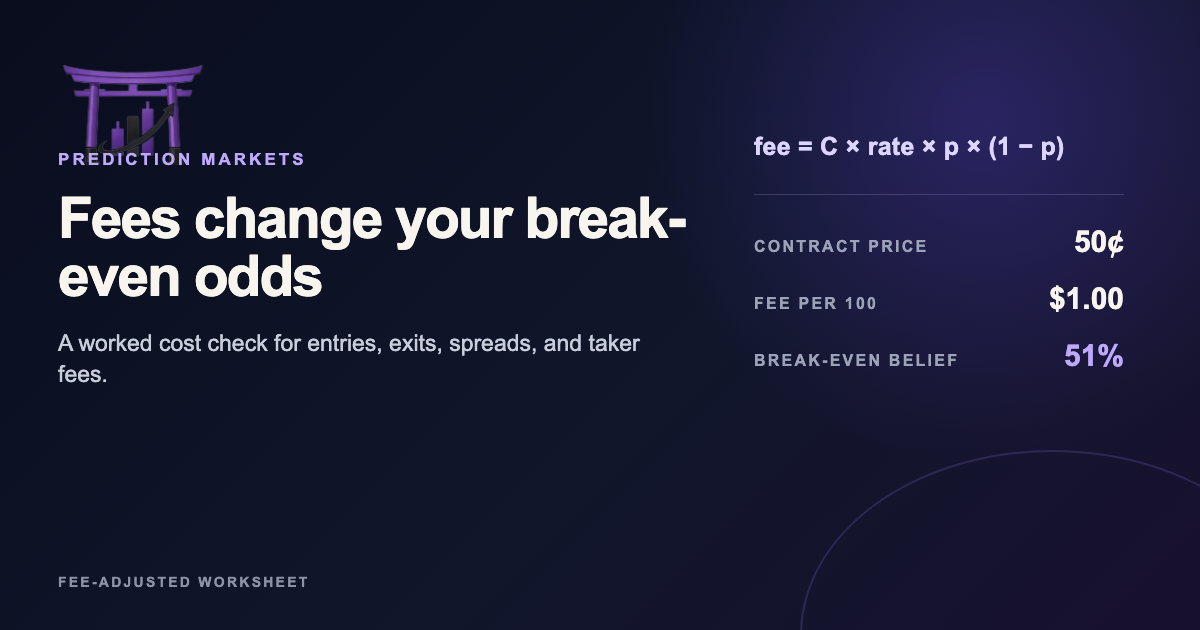
Prediction market fees raise the probability a forecast must achieve to break even. Add the entry fee to the contract price, then include the spread and slippage. Add any exit fee if you plan to sell before settlement. A 50-cent contract with a $1 fee per 100 shares needs a 51% belief just to cover the entry cost.
Fee schedules and documentation were checked at 8:10 a.m. ET on September 14, 2026. Platform fees can change by venue and market category. Order type and incentive tier can change the result too. The calculations below are educational examples, not financial advice.
TL;DR
- Convert every trading charge into cents per contract before comparing it with your estimated edge.
- Include the bid-ask spread and likely slippage. A published fee is only one part of execution cost.
- Model both settlement and early exit. Selling before resolution can introduce a second trading fee.
- Read the current order ticket and official schedule because fees may differ by category or maker and taker status.
How do prediction market fees affect break-even probability?
A binary event contract usually pays $1 if the specified outcome occurs and $0 if it does not. If a trader buys C contracts at price p and pays entry fee f, the cash committed is C × p + f. When the trader holds through resolution and faces no additional venue charge, the fee-adjusted break-even belief is:
Break-even probability = p + (f ÷ C)
The formula turns a dollar fee into a probability hurdle. Paying $1 on 100 contracts adds one cent per contract. A quoted 50-cent price therefore becomes a 51-cent economic cost. The trade needs an estimated probability above 51% to have positive expected value under those assumptions.
This method does not prove that the forecast is accurate. It only identifies the threshold that the forecast must clear after known entry cost. Contract wording and settlement risk still matter, as ChartDojo's prediction market resolution risk guide explains.
How prediction market fee mechanics work
Venues can set charges by price and quantity. Category and maker or taker status can also change the fee. A taker order executes against an order already resting in the book. A maker order rests first and supplies liquidity.
Polymarket's global documentation currently uses fee = C × fee rate × p × (1 - p) for fee-enabled markets. Makers pay no trading fee under that schedule, while takers pay a category rate:
- Crypto: 0.07
- Sports and several other categories: 0.05
- Finance, politics, mentions, and technology: 0.04
- Geopolitics: zero
The fee is largest in dollar terms near 50 cents because p × (1 - p) peaks there.
Polymarket US publishes a separate exchange-wide schedule effective July 1, 2026. Its taker coefficient is 0.06, with a maker rebate coefficient of 0.0125 and taker rebates tied to qualifying volume.
Kalshi's fee guidance says the exchange calculates transaction fees from expected contract earnings. It also warns that some markets have different fees and that maker fees can apply in certain cases. Kalshi directs traders to its current fee schedule and displays the applicable charge in the order interface. Use the displayed amount for the specific order instead of carrying a coefficient from another market.
The spread remains a separate cost. ChartDojo's prediction market liquidity guide shows how order-book depth and slippage can raise the average fill price beyond the best quote.
A worked prediction market fee calculator
These examples apply the official formulas checked above. They assume complete fills and exclude taxes or intermediary costs. Slippage is also excluded.
Example 1: a global finance contract held to settlement
A taker buys 100 shares at 50 cents in a fee-enabled finance market. The documented category rate is 0.04.
- Contract cost: 100 × $0.50 = $50.00
- Entry fee: 100 × 0.04 × 0.50 × 0.50 = $1.00
- Total cash committed: $51.00
- Fee-adjusted break-even belief: 51%
A 50.5% estimate has no fee-adjusted edge here. An estimate above 51% clears the arithmetic threshold, although forecast error and settlement risk remain.
Example 2: the same midpoint price under two schedules
At 50 cents, 100 taker shares in a fee-enabled global crypto market produce a $1.75 fee under the 0.07 category rate. The entry hurdle becomes 51.75%. Under the separate Polymarket US schedule, the same quantity and price produce a $1.50 taker fee, before any volume rebate, so the hurdle is 51.5%.
The quoted probability is identical in both cases, while the required forecasting edge differs. A cross-venue comparison should use each market's fee parameters and access rules.
Example 3: an early exit pays for two executions
Suppose a taker buys 100 finance-category shares at 45 cents and later sells them as a taker at 55 cents. The formula charges $0.99 on entry and $0.99 on exit because the fee curve is symmetric around 50 cents.
The ten-cent price move creates $10.00 of gross trading profit. After $1.98 in trading fees, the result is $8.02 before other execution costs. Fees consume 19.8% of the gross move.
Potential positives vs negatives
Potential positives
- Published formulas make cost estimates reproducible before an order is sent.
- Maker treatment or rebates can reduce trading cost when an order qualifies.
- A fee-adjusted threshold helps reject small apparent edges that do not survive execution.
Potential negatives
- Category-specific schedules can make the same price and quantity cost different amounts.
- An early exit may add a second fee as well as spread and slippage.
- Rounding, partial fills, and incentive eligibility can make a hand calculation differ from the final charge.
- Fee pages can change, leaving saved formulas or screenshots out of date.
What could happen from here
Base case: current schedules remain stable
Traders can keep a dated worksheet for each venue and verify the order ticket before submission. This case is confirmed when the published formula for the chosen category agrees with the previewed fee. A schedule update or unexplained order-ticket difference invalidates it.
Lower-cost case: the order earns maker treatment or a rebate
A resting limit order may receive more favorable treatment under the applicable program. Confirm the case only after the execution report shows the maker status or rebate. A missed or partial fill weakens the benefit. An ineligible market removes it.
Higher-cost case: the trade needs an urgent exit
Fresh news can force a taker exit through a wider spread. The original expected edge then has to cover entry and exit fees plus poorer execution. Stable depth and a patient limit exit weaken this case; a thin order book confirms it.
What traders should watch next
- Open the market's current fee details and record the effective date.
- Note price, quantity, category, and maker or taker status.
- Convert the fee to cents per contract and add it to the entry price.
- Estimate the full fill price from available order-book depth.
- Run one settlement case and one early-exit case.
- Compare the final hurdle with a documented probability estimate, then review the decision after resolution.
For a broader pre-trade process, use ChartDojo's guide to trading prediction markets.
FAQ
What is the break-even probability after a prediction market fee?
For a purchase held to settlement, divide the entry fee by the number of contracts and add that amount to the contract price. A 50-cent contract with a $1 entry fee on 100 shares has a 51% break-even belief under the stated assumptions.
Are prediction market fees highest at 50 cents?
Under schedules that use p × (1 - p), the dollar fee per contract peaks at 50 cents and declines toward zero and one. Other venues or market types may use different formulas, so check the current schedule.
Does a maker order avoid all trading costs?
No. Maker treatment depends on the venue and market, and a resting order may never fill. The trader still faces spread and price movement. Partial-fill risk and costs outside the trading fee also remain.
Should fees or implied probability come first?
Start with a defensible probability estimate, then subtract all realistic execution costs. A low fee cannot repair a weak forecast, while a strong forecast can still lose its edge after costs.
Sources
- CFTC: Prediction Markets and Event Contracts
- Polymarket: Global Trading Fees
- Polymarket US: Trading Fee Schedule
- Kalshi Help Center: Fees
- Kalshi: Current Fee Schedule
Practice fee-adjusted decisions before real money is at risk. Start a free ChartDojo trial for AI-powered feedback on your process. Build real skills, not bad habits.