
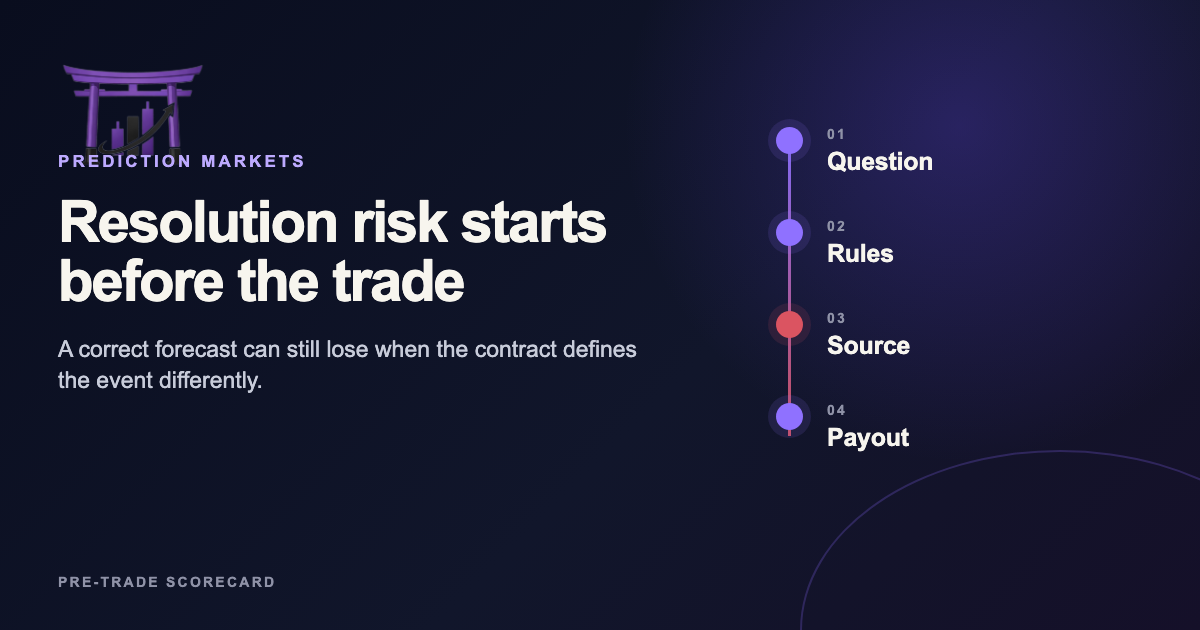
Prediction market resolution risk is the chance that a contract settles differently from the outcome a trader expected because of its wording, named data source, deadline, edge cases, or dispute process. Read those terms before studying the price. A sound forecast can still become a losing trade when the contract defines the event differently.
Reviewed as of 6:55 a.m. ET on September 13, 2026. Platform procedures can change. The scorecard and example below are educational tools, not live market recommendations or financial advice.
TL;DR
- Treat the contract rules as the asset you are trading. The headline is only a label.
- Identify the exact verification source, cutoff time, and wording for a Yes outcome.
- Score missing definitions and likely edge cases before deciding whether the quoted price is attractive.
- Plan for delayed settlement, a disputed result, or an expensive exit while the answer remains unclear.
What is prediction market resolution risk?
Prediction market resolution risk appears when ordinary language and contract language point to different answers. A market may ask whether inflation will exceed a level, whether a candidate will win, or whether a product will launch. Settlement depends on the written rule, the specified source, and the measurement deadline. It does not depend on what most traders thought the title meant.
The Commodity Futures Trading Commission's prediction-market guide says customers are entitled to clear contract terms, including how settlement determinations are made and who decides them. A binary contract normally pays $1 for the winning side and zero for the losing side.
Resolution risk is separate from forecasting risk. Forecasting risk asks whether your probability estimate was wrong. Resolution risk asks whether you estimated the wrong proposition.
How prediction market resolution works
The basic chain has four parts: the market poses a question, its rules define a valid outcome, a named process verifies the result, and the platform settles the contract.
Kalshi's market-rules guidance says each market has its own rules and a verification source. Its market-outcomes page says the source and determination method appear in the contract terms. It also says determination may take from one hour to more than twelve hours after the market closes, often because the platform is waiting for the source agency's data.
Polymarket's resolution guide says markets resolve under their predefined rules through the UMA Optimistic Oracle. A proposed answer enters a challenge period. Polymarket's current dispute guide describes a two-hour challenge window, a bond that is usually $750, and a longer debate and voting process when someone disputes the proposal. Check the live venue documentation because those figures and procedures may change.
Save the exact rules before entry. Match the question to the source and deadline. Decide whether an unresolved clause deserves a wider margin of safety.
ChartDojo's prediction-market trading workflow puts contract review before probability estimation. The prediction-market liquidity guide explains why an exit may also become costly when uncertainty widens the spread.
A five-part resolution-risk scorecard
This scorecard is an original pre-trade exercise. Give each category 0, 1, or 2 points. Zero means the term is clear. One means it needs a closer read. Two means the ambiguity could change settlement. Add the points for a total from 0 to 10.
- Question wording: Are the event and threshold objectively defined?
- Verification source: Is one authoritative source named, and does it publish the required value?
- Deadline: Are the date, time zone, reporting period, and revision policy explicit?
- Edge cases: Do the rules cover cancellations, postponements, ties, corrections, or missing data that could plausibly occur?
- Dispute and exit path: Can you explain the challenge process, likely delay, and cost of leaving before settlement?
A score of 0 to 3 suggests comparatively clean rules. A score of 4 to 6 calls for another review. A score of 7 to 10 warns that the contract may be unsuitable. These thresholds are a decision aid, not a venue rating.
Worked example: a temperature contract
Consider a hypothetical contract titled, "Will the city reach 100 degrees on July 15?" The title sounds simple. The rules say Yes if the maximum temperature at Airport Station is at least 100 degrees Fahrenheit in the National Weather Service Daily Climate Report for that calendar day.
Score the wording at 1 because "the city" in the title differs from one airport station in the rule. Score the verification source at 0 because a specific report is named. Give the deadline 0 if the calendar day and local time zone are stated. Give edge cases 1 if the terms do not explain a missing report or later correction. Give dispute and exit 1 if the review process is clear but the order book is thin near settlement. Total score: 3 out of 10.
A report that another station reached 101 degrees would not settle this contract Yes. The relevant value is the one in the named report.
Potential positives vs negatives
Potential positives
- Precise terms narrow the gap between the event traders discuss and the event the platform settles.
- A named primary source makes evidence easier to verify before the determination.
- A clear challenge process gives participants a defined route for presenting contrary evidence.
- A scorecard can expose a bad contract before price analysis consumes more time.
Potential negatives
- A catchy title can hide a narrower definition in the full rules.
- Source revisions or late publications can delay settlement and tie up capital.
- An undefined word may allow two reasonable readings with opposite payouts.
- A dispute can widen spreads and make an early exit more expensive.
What could happen from here
Clean-rule scenario: The source publishes on schedule, the reported value matches the contract definition, and no credible edge case appears. A prompt settlement supports this view. Conflicting source data or a correction would weaken it.
Delayed scenario: The event has occurred, but the named source has not published the required result. Trading may be closed while settlement waits. Publication of the specified report resolves the delay. A prolonged outage or unclear fallback source makes it worse.
Disputed scenario: Participants disagree about the wording, evidence, or timing. The contract remains exposed to the venue's challenge process, and the market price may stop tracking the event itself. A final determination ends the dispute. New contradictory evidence extends the uncertainty.
What traders should watch next
- Copy the question and full rules into your trade notes before entry.
- Open the named source and confirm it publishes the exact metric in the rule.
- Translate every date and cutoff into one time zone.
- Write the strongest plausible case for the opposite settlement.
- Record the scorecard total and the reason for each point.
- Define an exit plan for a delayed or disputed result.
After settlement, compare the ruling with your saved interpretation. If they differ, determine whether the miss came from the forecast, the contract, or your reading process.
FAQ
Can a prediction be correct while the contract still loses?
Yes. A trader can correctly anticipate the broad event but hold a contract tied to a narrower definition, a different source, or an earlier deadline. Settlement follows the written terms.
What is a resolution source?
It is the report, agency, data feed, court record, or other authority named in the contract rules to verify the outcome. Use the source specified by the contract, even when another reputable source reports a different figure first.
What happens when a prediction market result is disputed?
The answer depends on the venue. A challenge may trigger additional evidence review, bonding, debate, or voting. It can also delay payout. Read the current dispute rules before trading because platform procedures are not interchangeable.
Should a high resolution-risk score always mean no trade?
No mechanical score should make that decision alone. A high score says the uncertainty deserves more research, a larger pricing cushion, smaller exposure, or a decision to pass.
Sources
- CFTC: Understanding Prediction Markets and Event Contracts
- Kalshi Help Center: Market Rules
- Kalshi Help Center: Market Outcomes
- Polymarket Help Center: How Are Prediction Markets Resolved?
- Polymarket Help Center: How Are Markets Disputed?
Practice reading contract rules and reviewing settlement decisions before real money is at risk. Start a free ChartDojo trial for AI-powered feedback on your process. Build real skills, not bad habits.