
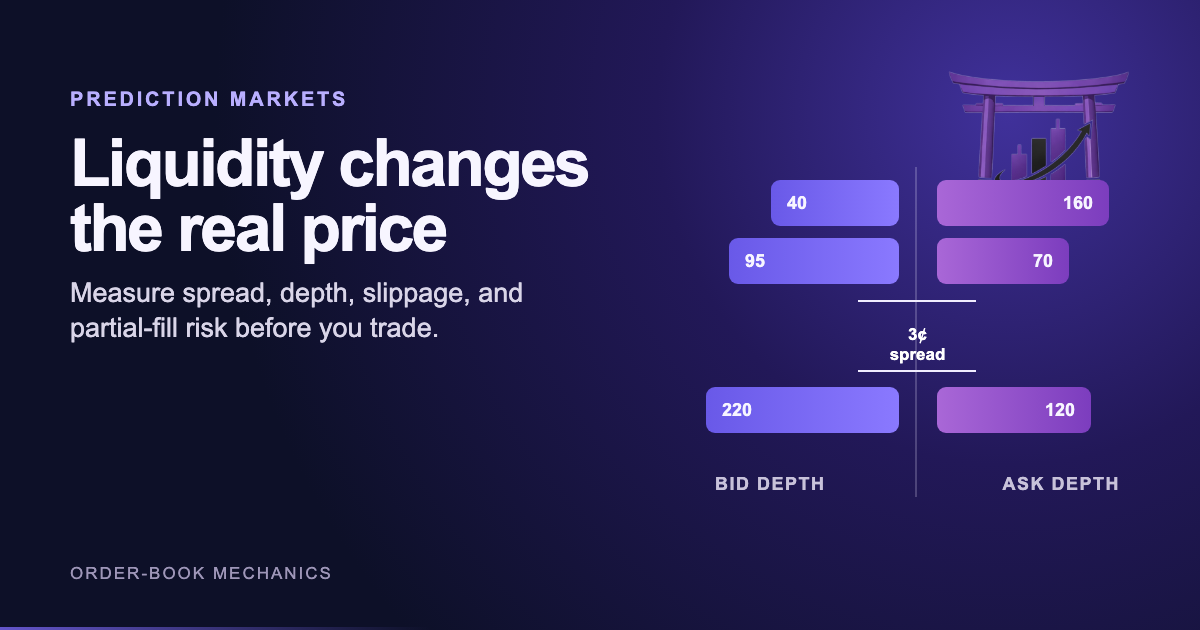
Prediction market liquidity is the amount of executable interest available near the quoted price. A liquid contract has a narrow bid-ask spread and enough order-book depth to absorb a trade without much price movement. Thin liquidity can turn a sound probability estimate into a poor trade through slippage, partial fills, wider spreads, and costly exits.
Reviewed as of 4:45 p.m. ET on September 12, 2026. The order books below are hypothetical examples, not live market quotes. This article is educational and is not financial advice.
TL;DR
- Check the spread and the quantity available at several nearby price levels.
- Estimate the volume-weighted average price for the full order. The first contract does not show the total cost.
- Use a limit order when price control matters, while accepting that some or all of the order may remain unfilled.
- Stress-test the exit book before entry. A market can look tradable on the way in and become expensive to leave.
What is prediction market liquidity?
Prediction market liquidity describes how easily a trader can buy or sell event contracts near the current quote and in the desired size. The visible price alone does not answer that question. Traders also need the spread between buyers and sellers, the number of contracts resting at each price, the likely execution price for the whole order, and the stability of those quotes.
The Commodity Futures Trading Commission explains that event contracts often use a fixed $1 payout and that order books usually show real-time customer bids and asks. In plain language, the highest bid is the best visible price a seller can receive. The lowest ask is the cheapest visible price a buyer can pay. The gap is the bid-ask spread.
A displayed price of 52 cents can therefore mean several different things. It may represent the last completed trade, the midpoint between a 50-cent bid and a 54-cent ask, the cheapest small offer currently available, or a quote that has already changed. Only the order book shows how much can actually trade at each level.
How liquidity, spreads, depth, and slippage work
Liquidity is best treated as a set of measurements rather than one number. A contract can show high historical volume but have little available depth now. It can also have a tight spread for 20 contracts and a much wider effective spread for 500.
- Spread: lowest ask minus highest bid. A 49-cent bid and 52-cent ask create a 3-cent spread.
- Depth: the quantity available at each price level. Nearby depth matters more than distant orders for immediate execution.
- Slippage: the difference between the expected price and the average price received when an order uses several levels.
- Partial fill: only part of an order trades because insufficient quantity is available at the chosen limit.
Kalshi's current order-book API documentation describes active bids on both the Yes and No sides. It explains that a Yes bid at one price is equivalent to a No ask at the complementary price. Polymarket's current order-book documentation exposes bid and ask levels with a price and size for each level. These platform details may change, so check the current rules, fees, order controls, and availability before trading.
For more on contract wording, probability estimates, execution, and review, see ChartDojo's guide to trading prediction markets. Price charts can help with timing, but the prediction market technical analysis guide explains why chart signals do not replace contract terms or fresh evidence.
Three prediction market order-book examples
The following calculations use invented books so the method is easy to reproduce. Transaction fees are excluded. Add them separately using the venue's current schedule.
Example 1: a market order walks the ask
Suppose the best Yes ask is 52 cents for 100 contracts, followed by 53 cents for 200 contracts. A trader buys 250 contracts immediately. The first 100 cost $52.00. The next 150 cost $79.50. Total cost is $131.50, so the volume-weighted average price is $131.50 divided by 250, or 52.6 cents.
The screen showed 52 cents, but the full order averaged 52.6 cents. Slippage was 0.6 cent per contract, or $1.50 across the position. That difference also raises the break-even probability before fees.
Example 2: a limit order protects price but does not promise completion
Now suppose 40 contracts are offered at 57 cents. A trader submits a limit order for 100 contracts at 57 cents. Forty contracts can fill for $22.80. The remaining 60 wait unless another seller accepts 57 cents.
This order avoids paying 58 cents or more, but it creates fill risk. If new information pushes the contract higher, the trader may own only 40 contracts. If the position depended on receiving all 100, that incomplete execution changes the original plan.
Example 3: exit depth disappears
A trader owns 200 Yes contracts bought at an average of 46 cents, for a $92 cost. At exit, the bid book holds 50 contracts at 44 cents, 100 at 42 cents, and 50 at 38 cents. Selling all 200 immediately produces $22, $42, and $19 across the three levels, or $83 total.
The average exit is 41.5 cents. Compared with the visible 44-cent best bid, exit slippage is 2.5 cents per contract, or $5. The full position loses $9 before fees even though the top bid looked only 2 cents below the entry price.
Potential positives vs negatives
Potential positives
- Deep books can support larger entries and exits with less price impact.
- Narrow spreads reduce the cost of changing a view or correcting a mistake.
- Limit orders can set a firm worst acceptable price and may add useful depth for other traders.
Potential negatives
- Displayed volume may describe past activity rather than current executable depth.
- Resting orders can be canceled as news arrives, so a snapshot is not a promise.
- Wide spreads and partial fills can erase a small forecasting advantage.
- Liquidity may weaken near settlement or during a disputed resolution.
What could happen from here
More reliable conditions: the spread stays narrow, several levels show meaningful size, both sides remain active, and repeated snapshots stay stable. This supports patient execution. It is weakened if depth vanishes after small trades or orders are repeatedly canceled.
Mixed conditions: the top quote is tight but depth falls away quickly. A small trade may be practical while a larger one walks the book. This view changes if new participants add size near the midpoint or if volatility removes the existing offers.
Fragile conditions: spreads widen, the book becomes one-sided, orders disappear quickly, and resolution uncertainty rises. Immediate execution becomes more expensive and exits deserve priority in planning. A return of two-sided depth and stable spreads would improve the assessment.
What traders should watch next
- Record the best bid, best ask, and quantity at the first few levels.
- Calculate the average price for the entire intended order.
- Repeat the snapshot after a short interval to see whether depth is stable.
- Decide the maximum acceptable price and whether a partial fill still serves the plan.
- Model an urgent exit with less depth than the entry book.
- Review fees, settlement wording, and jurisdiction before sending an order.
A useful post-trade review compares the quote you saw, the average price received, the unfilled quantity, and the exit cost.
FAQ
Does high trading volume mean a prediction market is liquid?
Not by itself. Volume measures completed trading over a period. Liquidity depends on the orders available now, their distance from the current quote, the size they can absorb, and whether they remain available.
How do I calculate slippage in a prediction market?
Subtract the expected price from the volume-weighted average execution price for a buy. For a sale, subtract the actual average price from the expected price. Multiply the per-contract difference by the number of contracts to express the cost in dollars.
Are limit orders always better than immediate orders?
No. A limit order controls price but may not fill. Immediate execution favors speed but can consume several price levels. The right choice depends on urgency, depth, volatility, and whether a partial position is acceptable.
Sources
- CFTC: Understanding Prediction Markets and Event Contracts
- Kalshi API: Get Market Orderbook
- Polymarket API: Get Order Book
Practice reading order books and reviewing execution decisions before real money is at risk. Start a free ChartDojo trial for AI-powered feedback on your process. Build real skills, not bad habits.