
TL;DR
- Wheat futures reached a three-year high late Wednesday as traders priced a higher risk of Russia-Ukraine escalation and further disruption to Black Sea grain flows.
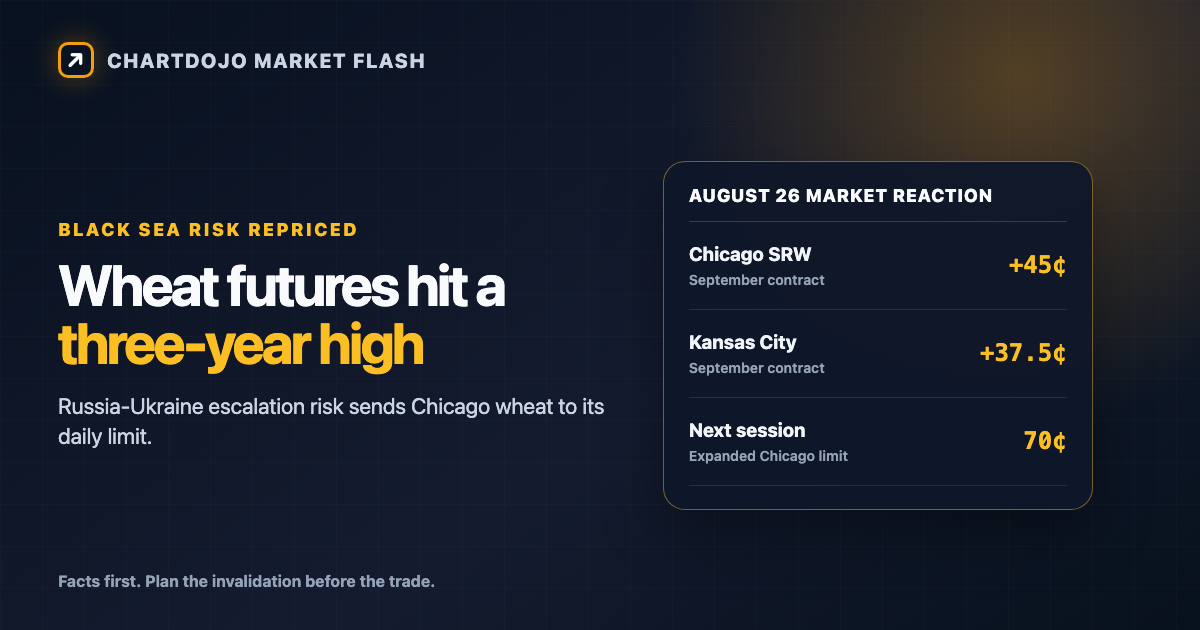
- September Chicago soft red winter wheat closed at its 45-cent daily limit at 730.5 cents a bushel, according to Total Farm Marketing.
- Kansas City and MIAX wheat also rose sharply, while corn and soybean futures gained as the grain complex repriced supply risk.
- The next test is whether expanded trading limits attract follow-through buying or expose a failed breakout after the first rush for protection.
The wheat futures three-year high was the clearest late-session commodity catalyst on Wednesday, August 26. Bloomberg reported the new high as Russia prepared to escalate the war in Ukraine. Total Farm Marketing separately reported a limit-up close in front-month Chicago wheat after cease-fire talks broke down and Russia threatened more attacks on Ukrainian grain infrastructure.
As of 11:30 p.m. ET, this is a grain-market event rather than a broad risk-asset shock. The move still matters for futures traders because daily price limits can compress liquidity, delay price discovery and force decisions into the next session.
What happened: wheat futures reached a three-year high
September Chicago soft red winter wheat rose 45 cents to 730.5 cents a bushel, the daily limit reported by Total Farm Marketing. September Kansas City wheat gained 37.5 cents to 792 cents, and September MIAX wheat added 27.5 cents to 721.5 cents.
Bloomberg reported that wheat reached its highest level in three years as markets reacted to reports of a possible escalation in Russia's war against Ukraine. Stock & Land also reported an overnight jump of about A$23 per metric ton in global wheat futures as traders responded to the latest escalation.
The move spread within agriculture. December corn rose 13 cents to 536.5 cents a bushel, while November soybeans gained 28.25 cents to 1,266 cents. Those gains do not prove that war risk drove every contract. They do show that wheat strength arrived alongside wider buying across grain futures.
Why wheat futures moved
The immediate concern is the Black Sea export corridor. Russia and Ukraine are major grain suppliers, so threats against ports or grain infrastructure can change expected shipping capacity before physical exports are visibly reduced. Futures markets react first to the probability of disruption.
There was already less room for delay. Total Farm Marketing said repairs to damaged grain infrastructure at Russia's Novorossiysk port could take one to four months. The same report said dry conditions in parts of Ukraine were reducing soil moisture before winter wheat planting. War risk therefore landed on a market already watching transport capacity and crop establishment.
Price limits added fuel. When a contract reaches its daily limit, some participants cannot transact at higher prices until the exchange expands or resets the allowed range. Total Farm Marketing said Chicago wheat would trade with a 70-cent limit on Thursday. That can create a large opening range as delayed orders meet fresh liquidity.
Implications for futures traders
For outright wheat traders, the first task is to separate an information shock from a crowded momentum trade. A sustained move should hold above the prior breakout area after the expanded limit opens. A quick return below the limit-up settlement would show that urgent hedging demand faded faster than expected.
For grain-spread traders, relative strength matters. Chicago, Kansas City and MIAX wheat did not move by the same amount. The next session can reveal whether the market is pricing broad wheat scarcity or a contract-specific squeeze. Watch volume and open interest alongside the spreads rather than treating every wheat contract as interchangeable.
For corn and soybean traders, wheat is a transmission channel, not a guarantee. Substitution in animal feed and acreage expectations can connect the markets, yet contract-specific export sales and weather can pull them apart. This analysis is educational and is not financial advice.
Potential positives vs negatives
Potential positives
- A three-year high confirms that buyers accepted prices above the recent range.
- Strength across several wheat contracts reduces the chance that the move was isolated to one contract.
- Corn and soybean gains show that the shock reached the broader grain complex.
- Any verified improvement in export security could restore more orderly two-way trade.
Potential negatives
- Further attacks on Black Sea ports or grain infrastructure could reduce shipping capacity.
- Expanded limits can produce larger gaps and worse fills when liquidity is thin.
- An overbought market can reverse sharply if escalation reports are softened or denied.
- Dry Ukrainian planting conditions could keep supply concerns alive after the immediate war premium fades.
What could happen from here
Base case, next 24 to 72 hours: Wheat opens with a wide range, holds part of Wednesday's advance and then consolidates as traders wait for verified information on ports and military plans. Confirmation would be acceptance above the prior breakout with two-way volume. A close below Wednesday's settlement would weaken this case.
Upside case: Fresh, independently confirmed attacks or export restrictions push Chicago wheat through the expanded range while Kansas City and MIAX contracts participate. Continued strength in corn would support a broader grain repricing. This case weakens if wheat rises alone on falling volume.
Downside case: Escalation reports fail to produce new confirmed disruptions, and urgent buyers step away after the open. Chicago wheat loses the limit-up settlement and closes back inside its former range. The case is invalidated if buyers reclaim the opening high with improving volume.
What to watch next in wheat futures
- The first 30-minute range after Chicago wheat begins trading with expanded limits.
- Verified reports on Novorossiysk and Ukrainian grain-export infrastructure.
- Whether Kansas City and MIAX wheat confirm the Chicago move.
- Corn and soybean participation after the initial wheat-led surge.
ChartDojo replay checklist
Load a five-minute Chicago wheat chart covering Wednesday's final two hours and Thursday's first hour. Hide the bars after the limit-up close. Mark the prior session high, Wednesday's settlement and the first tradable price after the expanded limit begins.
Advance one bar at a time. Before each decision, answer four questions: Is price accepting above settlement? Is volume expanding with the move? Are the other wheat contracts confirming it? Where is the invalidation level? Choose continuation or rejection only after writing the invalidation. Use no trade when neither pattern has confirmation.
Score the replay with one point for waiting through the first five-minute bar, one for checking confirmation in another wheat contract, one for defining risk before the decision and one for respecting a no-trade condition. Compare the process with bar replay versus paper trading and the deliberate practice framework for traders.
Quick questions
Why can wheat stop trading higher? Futures exchanges use daily price limits to contain extreme one-session moves. Trading may continue at the limit, but no transactions can occur beyond it until the allowed range changes.
Does a limit-up close guarantee another rally? No. It shows that buy demand overwhelmed available offers within the permitted range. The next session can gap higher or reverse once more sellers can transact.
Sources
- Bloomberg: wheat hits a three-year high as Russia prepares to escalate the war
- Total Farm Marketing: August 26 grain-market summary
- Stock & Land: wheat futures jump on Russia-Ukraine escalation
Feature image: ChartDojo original visual using the cited August 26 futures moves.
Build real skills, not bad habits. Start a free ChartDojo trial and use market replay with AI-powered feedback to review the decision process behind every trade.