
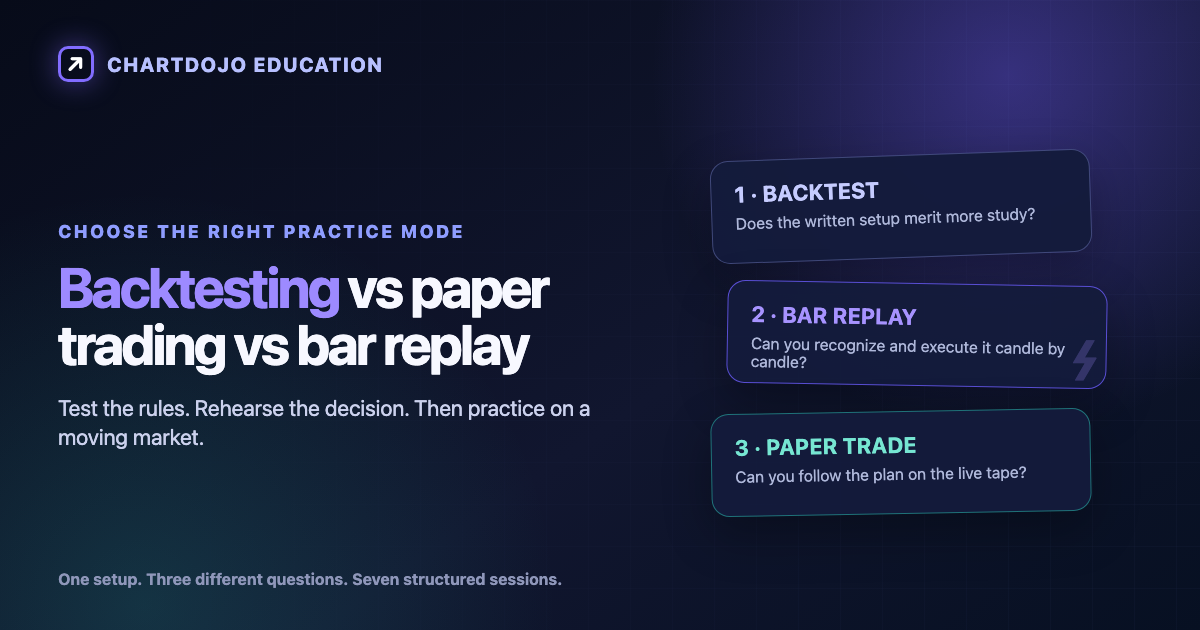
Backtesting vs paper trading sounds like a choice between two versions of the same exercise. Add bar replay and the labels get even messier. They are different practice modes. Backtesting asks whether written rules deserve more study. Bar replay asks whether you can recognize and act on a setup one candle at a time. Paper trading asks whether you can follow the plan while the current market keeps moving.
That distinction matters because a tool can look productive while training the wrong skill. A clean historical result does not prove you can make the decision in real time. A profitable paper session does not prove the rules have an edge. The right question is not which method is best. It is which weakness you need to work on today.
TL;DR
- Use backtesting to examine rules against historical observations, not to predict future returns.
- Use bar replay to practice chart recognition, timing, and risk decisions without seeing the next candle.
- Use paper trading to rehearse execution on a live or delayed market with simulated money.
- Do not compare the three by simulated profit alone. Each one answers a different question.
- A useful sequence is rules first, replay second, and paper execution last.
Backtesting vs paper trading vs bar replay
Backtesting is a historical rules check. You define a setup before looking at the result, then apply the same definition across past observations. The process may be manual or automated. A manual test might record every qualifying breakout on one market over a set period. An automated test may apply code to a larger data set. Either way, the value comes from consistent rules and honest recordkeeping. Changing the definition after each loss turns the exercise into hindsight.
A backtest is good at exposing vague ideas. "Buy strength" is not testable until strength has a definition. A rule such as "enter after a close above the prior 20-bar high, with the stop below the breakout bar" can be checked. You may discover that the idea appears too rarely, depends on one unusual month, or falls apart after estimated costs. That information can save time before you rehearse the setup.
Bar replay uses historical charts too, but the job is different. The chart is revealed in sequence so you must decide with limited information. You can pause before a possible entry, mark the level that would invalidate the idea, then advance one candle. Official TradingView Bar Replay guidance describes replay as a way to work with past data while controlling playback. Our TradingView Bar Replay practice guide shows how to turn those controls into structured exercises.
Replay is closer to a decision rehearsal than a broad statistical test. You see the chart as it unfolds, but you still choose the historical date and can unconsciously select memorable examples. You may also speed through dull periods and slow down near the setup you expect. Those choices introduce bias. Replay remains useful when the goal is skill practice and the session is scored against a fixed rubric.
Paper trading runs simulated orders against a current market feed. Depending on the platform, data may be live or delayed and simulated fills may be simpler than real fills. Schwab describes paperMoney as a simulated environment for testing strategies and becoming familiar with its platform. TradingView's Paper Trading documentation explains its virtual account and order controls.
The clock is the main difference. In replay, you decide when the next candle appears. In paper trading, the market chooses the pace. You must wait for the setup while distractions compete for attention. You also have to decide whether to skip a marginal trade. That makes paper trading useful for routines and execution discipline. It still cannot reproduce the emotional pressure or slippage of risking real capital. Liquidity limits and other live consequences are missing too.
A decision tree for choosing the right practice mode
Start with the question you cannot answer. If the setup itself is fuzzy, begin with backtesting. Write the entry condition in language another person could apply. Define what cancels the idea. Decide which market conditions count and which do not. Then collect enough historical observations to find contradictions. At this stage, you are testing the definition more than the trader.
If the rules are clear but you keep noticing setups after the move, switch to bar replay. Hide future candles and stop before each possible decision point. State the setup aloud or write one sentence. Mark an entry area and the price that makes the idea wrong. Then reveal the next candle. The score should reflect whether the decision matched the rules, even if the simulated trade loses.
If you recognize the setup in replay but break the plan during a normal session, use paper trading. The problem is now execution under an external clock. Limit the session to one defined setup. Record whether you waited, whether planned risk stayed intact, and whether you changed the exit because price moved against you. Profit can be noted, but it should not be the grade.
There is one more branch. If you cannot explain what went wrong, stop adding repetitions and improve the feedback. Repeating an unclear decision at higher speed usually makes the habit harder to remove. The guide on practicing trading without losing money covers the broader progression from safe mechanics to reviewed decisions.
| Your unanswered question | Practice mode | Primary grade | Common false conclusion |
|---|---|---|---|
| Are the setup rules specific enough to study? | Backtesting | Rule consistency across historical observations | A strong historical result guarantees future performance |
| Can I recognize and act on the setup without future candles? | Bar replay | Decision quality at each checkpoint | A winning replay trade proves the decision was good |
| Can I follow the plan while the current market moves? | Paper trading | Execution and risk adherence | Simulated fills will match live fills |
This tree does not force every trader through the same route. A platform beginner may need paper trading first to learn order controls. A trader with clear rules but late entries may spend most practice time in replay. A systematic trader may return to backtesting after a rule change. Choose by the next unanswered question, not by the tool with the most features.
A seven-session practice sequence
Here is a worked ChartDojo sequence for a simple breakout idea. The example is an exercise, not a claim that breakouts are profitable. Assume the written setup requires a close above a clearly marked range, an entry no more than a fixed distance above that close, and an invalidation below the breakout candle. The trader's recurring problem is chasing after price has already moved too far.
Session one is a definition audit. Review ten historical charts without placing a trade. Label each chart "qualifies," "does not qualify," or "unclear." If too many examples land in the unclear bucket, rewrite the range and entry rules. The output is a cleaner definition. Profit is irrelevant because no trade has been simulated.
Session two is a blind historical check. Select a period that was not used to create the rule and collect qualifying observations without changing the definition. Record whether the setup appears in different conditions. Note estimated transaction costs where they matter. The purpose is to look for dependence on one market phase and for rules that quietly require hindsight.
Sessions three and four move to bar replay. On each chart, pause before the suspected breakout. Mark the range first. Add the planned entry area and invalidation before advancing. Score setup match and timing. Use separate fields for risk definition and rule adherence. A losing outcome can still receive a clean score. A late winning entry should fail the timing field.
Session five repeats only the late-entry cases. This is deliberate practice, not another random tour through charts. Pause at the first qualifying close and decide whether the entry remains inside the written limit. If it does not, choose "skip" and advance. The goal is to make skipping visible as a correct action rather than an absence of action.
Sessions six and seven use paper trading on the current market. Watch only the market and timeframe covered by the exercise. Take no more than two qualifying decisions per session. If no setup appears, a clean no-trade session passes. After the session, compare the plan with the actual click. Keep the same four-field grade used in replay so the feedback travels with you.
| Session | Mode | Work product | Advance when |
|---|---|---|---|
| 1 | Manual backtest | Clear setup definition | Most examples can be classified without rewriting |
| 2 | Blind historical check | Unchanged rule applied to fresh observations | The rule survives contact with different conditions |
| 3-4 | Bar replay | Scored decisions before outcome | Timing and risk are stated before advancing |
| 5 | Targeted replay | Late-entry correction drill | Invalid late entries are skipped consistently |
| 6-7 | Paper trading | Current-market execution scores | The plan survives the market's clock |
At the end, do not blend all seven sessions into one profit number. The first two sessions grade the definition. The replay sessions grade decision recognition. The final sessions grade execution. If the last stage fails, return to the specific replay error instead of rewriting a setup that was followed poorly.
What these methods cannot prove
None of these practice modes can certify that a strategy will make money. Historical data contains regimes that may not repeat. The rule may have been adjusted until it fit the sample. Simulated orders may receive fills that were not available at the displayed size. A short test may also miss ordinary losing streaks. Treat every result as evidence with limits.
Real trading adds costs and pressure. The spread can widen. Orders can fill in pieces or not at all. A trader may hesitate when actual money is at risk. FINRA's guidance on frequent intraday trading warns that day trading can be extremely risky and may not suit people with limited resources or experience. Safe practice reduces avoidable mistakes, but it does not remove market risk.
Watch for outcome bias too. A replay trade that wins after a late entry is still a poor execution if the rule prohibited chasing. A paper loss taken exactly as planned may be a good decision. Our article on decision versus outcome in trading explains why the grade must be assigned to what was knowable at the time.
Sample selection is another trap. Choosing dramatic days makes replay entertaining but can distort practice. Backtesting only one market phase can make a fragile rule look stable. Paper trading only when you feel rested may hide mistakes that appear during a normal schedule. Write the sample plan before you see the results and record exceptions instead of quietly discarding them.
The practical standard is modest. Backtesting can tell you whether a defined idea merits another test. Replay can tell you whether a specific chart decision is becoming more consistent. Paper trading can tell you whether the routine survives a moving market without capital at risk. Those are useful answers. They are not promises.
FAQ
Is bar replay the same as backtesting?
No. Bar replay can support manual backtesting, but it is especially useful for decision practice because future candles stay hidden until you advance. A broader backtest focuses on applying fixed rules across historical observations. The same tool can support both jobs, but the session design and grade should be different.
Should a beginner start with backtesting or paper trading?
Start with the immediate gap. If you do not know how to place orders, a paper account can teach platform mechanics without real capital. If you can place orders but cannot define the setup, step back and test the rules. Once the definition is usable, replay can connect the rule to a chart decision.
How long should each practice stage take?
There is no universal duration. Advance when the stated question has a defensible answer. A clear setup may need more historical observations when it appears rarely. A timing error may improve after several focused replay sessions. Use pass criteria tied to the skill instead of a calendar deadline.
Does profitable paper trading mean I am ready for live trading?
No. Simulated profit can be useful context, but readiness also depends on rule adherence, realistic sizing, execution consistency, and the ability to handle losses. Live markets add emotional and practical costs that simulation cannot reproduce. Treat any move to real capital as a separate risk decision.
Can I use all three methods in the same week?
Yes, if each session has one job. Use a historical check to clarify the rule, replay to practice the decision, and paper trading to test execution on the current market. Keep separate scores so a profitable paper session does not hide a weak rule or a clean backtest does not hide poor execution.
Where ChartDojo fits
ChartDojo sits between paper trading and live trading. It is chart practice with AI-powered feedback on decision quality. A simulator can show where a hypothetical trade ended. ChartDojo focuses on the reasoning that existed before the outcome, including whether the setup matched the plan and whether the risk decision made sense.
The daily cadence is simple. Follow one setup and make the decision. Review the grade while the chart is still familiar, then carry one correction into the next session. Build real skills, not bad habits.
You can start a free ChartDojo trial and use the seven-session sequence before real capital is involved.