
Deliberate practice trading is what turns chart time into a testable skill. The difference is simple: ordinary repetition asks, "Did this trade win?" Deliberate practice asks, "Did I make the decision I meant to practice, and can I repeat it on a chart I have not seen?" That shift matters because a lucky outcome can reward a weak entry, while a clean decision can still lose.
This guide gives you a focused trading practice routine that isolates one skill. You get immediate feedback, then run a fresh retest. The worked example targets late entries, but the same process works for stop placement. You can also apply it to setup selection or patient skipping. All results below are illustrative practice data, not investment performance.
TL;DR
- Choose one decision skill narrow enough to score on every replay.
- Hide future candles and grade only information available at the moment of choice.
- Correct one recurring error, then retest it on unseen charts.
- Advance only when decision consistency improves across a full session, not because simulated profit rises.
- Keep real money out of the exercise. Replay practice cannot reproduce the full pressure or execution risk of live trading.
What deliberate practice trading changes
More screen time can help you recognize familiar shapes, but familiarity is not the same as skill. A trader can replay the same pattern for hours and keep making the same late entry. The repetition feels productive because candles move and simulated results accumulate. Nothing in that loop forces a correction.
Deliberate practice has a tighter structure. You name a specific weakness and set a rule for a successful decision. Attempt the skill with the outcome hidden, then review the choice. The next attempt uses a different example. Research on deliberate practice does not support the idea that practice explains all expert performance. A 2014 meta-analysis indexed by the U.S. National Library of Medicine found that it explained part of the variation in performance, with the share differing by domain. That is a useful reality check. Structured practice can improve a decision process, but it is not a promise of trading success.
The unit of improvement is the decision, not the simulated dollar result. Suppose your plan permits an entry only when price closes above a marked level and the next bar holds it. A valid attempt can lose after both conditions appear. An invalid attempt can win after you chase two candles late. If you grade only profit, the second attempt teaches the wrong lesson.
That is why the feedback window should stay short. Review the decision as soon as the replay reveals enough information to evaluate your process. Name the exact error in plain language: "I entered 0.7R beyond my planned trigger because I was afraid of missing the move." A label like "bad trade" is too vague to guide the next attempt.
ChartDojo's decision-feedback loop guide explains this distinction in more depth. The practical job here is to turn that idea into a session you can run today.
Build a one-skill trading practice routine
Start with a mistake you can observe before the outcome appears. "Be more disciplined" is too broad. "Do not enter more than 0.25R beyond the planned trigger" can be scored. In this guide, R means the distance between the planned entry and the invalidation level. Using that distance keeps the exercise comparable across charts with different prices and volatility.
Write a one-sentence skill rule before opening replay. For the late-entry exercise, use: "I may enter only after my trigger confirms, and I must skip if price is more than 0.25R beyond the planned entry." The rule has a valid action and a required skip. Both matter. Waiting without learning when to abandon a missed setup can turn patience practice into delayed chasing.
Next, prepare ten historical examples. Mix clean triggers with failed triggers and moves that run without giving an acceptable entry. Do not choose only textbook winners. If you know how each chart ends, use a different period or asset. TradingView's official Bar Replay instructions show how to choose a historical starting point and step through bars without exposing the full future sequence.
For every example, pause before the decision candle and write these fields:
- The setup you believe is present.
- The exact trigger price or candle condition.
- The invalidation level that makes the idea wrong.
- The maximum acceptable entry distance in R.
- Your action: enter, wait, or skip.
Then reveal enough bars to grade the choice. Do not move the trigger after seeing what price does. A changed plan counts as a failed rep unless the original rule explicitly allowed that adjustment. This may feel strict. Good. The point is to expose the gap between the plan you wrote and the choice you made under uncertainty.
Keep sessions small enough that attention stays sharp. Ten focused examples are more useful than fifty rushed clicks. The 20-minute chart pattern practice routine offers a compact schedule if you need a starting cadence. Use one or two sessions per week for this correction loop, then leave enough time between them to find fresh charts.
Worked example: correcting late entries across three sessions
Imagine a trader named Maya who practices breakout entries. Her setup requires a close above resistance followed by a hold above that level. Her planned invalidation sits below the breakout candle. She keeps entering after price has already traveled too far, especially when the first move looks fast.
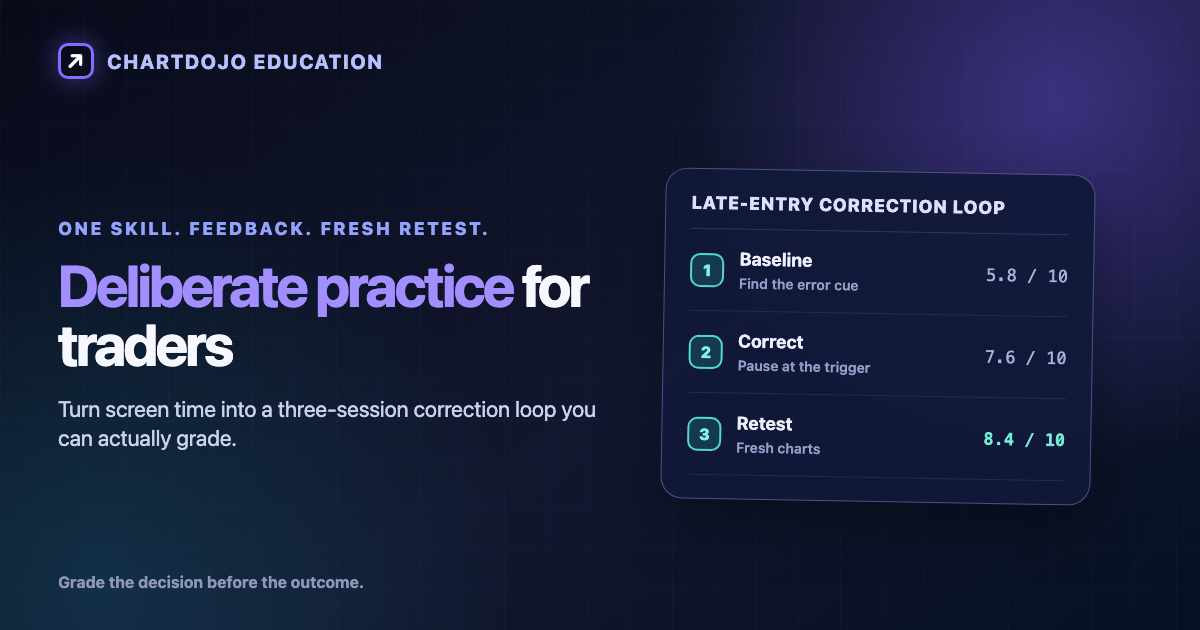
Maya selects thirty unseen replay examples and divides them into three sets of ten. She defines an on-time entry as one taken within 0.25R of the planned trigger. A late entry is farther than 0.25R. A correct skip occurs when no acceptable entry appears and she stays out. She grades each decision from zero to ten with the rubric in the next section.
| Session | Focus | On-time entries | Late entries | Correct skips | Average decision grade |
|---|---|---|---|---|---|
| 1 | Baseline, normal replay speed | 4 | 5 | 1 | 5.8 / 10 |
| 2 | Pause at trigger, say the rule aloud | 7 | 2 | 1 | 7.6 / 10 |
| 3 | Fresh charts, normal speed | 8 | 1 | 1 | 8.4 / 10 |
Illustrative practice results. Average grade equals the sum of ten decision grades divided by ten. It is not a return or a claim about live performance.
Session one reveals the pattern. Maya often identifies the setup correctly, but her action changes when a candle accelerates. Her most useful note is not "chased again." It is: "When the breakout bar exceeds half of the planned risk distance, I treat speed as confirmation and ignore my entry limit." That sentence identifies the cue that breaks her rule.
In session two, she inserts a temporary training aid. At the trigger, she pauses and says, "Inside 0.25R or skip." Slowing the exercise makes the target behavior obvious. The pause is scaffolding, not the finished skill. She removes it during the third session so the retest measures whether the correction survives at normal replay speed.
The third session uses fresh charts. This is the part traders are tempted to skip because the second set already looked better. Repeating familiar examples can measure memory. A shuffled, unseen set is a better check of whether the decision rule transferred. Maya's grade improves, and the late-entry count falls, but one clean session is still thin evidence. She should repeat the retest before raising difficulty.
Notice what the table does not show: simulated profit. Maya may have skipped a breakout that kept running, or taken a valid entry that failed. Those outcomes can be reviewed separately. They do not change whether she followed the skill rule.
Use a rubric that tells you when to advance
A useful rubric grades what was knowable at the time. Score each field from zero to two, for a maximum of ten points.
- Setup definition: 2 if the setup matched the written criteria, 1 if one condition was unclear, 0 if the label was assigned after price moved.
- Trigger discipline: 2 if the trigger was written before entry and followed, 1 if timing drifted but stayed inside 0.25R, 0 if the entry chased beyond the limit.
- Invalidation: 2 if the level was specific and fixed before entry, 1 if it was vague, 0 if it moved to avoid a losing result.
- Skip quality: 2 if the trader stayed out when the trigger failed or price ran too far, 1 if the skip came only after hesitation, 0 if fear of missing out overrode the rule.
- Review quality: 2 if the note names the cue and the decision error, 1 if it names only the error, 0 if it judges the result instead of the choice.
Use fixed progression rules so a good-looking chart does not move the goalposts. Repeat the same skill if the session average is below eight, if more than one rep breaks the target rule, or if the trader cannot explain the error without mentioning profit. Retest once more when the average reaches eight and the rule-break count is one or zero. Advance only after that result appears on another unseen set.
Advancing does not mean adding real capital. It means adding practice difficulty. You might remove the pause, use a less obvious setup, or shorten the decision window. Change one condition at a time so you know what caused the grade to move.
Also know what replay cannot train. Historical simulation may reduce hindsight, but it does not reproduce live fills or slippage. It also cannot reproduce latency and the emotional weight of loss. FINRA warns that frequent intraday trading can carry serious costs and risks. Treat that warning as a boundary around the exercise. Replay is education, not proof that someone is ready to risk money.
FAQ
How long should a deliberate practice trading session last?
Twenty to forty minutes is enough for most focused sessions. Stop when the notes become generic or you start clicking through decisions. Ten attentive reps beat a large batch performed on autopilot.
Should I practice one setup or several?
Use one decision skill at a time. The charts can vary, but the scoring rule should stay fixed. Once the skill passes two unseen retests, introduce a harder condition or choose the next weakness.
Can I use simulated profit to judge improvement?
Keep profit as a separate observation. It should not decide whether the practice skill passed. A valid decision can lose, and a weak decision can win. Grade the choice first.
What if I keep failing the same rule?
Make the cue smaller and easier to notice. Pause one candle earlier, write the rule beside the chart, or rehearse the correct skip without placing a simulated order. Then restore normal speed and retest on unseen examples.
Does replay prove I am ready for live trading?
No. Replay can test whether a decision rule is repeatable in historical simulation. It cannot reproduce every live-market cost or emotional response, and it cannot guarantee future results.
Where ChartDojo fits
ChartDojo sits between paper trading and live trading. It is paper trading with AI grading on decision quality, built for the part most simulators leave to self-review. You practice a chart decision, receive AI-powered feedback, and return the next day with one correction to test.
The cadence is intentionally simple: practice one decision, review the feedback, then retest it on a fresh chart. That makes ChartDojo a useful layer alongside TradingView Bar Replay. It can also complement thinkorswim paperMoney or Webull paper trading. It does not promise that simulation removes market risk. It helps you see whether your process is becoming more consistent before real capital enters the picture.
Build real skills, not bad habits. Start a free ChartDojo trial and use the three-session correction loop for your next practice block.