
TL;DR
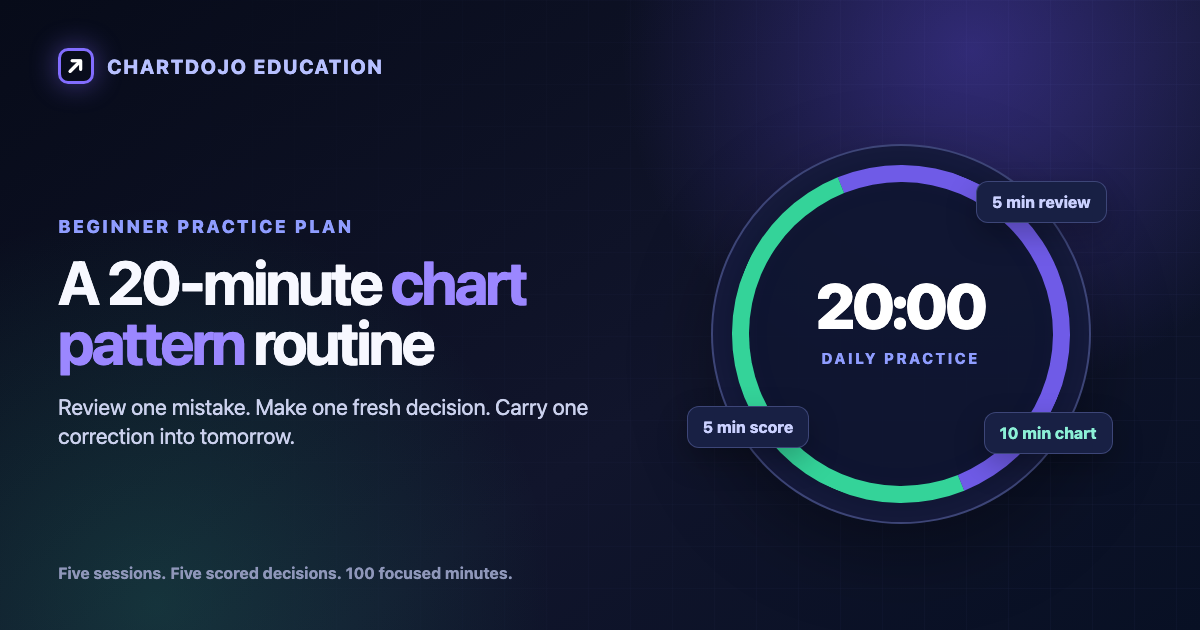
- A useful chart pattern practice routine can fit into 20 minutes: five minutes to review the prior session, ten minutes to make one fresh chart decision, then five minutes to score it and prepare the next session.
- Practice one setup at a time. Switching patterns every day makes it hard to tell whether your recognition is getting better.
- Hide future candles and write the decision before revealing the outcome. This reduces hindsight bias and keeps the session focused on process.
- Score what was visible at decision time. Profit and loss alone cannot tell you whether the entry followed your rule.
- Five weekday sessions add up to 100 focused minutes and five reviewed decisions. That is enough data for a useful weekly check without turning practice into a second job.
Why a 20-minute routine works for beginners
Chart pattern practice often starts with good intentions and a bad plan. A beginner opens a chart, scrolls through old price action, spots a pattern after it has completed, and feels as if recognition improved. The chart looked obvious because the result was already visible. That is study, but it is weak decision practice.
A short routine fixes the session boundary first. Twenty minutes is long enough to review one mistake and make one new decision. It is also short enough to repeat on a normal weekday. Repetition matters because pattern recognition develops through many encounters with similar conditions. One long weekend session can feel productive, yet the gap before the next session makes the lesson easy to lose.
The routine also limits the number of variables. Pick one market and one chart timeframe for the week. Choose a single setup such as a pullback to prior resistance after a breakout. Write a plain rule for what would make the setup valid. If you change the market or rule halfway through the week, you are testing a different skill.
Paper trading tools help with this work in different ways. TradingView Bar Replay can conceal future bars and advance through history. A broker simulator such as thinkorswim paperMoney can help you rehearse order entry. ChartDojo adds a feedback layer for the decision itself. The tool choice matters less than the session design: the future must be hidden, the choice must be recorded before reveal, and the review must refer to a written rule.
This routine is practice, not proof that a strategy will make money. Historical fills may differ from live fills. Real money also changes attention and behavior. FINRA's day-trading disclosure warns that day trading can be extremely risky, especially for people with limited resources or limited experience. Keep the routine educational and treat any later move to live trading as a separate risk decision.
The minute-by-minute chart pattern practice routine
Use a timer. The timer prevents review from expanding until there is no time left for a fresh decision. It also keeps one confusing chart from swallowing the whole session. If the example needs more research, mark it for the weekly check and move on.
| Time | Practice block | Required output | Question to answer |
|---|---|---|---|
| 0:00 to 5:00 | Review yesterday | One correction sentence | Which written rule did the decision follow or break? |
| 5:00 to 15:00 | Practice one fresh setup | Entry, invalidation point, and pass decision | Would I act with only the current candles visible? |
| 15:00 to 18:00 | Reveal and score | Process score from 0 to 4 | Was the choice sound before the outcome appeared? |
| 18:00 to 20:00 | Prepare tomorrow | Next scenario and one focus cue | What should I notice sooner next time? |
ChartDojo's 20-minute beginner routine. Five weekday sessions produce 100 focused minutes and five scored decisions.
Minutes 0 to 5: review yesterday's decision. Start with the prior screenshot or replay state. Read the rule you wrote before you see the outcome again. Write one correction sentence that begins with an action: "Wait for the candle to close above resistance" is useful. "Be more patient" is too vague. If the decision followed the rule, state what evidence made it valid so you can recognize that evidence again.
Minutes 5 to 15: make one new chart decision. Load a historical scenario with later candles hidden. Mark the possible entry and the price that would invalidate the idea. You may also pass. Passing is a real decision when the pattern is incomplete or the risk cannot be defined. Do not hunt for a prettier example once the timer starts. Learning to reject an imperfect setup is part of the exercise.
Write the reason in one or two sentences. Name the visible evidence rather than the hoped-for outcome. For example: "Price closed above the prior range, then returned to that level on lower volume. I will wait for a bullish close before considering an entry." This wording creates a decision that can be graded. "Looks strong" does not.
Minutes 15 to 18: reveal and score. Advance the chart enough to see what happened, but grade the process first. Give one point for a valid pattern. Give one point if the entry rule was followed. Add a point for defining invalidation before reveal. The fourth point is earned by correct position sizing or a correct pass. A 4 out of 4 decision can lose in simulation. A 1 out of 4 decision can win by luck.
Minutes 18 to 20: set up tomorrow. Choose the next replay location or save a scenario. Write one focus cue based on today's score, such as "check the close before marking entry." This small setup step removes friction. Tomorrow's session begins with review instead of searching for a chart.
How to use feedback without chasing the outcome
The most common review mistake is allowing the result to rewrite the quality of the choice. If price rose after a late entry, the entry was still late. If a valid setup failed immediately, the rule may still have been followed. Judge the information that existed when you clicked or passed.
A simple four-point scorecard makes this visible. Track the score each day and write the reason for every missing point. At the end of the week, total the points. Five sessions create a maximum score of 20. Suppose a beginner scores 11 in week one and loses four points because entries were marked before confirmation. That is a specific training target for week two. The raw win rate would not show it.
Use the correction sentence in the next session. Do not collect a growing list of reminders. One active cue is easier to apply under time pressure. When the same cue earns full points for three sessions, replace it with the next repeated mistake.
Outside feedback is useful when self-review becomes too forgiving. A coach can ask why a level mattered. A practice partner can compare the chart with your written rule. Chart practice with AI feedback can perform a similar role at daily cadence. The grader should respond to the decision and its evidence, not pretend that it knows the next market move.
Keep screenshots only when they support a lesson. Save one example that followed the rule and one that broke it. Label each image with the decision-time reason. A folder full of unlabeled winners is hard to study because it preserves outcomes without preserving thought.
If you need help setting up hidden-candle sessions, the guide to using Bar Replay for trade practice explains how to avoid seeing the answer too early. The companion article on the decision feedback loop shows why review must feed the next repetition.
A four-week progression that keeps the routine honest
Run the same basic routine for four weeks before adding another pattern. The progression changes the difficulty while keeping the time limit fixed. That makes weekly scores easier to compare.
In week one, use clean textbook examples and learn the sequence. Your target is completing all five sessions with a written invalidation point. Ignore speed beyond the 20-minute cap. If you cannot state the rule clearly, simplify it before the next session.
In week two, add imperfect examples from different historical periods in the same market. Keep the pattern definition unchanged. The aim is to distinguish a valid setup from a near match. Correct passes count toward the score because restraint is part of pattern recognition.
In week three, practice in mixed conditions. Include sessions where the setup never appears. Do not force a trade to fill the worksheet. A correct pass on a quiet or messy chart earns the same decision point as a valid entry.
In week four, test consistency. Use the same rule and scorecard without adding a new indicator. Compare the week's total with week one. Also count how many correction cues repeated. A higher score with fewer repeated mistakes suggests the routine is helping. A flat score tells you to inspect the rule or seek outside feedback before adding complexity.
After four weeks, decide whether to continue the pattern or rotate to a new one. Continue if the same error still appears. Rotate when the rule is clear and scores are stable, then revisit the original pattern after a break. This spacing checks whether recognition lasted beyond the most recent examples.
FAQ
How often should beginners practice chart patterns?
Five short sessions per week is a practical starting cadence. Consistency matters more than a single long session. If five days is unrealistic, use three fixed days and keep the same review structure.
Should I practice more than one chart pattern at a time?
Start with one. A narrow focus makes mistakes easier to diagnose. Add another pattern after the first rule is clear and your process score stays stable across several sessions.
Does a winning paper trade mean I recognized the pattern correctly?
No. A weak entry can make money in simulation, while a valid setup can lose. Grade whether the visible evidence matched your rule and whether invalidation was defined before the result appeared.
Which tool is best for a 20-minute routine?
Use chart replay when you need historical examples on demand. Use a broker simulator when order mechanics are the skill. Add decision feedback when your review notes are vague or repetitive. Many beginners use more than one layer over time.
When should I move from practice to live trading?
A practice score cannot decide that for you. Live trading adds execution risk and emotional pressure. Review the risks in official broker and regulator materials, then use small exposure only if it fits your finances and written plan.
Where ChartDojo fits
ChartDojo is paper trading with AI grading on decision quality. It fits inside the ten-minute fresh-setup block, after you understand basic order mechanics and before you put meaningful capital at risk. You make the choice while the chart is unresolved, then receive AI-powered feedback on the reasoning.
Use the feedback to write the next correction cue. That creates a daily loop: decide, receive a grade, and carry one lesson into tomorrow's chart. The goal is education over speculation. ChartDojo does not supply trade signals or promise that a pattern will work.
Build real skills, not bad habits. Start the free trial and use one practice scenario per day until the routine feels ordinary. Follow ChartDojo for a fresh practice prompt and keep the daily cadence small enough to repeat.