
Prediction market taxes in the United States do not yet have one settled treatment for every contract. The safe operational answer is to report taxable activity with complete records, while a qualified tax professional determines whether a specific position is treated as a wager, capital asset, digital-asset transaction, or another contract category under current law.
By Ulysses Cornelius. Educational information, not tax, legal, or financial advice. Federal guidance and platform documentation checked November 2, 2026, at 4:15 p.m. ET.
TL;DR
- Do not assume every event contract receives the same federal tax treatment. The IRS has not issued guidance specific to prediction-market contracts.
- Save the contract rules, trade confirmations, cash ledger, fee detail, settlement result, and any platform tax forms.
- A missing tax form does not erase the underlying activity. Reconcile your own records before filing.
- Use the worked example below to calculate economic profit or loss. Leave tax characterization to current guidance and a qualified adviser.
How do prediction market taxes work?
Start by separating two questions. First, what happened economically? Second, how does current tax law classify that activity? Your records can answer the first question. The second may depend on the contract, platform, funding method, account type, and current legal guidance.
Thomson Reuters Tax & Accounting reported in June 2026 that the IRS had not addressed prediction-market contracts directly. The report described competing possibilities discussed by tax professionals, including gambling-income rules, capital-gain treatment, or Section 1256 treatment for qualifying contracts. Those paths can produce different reporting and loss rules.
The IRS says Form 6781 is used for gains and losses on Section 1256 contracts and for certain straddles. That statement does not establish that every CFTC-regulated event contract qualifies. Exchange registration and a binary payout are not enough for a trader to select a form without checking the applicable definition.
If a position uses crypto or a stablecoin for funding or settlement, preserve the digital-asset leg as a separate record. The IRS digital-asset FAQ explains that disposals of digital assets can carry reporting duties. That issue can exist alongside the event-contract result.
How prediction-market tax recordkeeping works
Build one row for every opening trade, closing trade, settlement, fee, reward, deposit, and withdrawal. Keep the platform export in its original format, then add a readable working copy. Do not replace source files when you correct a label.
For each contract, preserve the following:
- Platform name, contract ticker or URL, full question, and saved resolution rules.
- Order time, fill time, side, quantity, fill price, and any partial fills.
- Gross cash paid or received, trading fees, incentives, and interest or rewards.
- Exit or settlement date, final outcome, dispute status, and void treatment.
- Account statements, transaction exports, wallet records when relevant, and every tax document supplied by the platform.
Kalshi's tax-documentation page says forms depend on the activity and applicable reporting thresholds. Its documentation should be reconciled with your trade history rather than treated as a complete profit-and-loss statement for every contract.
For a research workflow, link each tax row to the same contract snapshot used in your resolution-risk review. A rule change or void can alter the cash result, so the saved wording belongs beside the settlement record.
A worked prediction-market tax record
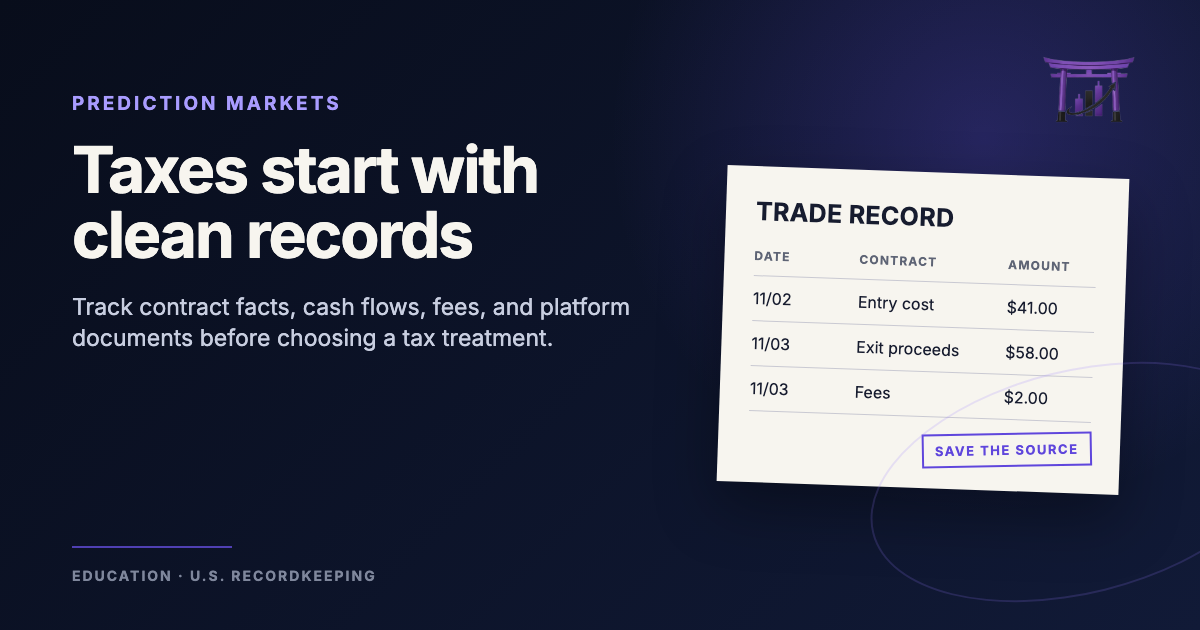
Assume a trader buys 100 Yes contracts at $0.41, later sells all 100 at $0.58, and pays $2.00 in total fees. This example is hypothetical and shows bookkeeping only.
| Record | Calculation | Amount |
|---|---|---|
| Entry cost | 100 × $0.41 | $41.00 |
| Exit proceeds | 100 × $0.58 | $58.00 |
| Total fees | Platform export | $2.00 |
| Economic result | $58.00 - $41.00 - $2.00 | $15.00 |
Attach the entry confirmation, exit confirmation, fee schedule, and contract rules to that row. Record any incentive separately. The $15 result is a cash calculation. It does not determine whether the item belongs on Form 6781, another capital-gain schedule, or an income line.
If the trade settles instead of being sold, replace exit proceeds with the settlement payment. If only 60 contracts fill on exit, keep the remaining 40 as a separate open lot. This mirrors the execution discipline in our guide to prediction-market fees.
Potential positives vs negatives
Clean records make review faster and reduce dependence on a year-end platform summary. They also expose missing fills, duplicate exports, fee errors, and unresolved contracts before filing season.
The limitation is that a tidy ledger cannot settle an unsettled legal classification. Different platforms or contract types may require different treatment. State obligations and a trader's individual facts can also change the answer. A spreadsheet is evidence, not personalized tax advice.
What could happen from here
Base scenario: classification stays case-specific
The IRS does not issue a prediction-market-specific rule before the next filing season. Traders continue to use existing tax principles with professional advice. New IRS guidance or a controlling court decision would weaken this scenario.
Clarity scenario: federal guidance defines a reporting path
The Treasury Department or IRS publishes guidance that identifies how one or more event-contract structures should be reported. Confirm this path only when the text addresses the relevant contract and effective date. A platform summary alone would not confirm it.
Fragmentation scenario: contract and platform differences widen
Cash-settled exchange contracts, sports-related products, and crypto-funded positions develop different reporting treatments. Traders would need more granular records. Uniform federal guidance covering those structures would weaken this scenario.
What traders should watch next
- New IRS or Treasury guidance that names event contracts or prediction markets.
- Changes to platform tax-document pages, form delivery dates, and downloadable trade exports.
- Court decisions that affect whether a contract is treated as a financial product or a wager.
- Corrections to settlement records, fee schedules, or digital-asset basis information before filing.
Review your export monthly rather than waiting for January. Match deposits and withdrawals to the cash ledger, then flag unresolved positions. Keep a read-only copy of every source file.
FAQ
Are prediction-market profits taxable in the United States?
Income is generally reportable, but the proper character and form can depend on the contract and the taxpayer's facts. This guide does not choose that treatment for you.
Does Kalshi send a 1099 for every prediction-market trade?
Kalshi says its tax documents depend on the type of activity and reporting thresholds. Users should check the current platform page and reconcile any form with their complete trading history.
Do prediction-market contracts automatically qualify for Section 1256 treatment?
No automatic conclusion is supported by the IRS Form 6781 page. Qualification depends on the statutory rules and the specific contract. Ask a qualified tax professional before using that treatment.
What should a Polymarket user save?
Keep contract rules, order history, wallet addresses, transaction hashes, token amounts, dollar values at the relevant times, fees, and settlement records. Crypto funding can create a recordkeeping issue separate from the event contract.
Sources
- IRS, About Form 6781, for the stated use of the form.
- IRS, digital-asset transaction FAQs, for digital-asset definitions and reporting context.
- Thomson Reuters Tax & Accounting, for reporting on unresolved prediction-market tax classification.
- Kalshi Help Center, for current platform tax-document information.
Cover: original ChartDojo recordkeeping illustration using the hypothetical trade example in this article.
Build real skills, not bad habits. Practice your decision process with ChartDojo and use AI-powered feedback to review the choices behind each trade. Start your free trial.