
Prediction market position sizing is the decision about how much capital to risk on an event contract. Start with an affordable loss limit, then test whether your estimated probability exceeds the all-in purchase cost. Fractional Kelly can help compare sizes, but forecast error and correlated positions can make its output too large.
By Ulysses Cornelius. Educational analysis, not financial advice. Documentation checked September 17, 2026, at 8:15 a.m. ET. All prices and probabilities below are hypothetical.
TL;DR
- A purchased binary contract can lose its entire purchase cost, including entry fees.
- Size from the executable price. A displayed probability is not a verified forecast.
- Reduce the probability estimate to test how quickly the apparent edge disappears.
- Apply a separate loss cap across positions exposed to the same event.
How does prediction market position sizing work?
The CFTC's event-contract explainer describes a common structure: the winning side receives $1 at settlement, while the losing side loses its investment. This article covers fully paid, purchased Yes contracts with that binary payout. Contracts with partial payouts or different collateral rules require different calculations.
At a 60-cent purchase price, 100 contracts cost $60 before fees. The maximum settlement payout is $100, not $100 of profit. If the outcome is No, the purchase cost is lost. Position sizing therefore measures dollars committed, rather than the number displayed beside a market question.
Use only capital available for this activity. Money needed for living expenses does not belong in the calculation. The guide to reading prediction-market odds explains why a price and your own probability estimate are different inputs.
How fractional Kelly works
The Kelly criterion chooses a stake to maximize expected logarithmic wealth under a specified probability model. MacLean, Thorp and Ziemba explain both its growth objective and its sensitivity to estimation errors. It does not promise a profit on the next contract or impose a maximum drawdown.
Let p be your estimated probability of Yes. Let c be the all-in cash cost per contract, expressed in dollars, with a $1 payout if Yes occurs. Assume the position is held to settlement, with no further fees or other payouts.
For a long-only purchase, the full-Kelly fraction of capital at risk is f = max(0, (p - c) / (1 - c)), for 0 < c < 1. Expected profit per contract is p - c. The formula follows from net winning odds of (1 - c) / c and a loss of the full stake when No occurs.
Quarter Kelly uses one-quarter of f. This is a smaller exposure under the same model, not proof that the exposure is suitable. A flawed estimate can still produce a losing trade at any positive fraction.
Actual fees may depend on quantity and execution details. Kalshi's fee-rounding documentation describes rounding adjustments and rebates across fills. Recalculate the total order cost when quantity changes. The fixed two-cent fee assumption below is an illustration, not a platform fee quote.
A worked sizing example with forecast error
Assume $1,000 of available risk capital, a 60-cent executable price, and an illustrative two-cent entry cost per contract. Then c = $0.62. With a 65% Yes estimate, expected profit is three cents per contract. Full Kelly is 0.03 / 0.38 = 7.89%; quarter Kelly is 1.97%, or about $19.74.
Rounding down to whole contracts gives 31 contracts costing $19.22. A Yes settlement returns $31, for $11.78 profit. A No settlement loses $19.22. These outcomes assume the stated fills and costs.
The table changes only the probability estimate. It also applies an illustrative $20 event-level loss cap. That cap is a worksheet input, not a recommended percentage.
| Yes estimate | Quarter-Kelly budget | Budget after $20 cap | Whole contracts | Cash at risk |
|---|---|---|---|---|
| 70% | $52.63 | $20.00 | 32 | $19.84 |
| 65% | $19.74 | $19.74 | 31 | $19.22 |
| 63% | $6.58 | $6.58 | 10 | $6.20 |
| 61% | $0.00 | $0.00 | 0 | $0.00 |
Method: budget = $1,000 × 0.25 × max(0, (p - 0.62) / 0.38). Apply the $20 cap before dividing by $0.62; round the contract count down. Dollar budgets are displayed to two decimals, while counts use unrounded values.
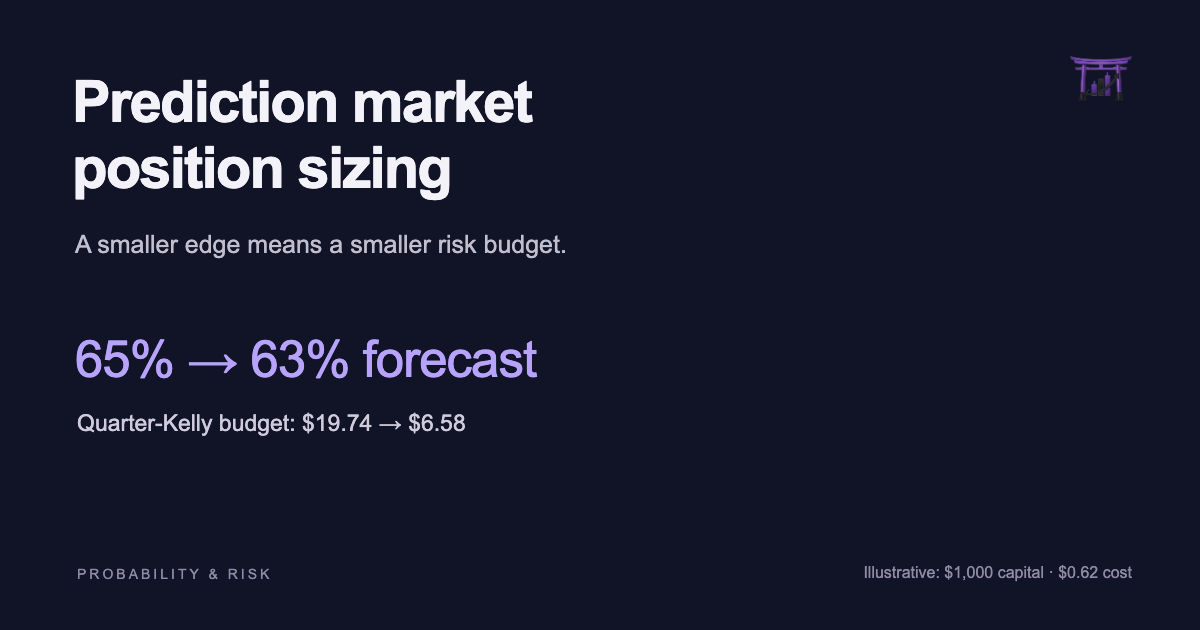
A two-percentage-point reduction from 65% to 63% cuts the modeled budget by two-thirds. At 61%, the estimated edge is negative. Lowering the forecast is a sensitivity test; it does not turn an unsupported guess into a reliable probability.
Potential positives vs negatives
A written sizing rule makes the loss visible before entry. It also makes it possible to compare decisions across contracts without letting a low nominal price encourage a larger cash commitment.
The weakness is the forecast. A precise formula can conceal uncertain inputs. Thin liquidity can raise the average purchase price, while several contracts can all lose after one announcement. Independent Kelly calculations do not account for that shared exposure.
Before adding a related position, subtract existing exposure from the event-level budget. Treat overlapping outcomes conservatively unless you have modeled their joint settlement payoffs. The prediction-market fees guide covers the separate question of whether trading costs consume the expected edge.
What could happen from here
Base scenario: the inputs remain stable
The 65% estimate and $0.62 cost remain supported. The worksheet permits 31 contracts, provided the event budget is unused. A worse executable price invalidates that quantity and requires a fresh calculation.
Upside scenario: stronger evidence supports 70%
The modeled budget rises to $52.63, but the independent $20 cap still limits exposure to 32 contracts. Stronger evidence must change the estimated chance of the specified settlement outcome. Repeated coverage of the same fact does not qualify.
Downside scenario: the estimate falls to 61%
The model allows no new Yes purchase at $0.62. For an existing position, evaluate the current sale proceeds against the remaining settlement value and costs. The original entry calculation cannot decide the exit for you.
What traders should watch next
Use this worksheet before the next practice decision:
- Copy the exact settlement question and record the executable price with its timestamp.
- Write your probability estimate and the evidence supporting it before calculating size.
- Repeat the calculation with a lower estimate and the total quoted order cost.
- Check existing event exposure, then record the maximum affordable loss separately.
After settlement, compare your forecasts with outcomes over many observations. One profitable contract cannot establish calibration. Also review whether your actual fills matched the assumptions and whether you respected the written limit.
FAQ
Is a 90% contract safer to size aggressively?
A high probability alone does not establish value. Paying more than your estimated probability implies a negative expected return under the simple $1-payout model. The losing outcome can still occur.
Does quarter Kelly prevent a large drawdown?
No. It reduces the stake relative to full Kelly for the same inputs. Incorrect forecasts or several related losses can still cause a large decline in capital.
Can a stop order replace the loss budget?
No. An intended exit depends on executable liquidity and platform order support. A sudden event can leave a contract with little resale value. Budget for the contractual loss even when you plan to exit earlier.
Sources
The linked CFTC explainer supplies the binary-payout definition. The MacLean, Thorp and Ziemba paper supports the Kelly framework and estimation-error discussion. Kalshi documents execution-fee rounding. The sensitivity table and cover are original ChartDojo educational illustrations using hypothetical inputs, not observed returns.
Build real skills, not bad habits. Practice trading decisions with ChartDojo's AI-powered feedback, then review how consistently you followed your risk rules. Start your free trial.