
Prediction market news trading means revising an event forecast when new information arrives, then checking whether an executable contract price still offers value after costs. Start with the original source and its timestamp. Match the update to the settlement rules and document your revised probability. Skip the order when confirmation arrives after the price has already adjusted.
By Ulysses Cornelius. Educational analysis, not financial advice. Documentation checked as of September 16, 2026, at 8:12 a.m. ET. All times and prices in the exercise are hypothetical.
TL;DR
- A fresh notification may contain an old fact. Find the original publication time.
- Two outlets repeating one anonymous report provide one evidentiary chain.
- Recalculate value at the price available after verification.
- Keep a record of rejected orders as well as completed trades.
How does prediction market news trading work?
A binary event contract pays according to a defined outcome. The CFTC's explanation describes common Yes/No contracts with a fixed payout, usually $1. The contract price reflects participants' expectations; it does not establish the true probability.
News trading adds a timing problem. Evidence may improve a forecast while other participants raise the asking price. A correct interpretation can therefore produce an unattractive purchase. The practical question is whether the remaining price gap compensates for costs and estimation error.
This guide concerns publicly available information and legally accessible contracts. Platform participation restrictions still apply. Readers learning contract basics can start with how to trade prediction markets.
Build a source-first decision process
Separate the clocks
Record when the event happened and when its original source became public. Separately record when you received the alert and when you observed an executable quote. Include the time zone. An article's updated timestamp can reflect an editorial correction without introducing a new event.
For scheduled announcements, prepare the official release page before publication. For unscheduled developments, follow reporting back to the originating document or named statement. A screenshot without a source link is insufficient evidence for this exercise.
Translate the headline into contract language
Ask exactly which settlement condition changed. A committee recommendation differs from a final decision. A preliminary data release may differ from the revised figure named in a contract. Polymarket's global-market resolution guide says predefined rules govern resolution. Check the exact venue's rules rather than applying that venue's process to another exchange.
When accounts conflict, preserve both statements in your notes. Do not assign extra weight to a report merely because several sites republished it. If the disagreement prevents a defensible forecast, pause the trade.
Refresh the executable price
The ask is the price a seller currently requests. It can differ from the large percentage shown on screen. Polymarket explains that its displayed probability normally uses the bid-ask midpoint; when the spread exceeds 10 cents, it uses the last traded price.
Kalshi's limit-order documentation explains how a purchase limit caps the price and why an order may remain unfilled. A limit cannot protect against a mistaken forecast. Check the current fee schedule too; order type alone does not establish the applicable fee.
Worked example: a headline-to-order decision tree
Consider a hypothetical contract paying $1 if a public authority approves an application by a specified deadline, and $0 otherwise. Assume a 50% initial forecast. A preliminary recommendation raises your estimate to 64%, with a plausible range of 58% to 68%. These estimates are exercise inputs, not measured forecasting accuracy.
A favorable preliminary recommendation appears.An alert arrives. An older screenshot shows a 55-cent ask.The original document confirms the recommendation. The current ask is 62 cents.The ask rises to 66 cents without additional evidence.
| Time, ET | Evidence or quote | Decision |
|---|---|---|
| 10:00 | Check whether final approval is still required. | |
| 10:02 | Do not use the screenshot as a current quote. | |
| 10:04 | Calculate the remaining margin. | |
| 10:06 | Reject the purchase under these assumptions. |
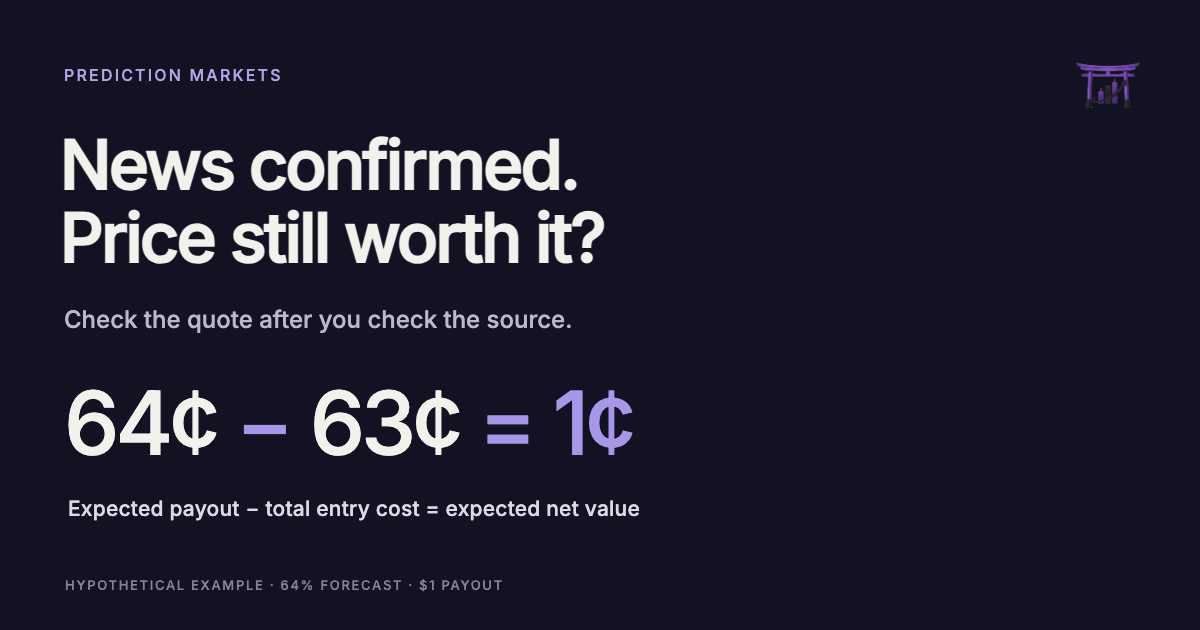
Assume one cent of total per-contract costs for a position held to settlement, excluding taxes and capital opportunity cost. This is a teaching assumption, not a venue fee quote. Expected net value is estimated probability times the $1 payout, minus entry price and assumed costs.
At 62 cents, the central estimate gives $0.64 - $0.62 - $0.01 = $0.01 per contract. Using the conservative 58% estimate gives a loss of five cents in expected value. At 66 cents, even the central estimate gives negative three cents. Verification improved the evidence, but the quoted opportunity disappeared.
Use this branching checklist before submitting an order:
- Can you verify a new public fact? If no, wait.
- Does it affect the contract's actual settlement condition? If no, record it as context.
- Can you defend the revised probability without copying the market percentage? If no, keep the exercise hypothetical.
- Does value remain at the current ask after costs and an uncertainty allowance? If no, reject the entry.
- Can the intended quantity fill within your price limit and loss budget? If no, reduce the planned quantity or abstain.
For cost mechanics, use the prediction market fees guide. This exercise grades the timing of a decision, not its eventual payout.
Potential positives vs negatives
Potential positives
The record exposes recycled headlines and makes probability revisions reviewable. It also gives a reason for rejecting a trade even when the news interpretation was correct.
Potential negatives
Verification takes time. Faster participants may remove an apparent advantage before an order can execute. Confidence in a source can also spill into unjustified confidence in a probability estimate. A purchase can lose its entire entry cost plus fees.
What could happen from here
Base scenario: the price adjusts during verification
The current quote removes the estimated margin, so no order follows. A timestamped quote confirms this scenario; a still-executable price below the conservative threshold would invalidate it.
Upside scenario for the method: evidence remains underpriced
A verified update leaves room after realistic costs at the intended quantity. This supports further evaluation, not a promised profit. A weaker probability estimate or a higher ask invalidates the entry case.
Downside scenario: the source or rule interpretation fails
A correction withdraws the original claim, or the contract requires a later decision. Stop using the prior estimate and review any open orders. A definitive document matching the settlement condition would weaken this scenario.
What traders should watch next
Before the next announcement, prepare a blank record with source links and four timestamp fields. Add your initial forecast and its uncertainty range. Set the price at which you would reject an entry. Afterward, check whether later revisions changed the underlying fact.
Repeat the exercise across several announcements without assuming simulated fills were available. Compare rejected decisions with accepted ones. Keeping a record of only completed trades hides the moments when the process correctly said to wait.
FAQ
Is the newest headline always new information?
No. Notifications can repeat earlier reporting. Compare the underlying event time with the original publication and check what changed in an update.
Do two articles count as independent confirmation?
Not when both rely on the same originating report. Identify the evidence behind each account before treating them as separate confirmation.
Does a correct forecast make a trade profitable?
No. Entry price and costs determine the payoff from a correct outcome. An early sale also depends on available buyers and the exit price.
Sources
- CFTC: Understanding Prediction Markets and Event Contracts, linked above.
- Kalshi Help Center: Limit Orders, linked above.
- Polymarket Help Center: price display and resolution documentation, linked above.
Cover: original ChartDojo educational artwork illustrating the hypothetical 64% forecast and 63-cent total entry cost. It depicts no live market data.
Build real skills, not bad habits. Practice trading decisions with AI-powered feedback and start a free ChartDojo trial.