
TL;DR
Kalshi vs Polymarket is not a simple two-platform choice. U.S. traders should compare Kalshi with Polymarket US, both CFTC-regulated designated contract markets. Polymarket's global on-chain venue is a separate service that blocks U.S. order placement. The better venue depends on the exact contract, executable spread, fee, funding route, and resolution rule.
- Check the legal entity and venue before comparing prices. Polymarket US and Polymarket global do not use the same access model or fee schedule.
- Compare the executable bid and ask, not a headline probability or midpoint.
- Read each contract's resolution source and deadline before treating two questions as equivalent.
- Documentation and access were checked at 8:10 a.m. ET on September 6, 2026. Platform terms can change.
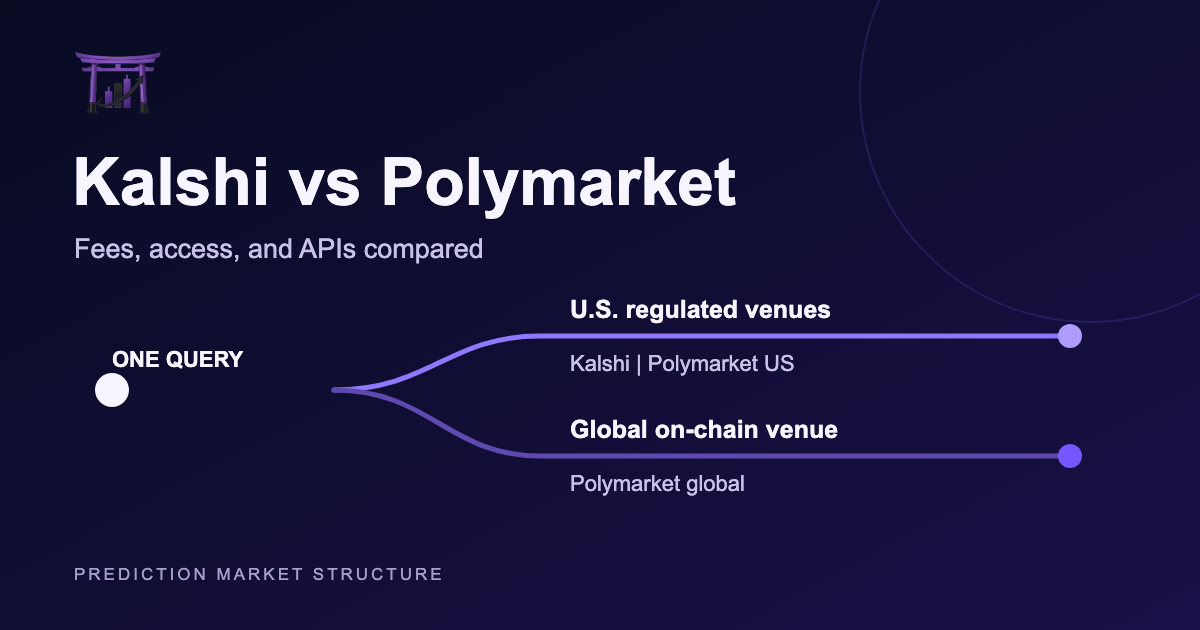
Feature graphic: Original ChartDojo market-structure diagram drawn from the official platform documentation cited below.
Kalshi vs Polymarket: which is better?
Neither venue is better for every trader. Kalshi has a mature U.S. event-contract exchange and supports bank, card, crypto, and wire funding methods. Polymarket US is also a CFTC-regulated exchange, with its own dollar funding, fee schedule, and API. Polymarket global is an on-chain market that uses USDC and applies geographic restrictions, including close-only restrictions for the United States.
The decisive comparison happens at the contract level. A trader needs to know whether the question wording matches, how the market resolves, what price is actually available for the desired size, and what fee applies to that fill. A larger platform-wide volume number cannot answer those questions.
How the platforms and venues work
| Decision point | Kalshi | Polymarket US | Polymarket global |
|---|---|---|---|
| Venue | CFTC-regulated designated contract market | CFTC-regulated designated contract market | Separate on-chain platform |
| U.S. access | U.S. regulated access, subject to account and product eligibility | U.S. regulated access, subject to account and product eligibility | U.S. order placement is restricted under the published geoblock policy |
| Funding | Bank transfer, debit card, crypto, or wire options are documented | ACH and debit-card funding are documented | USDC wallet and bridge workflow |
| Trading cost | Transaction fee tied to expected contract earnings; some markets differ | Exchange-wide formula with a 0.06 taker coefficient as of July 1, 2026 | Category-specific taker fees on certain markets; makers are not charged |
| Developer access | REST, WebSocket, and FIX interfaces | Trading, funding, reporting, and account API workflows | Market discovery, order-book, trade, history, and real-time data interfaces |
This table describes the published structure, not the quality of any individual market. Depth can vary sharply between two contracts on the same venue. Resolution language can also differ even when titles look similar.
Worked fee comparison at 50 cents
Polymarket US publishes the taker formula fee = 0.06 × contracts × price × (1 - price). For 100 contracts at 50 cents, the fee is:
0.06 × 100 × 0.50 × 0.50 = $1.50
The same 100-lot on Polymarket global uses a category coefficient. At 50 cents, the published taker fee is $1.00 for finance or politics, $1.25 for sports, and $1.75 for crypto. The global documentation says geopolitical and world-events markets are fee-free. Makers are not charged, while eligible makers may receive rebates.
Kalshi's help center says its transaction fee is tied to expected earnings and warns that some markets use different fees. That makes the order ticket's fee display and the current official schedule the correct source for a live comparison. Do not carry a remembered formula from one market into another.
A practical effective-cost checklist
- Record the best executable price for the full size you want.
- Add the displayed trading fee and any funding or withdrawal cost that applies to your route.
- Estimate slippage by walking the visible order book to the last required contract.
- Compare the net payout only after confirming that the resolution wording and source match.
This is the original decision tool in this comparison. It treats spread, fee, and settlement wording as separate costs. A one-cent price advantage can disappear if the market is thin or the contracts settle against different sources.
Potential positives vs negatives
Kalshi positives: a U.S.-regulated account, familiar funding choices, and documented institutional interfaces. Kalshi negatives: fees can differ by market, and the best available depth may not sit on the contract a trader wants.
Polymarket US positives: a clear published fee formula, maker rebates, and a regulated U.S. venue. Polymarket US negatives: it is newer than the global Polymarket venue and should be evaluated on its own listings and depth.
Polymarket global positives: broad market discovery, public on-chain data, and a detailed data API. Polymarket global negatives: geographic blocks matter, USDC adds a crypto funding layer, and fee rates differ by category.
What could happen from here
For a U.S. retail workflow: Kalshi or Polymarket US may fit when identity checks, permitted products, and funding methods line up with the trader's location. Recheck access before depositing because state litigation and product rules can change.
For a maker workflow: the result may turn on rebates, queue position, and fill rate. A maker rebate is useful only when resting orders actually trade without taking adverse selection, which is the risk of getting filled just before the market moves against the quote.
For a research workflow: both platform families provide useful APIs, but their data models differ. Kalshi organizes event-contract markets through exchange endpoints. Polymarket global assigns token IDs to YES and NO outcomes, while Polymarket US has a separate API. Code and identifiers should never be mixed across venues.
What traders should watch next
- The current fee page for the exact market and whether the order is maker or taker.
- The best bid, best ask, and visible depth at the intended size.
- The resolution source, deadline, cancellation language, and dispute process.
- Current location and product eligibility, especially while state and federal cases remain active.
New traders can use ChartDojo's prediction-market trading workflow before choosing a venue. Anyone comparing the same question across exchanges should also read the prediction-market arbitrage risk guide. For the live legal backdrop, see the Kalshi Supreme Court petition explainer.
FAQ
Is Polymarket legal in the United States?
Polymarket US is a CFTC-regulated designated contract market. The separate global Polymarket platform lists the United States as a restricted jurisdiction for order placement. Traders should use the correct entity and confirm current account eligibility.
Which is cheaper, Kalshi or Polymarket?
There is no reliable platform-wide answer. The fee, spread, available depth, order type, and funding route all matter. Compare the executable cost on the exact contract and size.
Do Kalshi and Polymarket contracts always resolve the same way?
No. Similar titles can use different source agencies, deadlines, definitions, or cancellation rules. Contract equivalence must be checked line by line.
Which platform has the better API?
That depends on the task. Kalshi documents REST, WebSocket, and FIX access. Polymarket global documents market, order-book, trade, historical-price, and streaming data. Polymarket US operates a separate API for its regulated venue.
Sources
- CFTC: Understanding prediction markets and event contracts
- Kalshi Help Center: Fees
- Kalshi API documentation
- Polymarket US: Designated contract market information
- Polymarket US fee schedule
- Polymarket global trading fees
- Polymarket global geographic restrictions
Build real skills, not bad habits. ChartDojo lets traders practice decisions and get AI-powered feedback before real capital is at risk. Start a free trial.