
TL;DR
- This US stocks risk map shows what traders should watch next session. As of 10:02 a.m. ET on Monday, Reuters reported the S&P 500 at 6,604.91, the Dow Jones Industrial Average at 46,573.53, the Nasdaq Composite at 21,992.14, and the VIX at 24.34. The headline move was positive, but not decisive.
- AP then reported that by 11:45 a.m. ET the S&P 500 was still up only 0.2%, the Dow was up 56 points, and the Nasdaq was ahead 0.3% while WTI crude sat near $112.21 and Brent near $109.61. That is not a clean risk-on signal. It is a market waiting for the next headline.
- Reuters said the S&P 500 information technology sector was the biggest early boost, while industrials and miners lagged. AP also showed the split inside mega-cap tech, with Apple and Amazon higher but Microsoft and Nvidia softer, while bank stocks outperformed.
- The next-session setup is therefore about breadth, not just direction. If oil, yields, and the Hormuz deadline stay elevated together, semis and banks may keep masking weakness underneath the index surface.
What happened
This routine run needed a stock-first angle, and the clearest one is a risk map rather than another duplicate Hormuz recap. Reuters reported that Wall Street's main indexes edged higher on Monday after last week's rebound, but the move was built on cautious relief around ceasefire discussions rather than on a durable improvement in the underlying macro picture. Reuters' 10:02 a.m. ET snapshot put the S&P 500 up 0.31%, the Dow up 0.15%, and the Nasdaq up 0.52%.
That looked encouraging on the surface, but AP's later midday read was still restrained. By 11:45 a.m. ET, the S&P 500 was up just 0.2%, the Dow was higher by 56 points, and the Nasdaq was ahead 0.3% as oil prices flip-flopped again. AP said benchmark U.S. crude was up 0.6% to $112.21 while Brent was near $109.61. In other words, stocks were holding up, but they were doing so with crude still above $100 and with another geopolitical deadline approaching.
The geopolitical tape remains the main reason that equity traders cannot relax. CNBC reported Monday that President Donald Trump called the latest Iran ceasefire proposal a significant step but "not good enough," while keeping pressure on Tehran ahead of the Strait of Hormuz deadline. Reuters also reported that a framework to end hostilities was being discussed, but that Iran rejected any immediate reopening of Hormuz. AP separately reported that Iran wants a permanent end to the war rather than a simple ceasefire. Those are not contradictory headlines, but they do explain why stocks have not priced a cleaner relief rally.
The macro backdrop also stayed mixed. Reuters said Friday's stronger-than-expected March payrolls reinforced the idea that the Federal Reserve may stay on hold. CNBC then reported Monday that the ISM services index slipped to 54 in March, below expectations, while the prices index jumped to 70.7 and the employment gauge fell to 45.2. In plain English, growth is still expanding, but inflation pressure remains uncomfortable and hiring inside services looks softer. That combination matters for stocks because it keeps the rates story unsettled even if the economy is not falling apart.
One more important stock-specific signal came from Jamie Dimon. Reuters reported that the JPMorgan chief warned the Iran war could keep inflation sticky and push interest rates higher than markets expect. AP noted that JPMorgan shares rose 1.4% anyway, which tells you investors are still willing to own financials into a higher-for-longer tape, at least for now. That helps explain Monday's sector split.
US stocks risk map: semis and banks hold, but breadth is still narrow
The concrete levels matter because this fallback post has to be useful as a next-session map. Reuters said the S&P 500 information technology sector was up 0.4% and the Philadelphia SE Semiconductor index was up 0.8% in early trading, with Seagate jumping 8.3% after a Morgan Stanley top-pick call. Reuters also said JPMorgan and Goldman Sachs helped lift the Dow. But the same report showed industrials down 0.3% and mining stocks down 0.7%.
AP confirmed that the leadership was not broad. Apple rose 1.3% and Amazon added 1.2%, but Microsoft fell 0.6% and Nvidia slipped 0.2%. That is a decent read-through for the next session. Traders are buying selective growth and balance-sheet quality, not blindly chasing every large-cap name. If that pattern persists, the indexes can stay green while internal participation stays thinner than the headline suggests.
Rates are the other part of the map. AP said the 10-year Treasury yield was 4.32%, down slightly from Friday's 4.35% but still far above its pre-war level near 3.97%. Reuters said money markets are no longer pricing any Fed easing this year after earlier expecting two cuts before the war began. That is a meaningful shift. Higher yields may be manageable for banks and some quality cyclicals, but they are a tougher valuation input for long-duration growth stocks when oil is also elevated.
Energy still matters because the shock has not actually cleared. Reuters said Brent was trading near $109.13 and WTI near $112.31 at 1326 GMT, while the Strait of Hormuz remained largely closed even though some selected vessels have crossed. Reuters also reported that spot premiums for U.S. crude have climbed to record highs as Asian and European refiners compete for replacement barrels. That is the sort of transmission signal equity traders should care about. It means the market is dealing with more than scary headlines. The physical squeeze is still visible.
Put together, this leaves a fairly clean stock interpretation. The market is not in panic mode, but it is also not rewarding broad cyclical exposure yet. The strongest parts of the tape are the areas that can either live with higher yields, like banks, or still command earnings confidence, like selective semis and platform tech. The weaker parts are the groups that depend more directly on smooth global trade, lower input costs, or wider risk appetite.
Implications for the most impacted trader cohorts
Index and Nasdaq traders: The key issue is whether leadership broadens beyond semiconductors and a few mega-cap names. If Nasdaq outperformance depends on a narrow chip bid while oil and yields stay elevated, that leadership can fade quickly.
Bank and financial traders: Financials are acting better than many expected. Higher-for-longer rates can help, but only if the market stays in a controlled slowdown view rather than shifting toward fresh macro stress.
Industrial, materials, and transport traders: This cohort still looks most exposed to the physical side of the energy shock. Reuters' underperformance in industrials and mining is an early warning that cost pressure and trade friction are not fully priced out.
Potential positives vs negatives
- Potential positive: Reuters and CNBC both showed that ceasefire channels are active, even if no final agreement exists yet.
- Potential positive: Stocks are holding positive territory with oil still above $100, which suggests positioning is not as fragile as it looked in late March.
- Potential positive: Bank strength and selective semiconductor leadership show investors are still willing to add risk where earnings confidence remains credible.
- Potential negative: CNBC reported Trump still called the proposal "not good enough," which keeps the Tuesday deadline alive as a genuine event risk.
- Potential negative: Reuters said the market is no longer pricing Fed easing this year, while AP and CNBC both showed inflation-sensitive data and costs still running hot.
- Potential negative: Record U.S. crude premiums and a still-constrained Hormuz route argue that the supply shock is not merely rhetorical.
What could happen from here
Base case: The next session stays choppy but broadly stable, with the S&P 500 holding near the 6,600 area, the VIX remaining in the mid-20s, and oil failing to break sharply higher again. This is confirmed if banks and selective tech continue to offset weakness elsewhere. It is invalidated if breadth collapses and the market can no longer hide weakness underneath a few large-cap winners.
Upside case: Traders get a more credible de-escalation signal on Iran and Hormuz, oil cools, and breadth expands into industrials, discretionary, and lagging mega-caps. This is confirmed if yields ease, the Nasdaq leads without relying only on semis, and the Dow starts participating through more than just financials. It is invalidated if oil stays sticky and defensive posture remains necessary.
Downside case: The deadline rhetoric hardens or the physical energy squeeze worsens, pushing crude and inflation expectations higher together. This is confirmed if WTI and Brent push materially higher from current levels, the VIX moves decisively above 25, and industrials, discretionary, and big tech weaken at the same time. It is invalidated if oil remains rangebound and the next round of headlines points toward a clearer diplomatic path.
What traders should watch next
- Whether the S&P 500 can hold around Reuters' 6,604.91 reference area, or whether gains keep narrowing into a handful of names.
- Oil around AP's midday levels of roughly $112.21 WTI and $109.61 Brent, plus whether Reuters' record U.S. crude premium story keeps intensifying.
- The 10-year Treasury yield near 4.32% and whether sticky yields start to pressure tech more visibly.
- Any fresh Reuters, AP, or CNBC confirmation on the ceasefire framework, Hormuz traffic, or Trump's deadline posture.
- Whether banks continue to outperform while industrials and materials lag, because that relative trade may tell you more than the index close.
- Later-this-week inflation and Fed communication, which still look like the next domestic catalysts once the current geopolitical tape cools even slightly.
FAQ
Why are stocks still rising if the Iran and Hormuz story is unresolved?
Because investors are trading probabilities, not certainty. Ceasefire talks, a resilient jobs backdrop, and selective earnings confidence are enough to support some risk appetite, but not enough to produce a broad relief rally.
Why do banks look stronger than industrials in this setup?
Banks can benefit from a higher-rate backdrop if the economy avoids a sharp downturn. Industrials and materials are more exposed to input costs, shipping stress, and the physical side of the oil disruption.
For related context, see ChartDojo's recent coverage of Nasdaq and airlines under the oil test, the latest Hormuz shipping disruption, and this week's cross-asset setup into CPI, Fed, and oil.
Sources
- Reuters: Wall Street edges higher as investors assess Mideast resolution prospects
- AP: US stocks and oil prices flip-flop ahead of Trump's deadline to bomb Iranian power plants
- Reuters: Oil edges up in choppy trade; US, Iran receive ceasefire proposal framework
- CNBC: Trump says Iran ceasefire proposal is significant but not good enough
- Reuters: JPMorgan's Dimon warns Iran war may drive inflation and interest rates higher
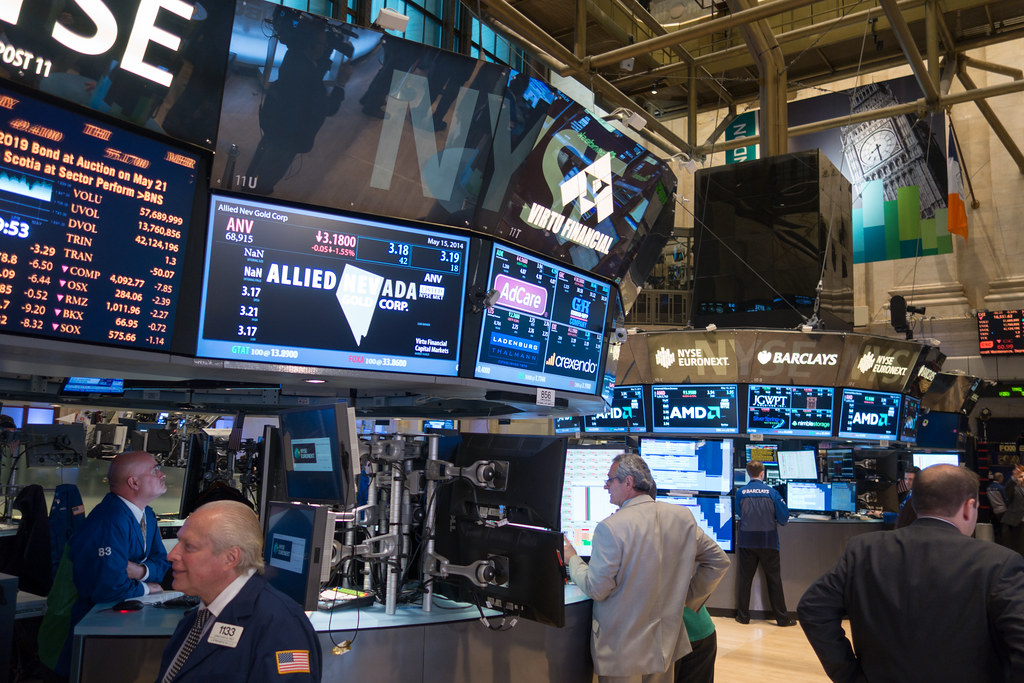
- Feature image: Trading Floor at the New York Stock Exchange by Scott Beale via Wikimedia Commons, licensed CC BY-SA 4.0.

Build real skills, not bad habits. ChartDojo gives traders AI-powered feedback on execution and decision-making, with a free trial if you want a better process for fast-moving setups like this one. Start free here.