
TL;DR
- Binance says all deposits and withdrawals are temporarily suspended while it conducts security checks, freezes assets, and works with law enforcement.
- The exchange says user funds are safe, it will cover all losses, and it will publish a full post-mortem after the investigation.
- Binance says the current verified frozen total is $2.54 billion. That supersedes earlier figures of approximately $1.8 billion to $2.3 billion.
- A $5.57 billion multi-chain outflow tally reported by Decrypt remains a gross estimate, not a Binance-confirmed loss.
Developing story: ChartDojo is tracking official statements and independently verifiable on-chain evidence. This draft reflects information available at approximately 9:25 p.m. ET on October 29.
Binance suspends deposits and withdrawals
Binance has moved from investigating a potential security issue to taking broad operational precautions. In a statement posted shortly after midnight UTC, the exchange said all deposits and withdrawals were temporarily suspended while its team conducted security checks, froze funds, and worked with law enforcement.
The company said user funds were safe, promised to cover all losses, and said it would publish a full post-mortem after the investigation. Binance did not provide a final loss figure or a timetable for restoring deposits and withdrawals.
Earlier, Binance said withdrawals would resume when the security issue was fully resolved. It also temporarily suspended Binance Alpha trading functions as part of its security measures.
For customers, the operational restriction is now the most important confirmed development. A deposit or withdrawal suspension can affect settlement timing, collateral transfers, and hedging plans even when an exchange says customer balances remain covered.
What Binance has confirmed so far
The public timeline changed quickly. At 5:16 p.m. ET, Binance said it was investigating a potential security issue and had not confirmed an impact to user funds. At 5:29 p.m. ET, a revised statement said user funds were completely safe.
At 11:22 p.m. UTC, Binance said its verified frozen total had reached $2.54 billion. The exchange said that figure could rise as it worked with law enforcement, issuers, blockchain intelligence firms, and industry partners.
Shortly after midnight UTC, Binance said it would cover all losses and promised a post-mortem. Co-founder Yi He separately referred to hacking losses while repeating that user funds were safe. These statements strengthen the evidence that Binance is treating the event as a security incident, but they still do not establish a final net loss.
Why the $5.57 billion estimate remains uncertain
Decrypt reported an on-chain tally of at least $5.57 billion leaving Binance-linked wallets across Ethereum, Bitcoin, and Tron. Its breakdown was approximately $3.51 billion on Ethereum, $1.44 billion in 18,270 Bitcoin, and $630 million on Tron.
That is a gross wallet-flow estimate, not a confirmed customer loss. Cross-chain totals depend on wallet attribution, asset prices, cutoff times, internal transfers, forwarded funds, and whether the same economic exposure is counted more than once.
Unchained independently counted approximately $3.52 billion reaching the main receiving address on Ethereum. It said reported Bitcoin outflows remained unverified in its analysis. Unchained later noted a multi-chain estimate near $5.64 billion but said it had not verified that total.
The difference between the Ethereum-only count and the broader tally is a scope difference. Neither should be presented as Binance's final loss until the exchange publishes address-level findings and reconciles recoveries, freezes, and internal movements.
What the Ethereum records show
Etherscan records show the wallet labeled Binance 14 sent 167,464.24 ETH at 20:24:23 UTC to 0x5227...CB2f8c, an address Etherscan labels Binance Hot Wallet Exploiter 2.
Unchained documented an EIP-7702 delegation shortly before that movement and a later sweep after Binance's first statement. It also reported transfers involving Binance 16 and a wallet labeled Hot Wallet 34. How the required signing authority was obtained has not been established publicly.
These records support the description of apparently unauthorized movement from Binance-labeled wallets. They do not by themselves determine customer exposure or the final recoverable amount.
Frozen assets reach $2.54 billion
Earlier first-party statements established large stablecoin freezes. Tether CEO Paolo Ardoino said Tether froze more than 1.567 billion USDT. Circle CEO Jeremy Allaire said Circle froze more than 800 million USDC in coordination with law enforcement.
Binance's later $2.54 billion verified total is broader and now the most current company figure. Frozen assets are not automatically recovered assets, and they should not simply be subtracted from the $5.57 billion gross flow estimate. Legal process, issuer controls, downstream transfers, and ownership determinations still matter.
Crypto market reaction
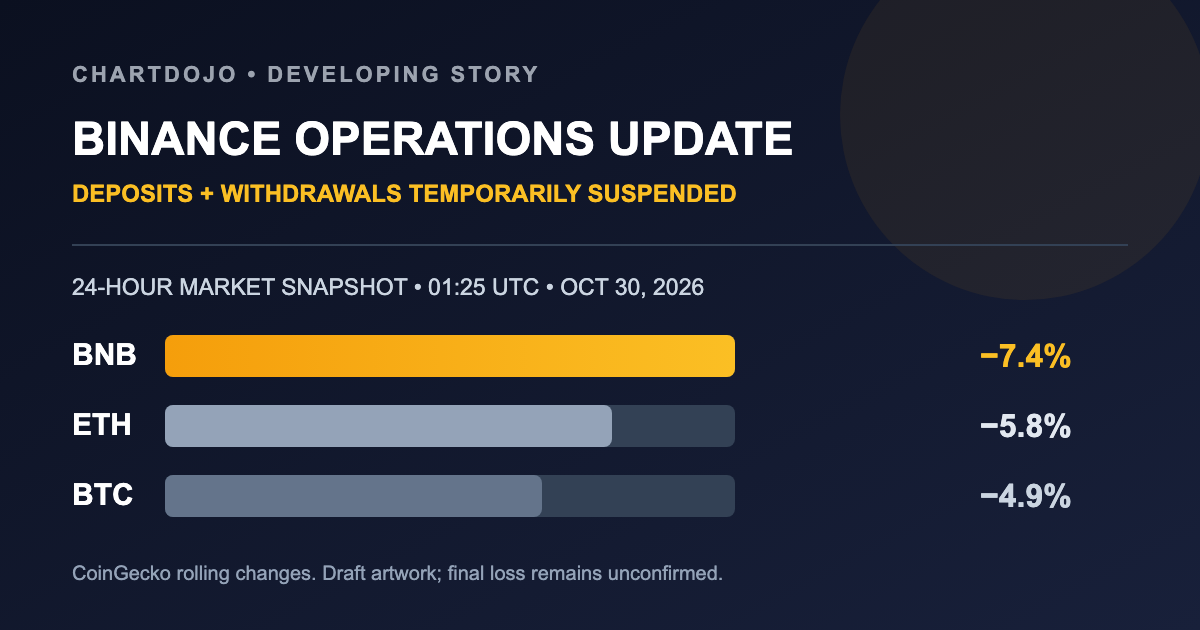
At approximately 01:25 UTC, a CoinGecko snapshot showed BNB near $698, down 7.4% over 24 hours. Ether was near $2,207, down 5.8%, while Bitcoin was near $76,874, down 4.9%.
BNB remained the weakest of the three, consistent with additional exchange-specific risk. These are rolling changes and do not prove that the Binance incident caused the entire decline. Broader crypto conditions were already fragile before the wallet alerts, as discussed in ChartDojo's October 24 market update.
Implications for crypto traders
The confirmed suspension changes the immediate checklist. Users should not assume deposits or withdrawals will settle on their normal schedule. Traders relying on cross-exchange collateral transfers may need to reduce exposure rather than wait for funds that cannot move.
- Check official Binance channels before initiating any deposit or withdrawal.
- Do not trust direct messages, unofficial recovery links, or requests for account credentials.
- Separate gross outflows, frozen balances, recoveries, and customer losses.
- Reduce position size if transfer restrictions make the original hedge or liquidation plan unreliable.
- Keep records of balances, pending transfers, and transaction identifiers.
Traders can rehearse the sizing decision with ChartDojo's guide to risk-reward decisions in paper trading.
Potential positives vs negatives
Potential positives: Binance says it will cover all losses, user funds remain safe, and $2.54 billion has been frozen. A transparent post-mortem, independently verifiable wallet list, and orderly reopening would reduce uncertainty.
Potential negatives: deposits and withdrawals are suspended, Binance Alpha functions are restricted, and the multi-chain scope remains unresolved. Extended downtime, additional wallet movements, or a broader signing compromise would increase counterparty and liquidity risk.
What could happen from here
Base case: Binance completes its security review, documents a bounded loss, and restores deposits and withdrawals in stages. This gains support if no new unauthorized transfers appear and the verified frozen total remains stable or rises.
Upside case: most affected assets remain frozen or are recovered, the exchange publishes a clear reimbursement plan, and normal operations resume quickly. New unexplained wallet movement would weaken this case.
Downside case: the investigation finds a broader signing compromise, additional assets move beyond freeze controls, or operational restrictions persist. Evidence of unaffected reserves and orderly reopening would weaken this scenario.
What to watch next
- The timing and network scope of restored deposits and withdrawals.
- Binance's promised post-mortem and final address-level loss reconciliation.
- Whether the $2.54 billion frozen total changes.
- New movements from Binance-labeled or exploiter-linked wallets.
- Reserve disclosures and any customer reimbursement details.
Sources
- Binance: deposits and withdrawals suspended
- Binance: $2.54 billion verified frozen
- Decrypt: $5.57 billion multi-chain tally
- Unchained: Ethereum transaction analysis
- Etherscan: main receiving address
Reporting cutoff: October 29, 2026, 9:25 p.m. ET. This draft distinguishes verified operational restrictions from disputed gross-flow estimates and an unconfirmed final loss. It is educational information, not financial advice.
Build real skills, not bad habits. Use ChartDojo's AI-powered feedback to replay volatile market decisions and start a free trial.