
Practicing entries is easy to understand. Wait for a setup, then choose a price and click. Trade management is harder because every new bar creates another choice. You may hold or reduce the position. You can also move a stop or close the trade. A profitable outcome can hide a poor choice, while a sound decision can still lose.
The best way to practice trade management with bar replay is to define the choices before playback. Pause only at planned checkpoints. Grade each decision against the information visible at that moment. The exercise below gives you a repeatable method. It is educational practice, not financial advice or a promise that replay performance will carry into live markets.
TL;DR
- Write your management rules before replay starts so later price action cannot rewrite the plan.
- Use fixed decision checkpoints instead of pausing whenever a candle makes you uncomfortable.
- Grade the reason for each adjustment separately from the simulated profit or loss.
- Repeat the same drill across different sessions before changing a rule.
- Use replay to expose inconsistent choices, then test one correction at a time.
What trade management practice should train
Trade management begins after a simulated order fills. From that point, the job is to respond to new information without abandoning the risk plan. That includes deciding whether the original idea remains valid and whether the position still fits the amount of loss you agreed to accept. It also includes knowing when a planned target or time stop has done its job.
Bar replay is useful because it hides future price movement while presenting historical bars in sequence. TradingView describes Bar Replay as a way to simulate past price movements and practice decisions without financial exposure. The tool supplies the sequence. Your written rules supply the training objective. Our Bar Replay practice guide covers the basic setup if you have not used the feature before.
Do not treat a replay result as proof that a management method works. Historical playback cannot reproduce every live fill or spread change. It may also simplify queue position and cannot recreate your emotional response. It can show whether you made a decision with the evidence available and whether you applied the same rule consistently. That is a narrower claim, but it is a useful one.
The distinction between process and outcome matters most near exits. Imagine that you ignore a planned stop, then watch price reverse into a winner. The simulated profit rewards the mistake. In another session, you may honor the stop exactly and see price recover one bar later. The loss does not make the decision wrong. Replay practice should prevent the future candles from becoming the judge.
A management drill should answer two questions. First, did the market information satisfy a rule you wrote in advance? Second, did the action preserve the risk boundary for the exercise? If you cannot answer both from your notes, the replay may be entertaining, but it is not producing clean practice evidence.
Set up the replay before the first bar
Choose one liquid market and one historical session that you have not studied recently. Hide the future bars and start far enough before the setup to read the context. Keep the chart layout close to what you would use in ordinary practice. Changing indicators or time frames mid-session adds another variable and makes the result difficult to compare.
Write a short management card before placing the simulated trade. Record the setup and entry condition. Add the initial invalidation price and maximum planned risk. Then define the events that permit an adjustment. An event could be a close beyond a structural level or a fixed time limit. A planned price objective can also qualify. Use conditions that can be recognized from the chart rather than feelings such as "the move looks weak."
The initial stop deserves special attention. CME Group's trade and risk management education says a trader should know the exit point before taking a trade and use the distance between entry and stop to understand capital at risk. Your replay exercise does not need to copy a particular risk percentage. It does need a precommitted invalidation point and a position size that makes the hypothetical loss explicit. For focused practice on that step, use our guide to practicing stop placement with Bar Replay.
Decide how the replay will advance. One-bar steps work well around a management checkpoint because they prevent you from reading several candles as one finished pattern. A steady playback speed works better between checkpoints. Switching between the two is fine when the rule is fixed before the session. Random pausing invites hindsight because the most dramatic bars receive more attention than ordinary ones.
Create a blank decision record with four rows. Each row needs the visible evidence and the permitted action. Record the action you chose and the risk after that choice. Leave the result column hidden until the replay ends. This separation keeps the score attached to the decision that was available, not to the later path.
A four-checkpoint trade management replay drill
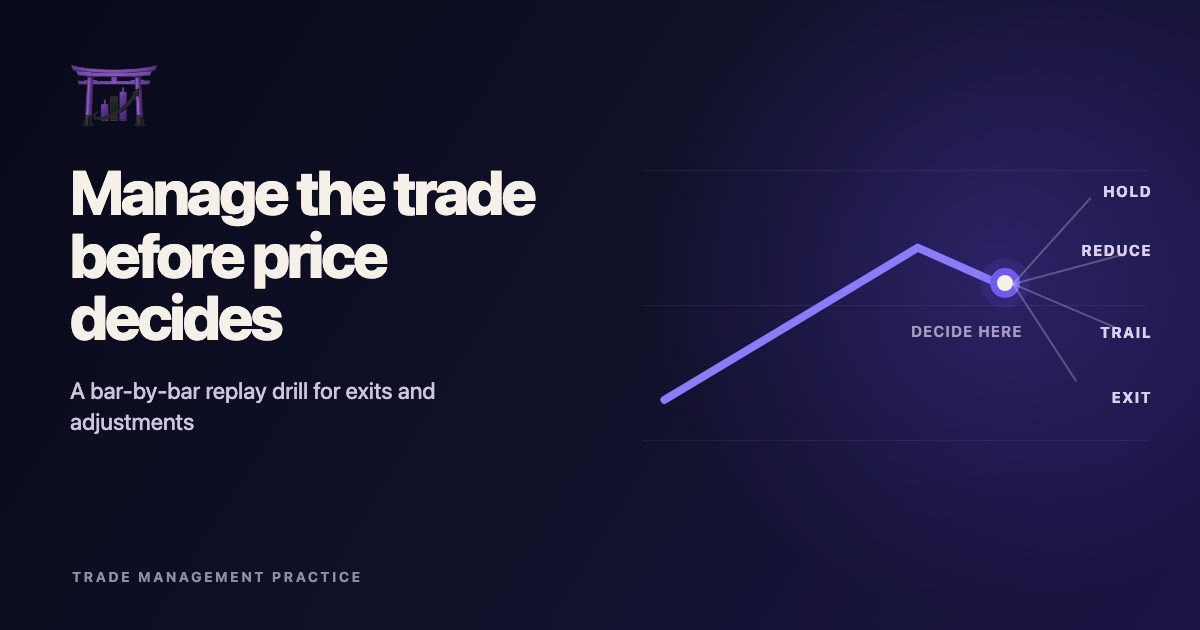
This drill uses four branch points: the first test after entry; the first favorable move; the first meaningful pullback; and the planned exit event. The labels describe when to inspect the trade. They do not prescribe the same action for every setup. Your management card determines whether the correct choice is to hold or reduce. It may instead require you to trail the stop or exit.
Checkpoint 1: the first test after entry
Advance until price first tests the entry area or the nearby structure that supported the idea. Pause after the bar closes. Record whether the original invalidation level remains intact. If nothing in the written plan changed, "hold" may be the rule-compliant answer even when the bar feels uncomfortable. If the invalidation condition occurred, exit according to the exercise rather than waiting for a more convenient price.
Checkpoint 2: the first favorable move
Continue until price reaches the first objective or travels one unit of initial risk in your favor. Stop and compare the bar with the management card. A plan might call for no change or a partial reduction. It could instead allow a stop adjustment. Each is a different hypothesis. Pick the action already allowed by the plan and write its effect on the remaining risk before advancing.
Checkpoint 3: the first meaningful pullback
Pause when price retraces to a level you defined as meaningful. Ask whether the pullback changes the setup or merely reduces open profit. Those are different observations. Moving a stop solely because open profit shrank often changes the rule in response to discomfort. Moving it because the chart met a prewritten condition is testable across sessions.
Checkpoint 4: the planned exit event
Continue until the target or time limit occurs. A trailing condition or invalidation event can also end the exercise. Apply the corresponding action and end the simulated trade. Do not replay the final bars to search for a better exit. The purpose is to test one management plan. A second plan belongs in a separate run using the same starting point.
Worked example
Suppose a hypothetical stock entry is $50.00 with 100 simulated shares and an initial stop at $49.50. The planned risk is $50 before slippage or fees. The management card says to hold while the invalidation remains intact; reduce 25 shares if price closes above $50.50; trail the stop to $50.20 only after a pullback holds above $50.25; and exit the rest at $51.00 or at the session time limit.
At the first checkpoint, price trades to $49.78 and closes at $49.92. The invalidation has not occurred, so the plan says hold. At the second checkpoint, a bar closes at $50.56. The exercise reduces 25 shares and records the new exposure. Price then pulls back to $50.31 without closing below $50.25. The third condition permits the stop to move to $50.20. Later, price reaches $51.00, so the remaining simulated shares exit.
The ending profit is not the main score. The useful evidence is that every action matched a condition written before playback. If the same trade had stopped at $50.20 after the third checkpoint, the process score would be unchanged. If price had reached $51.00 after an unplanned stop cancellation, the process score would fall even though the outcome improved.
Score the decision, then repeat the exercise
Use a zero-to-two score for each category below. Zero means the requirement was missed. One means it was partly met. Two means the record shows full compliance. Five categories create a ten-point decision-quality score without pretending to measure market edge.
| Category | Question | Two-point evidence |
|---|---|---|
| Plan match | Was the action allowed by the prewritten card? | The exact condition and action were recorded before replay. |
| Visible evidence | Did the decision use only bars available at the checkpoint? | The note cites a visible close, level, or time condition. |
| Risk control | Was remaining hypothetical risk known after the action? | Size and stop location were updated in the record. |
| Consistency | Was the same rule applied at comparable checkpoints? | No exception was invented because of the result. |
| Review clarity | Could another reader understand why the choice was made? | The reason is specific enough to reproduce. |
Score the session before revealing the final result column. Then record simulated profit or loss as a separate observation. A high process score and a losing result can coexist. A low process score with a winner should trigger another practice run, not confidence that the improvisation was correct.
Repeat the drill across at least several different sessions before drawing a conclusion. Include calm and volatile examples when the setup appears in both conditions. Change only one management rule in the next batch. If you alter the stop method and the partial-exit rule together, you will not know which change affected your decisions.
Watch for three common errors during review. The first is moving a stop because of open profit rather than a written chart condition. The second is pausing after an unusually large bar even though no checkpoint occurred. The third is grading the trade from the final price. List errors in the notes, but choose the most frequent one as the focus for the next session.
Replay also has execution limits. Investor.gov explains that a stop order becomes a market order after the stop price is reached, so the execution price can differ from the stop price in a fast market. A simulator may simplify that gap. When reviewing the exercise, note whether a precise fill assumption made the result look cleaner than live execution might be. Do not invent slippage after the fact to rescue or punish a trade.
FINRA warns that frequent intraday trading carries serious risk, especially when borrowed money or short selling is involved. Replay removes real capital from the exercise, but it does not establish suitability or eliminate those risks later. Treat a clean practice score as evidence of rule execution inside the simulation. It is not evidence that live trading will be profitable.
FAQ
How often should I pause during Bar Replay?
Pause only at the checkpoints defined before playback. Four checkpoints are enough for this exercise. If a setup needs fewer decision points, use fewer. Adding pauses whenever price moves quickly encourages hindsight and makes sessions harder to compare.
Should I practice trailing stops or fixed targets first?
Start with the rule you can define most clearly. A fixed target is easier to reproduce, while a trailing rule needs an observable trigger and a precise new stop location. Test one method across a batch of replays before comparing it with another.
What if Bar Replay gives unrealistic fills?
Grade the management decision separately from the fill. Record the simulator's execution and flag any result that depends on an implausibly exact price. The exercise trains decisions under visible information. It cannot prove that a live order would receive the same execution.
Can I replay the same trade with a different management plan?
Yes, but treat it as a separate experiment. Reset to the same starting point and write the alternative rules before advancing. Avoid using details remembered from the first run. A different historical session provides a cleaner test when memory strongly influences the second attempt.
Where ChartDojo fits
ChartDojo sits between paper trading and live trading. It provides chart practice with AI-powered feedback on the quality of the decision, so a winning simulation does not automatically receive a good grade. Record the reason for each management choice and compare it with the plan. Use the feedback to find where your process changed.
That follow-first workflow supports a daily practice cadence. Make the decision and explain it. Review the feedback, then return for the next focused exercise. ChartDojo is paper trading with AI grading on decision quality. Simulated results do not guarantee future outcomes. Build real skills, not bad habits. Start a free ChartDojo trial and use the four-checkpoint drill in your next practice session.