
To practice a daily loss limit with paper trading, write the session's loss boundary before placing an order, check how much risk remains before each entry, and rehearse closing the session when the rule says to stop. A simulator lets you test that sequence without putting cash at risk.
The difficult moment often arrives before the boundary is reached. After losing part of the budget, you see another setup. The next trade would risk more than the amount remaining. This guide gives that decision its own exercise. The figures below are hypothetical teaching inputs, not recommended account limits or evidence of trading performance.
TL;DR
- Define the daily limit against a fixed session-start balance and include open losses when monitoring the boundary.
- Check whether the next planned loss, estimated costs, and a stated buffer fit the remaining budget.
- Stop new entries when the exercise's fixed trade risk no longer fits. Do not wait for a full limit breach.
- Practice canceling entry orders and confirming that the account is flat when the session closes.
- Grade compliance separately from profit. Five practice sessions cannot prove readiness for live trading.
Practice a daily loss limit with paper trading: define the rule
A daily loss limit is a session-level stopping rule. A stop order applies to a position. You need to distinguish them because several individually acceptable losses can exhaust a session budget. A written figure on a worksheet does not automatically cancel an order or close a position.
For this exercise, start each session flat and allow only one open position at a time. Choose one instrument with a position-size calculation you understand. Write the session's start and end times in a named time zone. An overnight position falls outside this simple drill; do not quietly carry it into the next session's numbers.
Set a fixed loss boundary measured from the starting balance. Monitor current equity, including unrealized profit or loss, with fees already charged reflected in the balance. For example, a $10,000 starting balance and a $150 loss limit produce an equity floor of $9,850. A profitable morning does not move that floor in this exercise. A trailing drawdown rule would be a different exercise.
Also define the maximum planned risk per trade. The paper trading position-sizing drill explains how entry and stop distance determine quantity. Here, keep that per-trade budget fixed throughout the session. Do not increase it after losses or shrink it simply to squeeze in one more attempt.
Write the shutdown action before beginning. Block new entries and cancel unfilled entry orders. Flatten the simulated position if the equity floor is reached. Keep protective exit orders in place until the position is closed, then confirm that no orders remain. Once stopped, this session stays stopped, even if price subsequently recovers.
A worked remaining-risk example
Suppose the practice account starts at $10,000. Use a $150 daily limit and $50 of planned price risk per trade, which we call one risk unit, or 1R. Allow another $5 for estimated round-trip costs and a $10 execution buffer. These amounts are chosen to make the exercise transparent. Actual costs depend on the instrument and execution conditions.
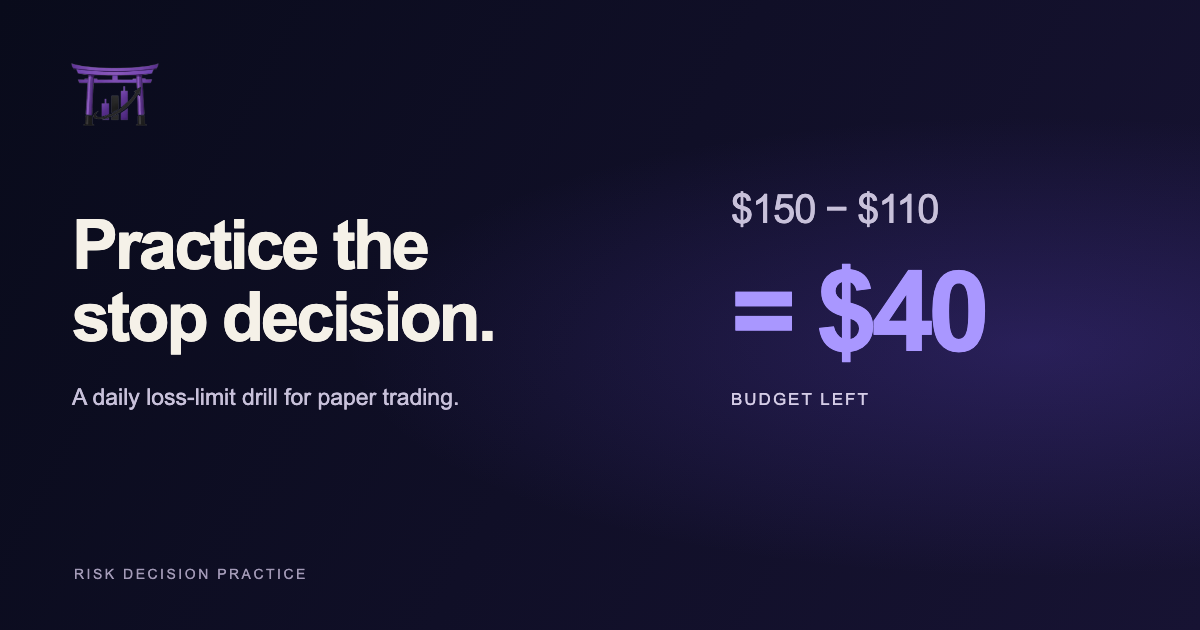
Before an entry, while the account is flat, calculate remaining budget as $150 plus the smaller of net session profit/loss and zero. That convention prevents earlier profits from expanding the original risk allowance. At a net loss of $110, the calculation is $150 minus $110, leaving $40.
The proposed trade needs $50 plus $5 plus $10, or $65 of budget. Because $65 exceeds $40, the session ends without another entry. The $10 buffer is an accounting allowance for this exercise, not a guarantee against a worse fill. Do not subtract it from realized results unless a cost or loss actually occurred.
| Checkpoint | Net session P/L | Budget remaining | Proposed trade allowance | Decision |
|---|---|---|---|---|
| Session start | $0 | $150 | $65 | Fits if the setup qualifies |
| After first loss including costs | -$55 | $95 | $65 | Fits if the setup qualifies |
| After second identical loss | -$110 | $40 | $65 | End entries for this session |
| Separate profitable-session example | +$30 | $150 | $65 | No extra risk allowance from profit |
The table assumes each losing trade loses exactly $50 on price and incurs $5 in costs. It illustrates arithmetic, not observed fills. There is no instruction to take a trade merely because its budget fits. The setup must still meet the written entry rule.
During an open trade, monitor total equity against the $9,850 floor. If a worse-than-planned fill leaves equity at $9,840, record the $160 net loss honestly and keep the session closed. The boundary was exceeded; rewriting the worksheet to show $150 would hide the execution problem.
The SEC's order guide explains that a stop order becomes a market order when triggered. Market orders do not guarantee an execution price. A daily limit therefore controls your decisions and planned exposure; it cannot promise an exact maximum realized loss.
The five-session daily stop trading practice drill
Use a paper account or a historical replay tool whose order behavior you understand. TradingView's documentation describes simulated-money trading and supported order interfaces. If you use replay, confirm whether the order ticket follows the replay timeline; do not assume an ordinary paper account is executing against historical prices.
Keep one written setup definition for the five sessions. Record the original budget before revealing new price action. Use fresh chart segments for independent decisions. Where a session needs a particular loss condition, use the hypothetical worksheet state below instead of deliberately taking poor trades to manufacture it.
Session 1: verify the calculation
Begin with no session loss. Before every eligible entry, write the remaining budget and the proposed trade allowance. Compare the two before opening the order ticket. After the simulated exit, reconcile the displayed balance with the recorded result. If your worksheet and platform disagree, stop and identify whether costs were omitted or counted twice.
Session 2: start near the boundary
Use a worksheet checkpoint showing a $110 net session loss under the example's $150 limit. Inspect a fresh setup as though the earlier losses had already occurred. The $65 proposal does not fit the $40 remaining. Record the no-entry decision before advancing the chart. This session tests whether an attractive setup changes your arithmetic.
Session 3: rehearse a limit breach
Use a separate hypothetical checkpoint where an adverse move takes total equity below the floor. Rehearse the closure sequence in simulation, including verification that the account is flat. Record the final simulated loss even if it exceeds the limit. Note any gap between recognizing the trigger and completing the exit; do not infer live execution speed from the rehearsal.
Session 4: face a later opportunity
Return to a stopped worksheet state, then reveal a later chart segment containing a plausible setup. Leave the order ticket untouched and write why the session remains closed. Watching that setup work after you declined it does not change the score. Use this checkpoint to expose whether a missed move tempts you to reopen a session.
Session 5: run an unprompted session
Use a fresh segment with no preselected outcome. Apply the same budget checks and end at the written session time or an earlier stopping trigger. If losses never create a shutdown condition, mark that part untested. Complete the separate breach checkpoint afterward as a labeled rehearsal, rather than claiming the market tested something it did not.
A compliance scorecard that profit cannot overwrite
At the end of each session, mark each question below as yes or no. Use not tested when the checkpoint did not occur. Keep the original worksheet alongside the answers. A profitable result cannot turn a late risk check into an on-time check.
| Check | Evidence to retain |
|---|---|
| Was the boundary fixed before the first decision? | Starting balance, floor, session time, and written trade allowance |
| Was remaining budget checked before every entry? | Pre-entry arithmetic with costs stated |
| Were disallowed entries refused? | No-entry note at the decision checkpoint |
| Was shutdown completed when required? | Closing equity and confirmation of flat position and no remaining orders |
| Did the stopped session remain closed? | No later entry; record whether a later opportunity was observed |
A session passes this teaching exercise only when every applicable item is yes. A no requires a specific correction before the next session. An untested shutdown means incomplete evidence, not a perfect score. The scorecard is a practice aid created for this article, not a validated measure of trading ability.
Make the next correction observable. If arithmetic was late, require a written budget check before opening the ticket. If an entry order remained working after shutdown, add order-status confirmation to the closure routine. The broader guide to paper trading mistakes covers how simulator habits can drift; this drill isolates the session-stop decision.
What a simulator cannot establish
Paper results do not reproduce every live execution condition. The CFTC's hypothetical-performance disclosure rule describes limitations involving liquidity and hindsight in simulated commodity-interest results. That rule has a specific regulatory scope, but the underlying warning is relevant when interpreting a practice record: a simulation is not an actual trading record.
Keep the risk allowance realistic for the product you are studying, and use its contract specifications when calculating exposure. Multiple simultaneous positions require an aggregate-risk method beyond this one-position drill. Do not assume separate stops on correlated positions create independent protection.
Five sessions are enough to inspect a procedure, not to estimate an edge or establish emotional readiness for real losses. Keep practicing any step you could not execute consistently. These exercises are educational and are not personalized investment advice.
FAQ
What daily loss percentage should I use?
No percentage fits every account or instrument. The $150 example is a teaching input, not a recommendation to risk 1.5% of real capital. Choose simulation inputs you can explain, and keep them unchanged while testing the stopping procedure.
Should unrealized losses count toward the limit?
They count in this exercise because the boundary uses current equity and therefore includes open-position P/L. If a platform or firm uses a different definition, document that definition separately before practicing its rule.
Can I reset the paper account after hitting the limit?
Do not reset within a session to resume trading. Preserve the original results. A new scheduled practice session may begin with fresh teaching inputs, but label it separately so a reset cannot conceal a rule breach.
Does ChartDojo automatically enforce this limit?
This article does not claim an automatic account lockout in ChartDojo. The worksheet is a manual exercise. Confirm any platform's current risk-control features before relying on software to stop trading.
Where ChartDojo fits
ChartDojo provides chart practice with AI-powered feedback on decision quality. It sits between paper trading and live trading, adding a way to examine decisions before real capital is involved. Use this article's manual scorecard alongside your practice; it is not a claim that the product reproduces the worksheet or enforces its daily boundary.
Follow ChartDojo for trading education and build a daily habit around one practice decision. Review the feedback and carry one correction into the next session. Build real skills, not bad habits. Start a free ChartDojo trial to practice with AI-powered feedback.
Sources
- SEC Investor.gov: Types of orders. Order triggers and execution-price limitations.
- TradingView: Paper trading functionality. Simulated-money trading and order interfaces.
- CFTC, 17 CFR 4.41. Scope and limitations of hypothetical-performance presentations.