
Bitcoin risk map conditions are still being set more by oil and rates than by any single crypto-native headline. As of 8:11 p.m. UTC, or 4:11 p.m. ET, on Monday, March 30, CoinGecko showed bitcoin trading near $66,582, while Coinbase spot showed about $66,586. Reuters reported that Federal Reserve Chair Jerome Powell said the Fed can "wait and see" how the Iran war affects inflation, while CNBC reported that WTI settled at $102.88, its first close above $100 since July 2022, and Brent finished at $112.78. CoinDesk separately reported that Square has begun auto-enabling bitcoin payments for eligible U.S. sellers and that bitcoin network hashrate is down about 4% year to date as miners redirect capital toward AI infrastructure. The result is a market with one constructive adoption headline, one stressed mining backdrop, and a macro tape that still matters more. This is market education, not financial advice.
TL;DR
- CoinGecko showed bitcoin at about $66,582 at 20:11 UTC, with a 24-hour range of $65,112 to $68,019 and a 7-day change of -6.3%. Coinbase spot was about $66,586.
- Reuters reported Powell said the Fed can "wait and see" how the war-driven energy shock affects inflation, and Reuters also said the U.S. 10-year yield fell to about 4.346% while the 2-year yield slipped to about 3.832%.
- CNBC reported WTI settled at $102.88, the first close above $100 since July 2022, while Brent settled at $112.78. That keeps inflation pressure and cross-asset stress alive.
- CoinDesk reported Square began auto-enabling bitcoin payments for eligible U.S. sellers, a real adoption-positive signal, but it still lacks the kind of broad two-source confirmation that would let traders treat it as the dominant driver of tonight's tape.
- CoinDesk also reported bitcoin hashrate is down about 4% year to date as miners pivot capital toward AI infrastructure, highlighting that crypto's internal fundamentals are mixed rather than cleanly bullish.
- The key levels for the next 24 hours are $65,112 and then $65,000 below, with $67,000 and then $68,019 above.
What happened
ChartDojo already framed the broader setup in Monday Market Open Risk Map: Brent Above $115, S&P Futures Bounce, Bitcoin Rebounds, covered the Fed angle in Powell Iran Oil Shock: Fed Wait-and-See Sinks Hike Odds, and laid out the prior crypto-specific weekend issue in Bitcoin Risk Map: Key Scenarios for the Next 24 Hours. Tonight's distinct question is different from yesterday's crowded-long setup. The issue now is whether a constructive bitcoin adoption headline can matter when oil is still above $100, inflation risk is still active, and traders still have to price crypto as part of a wider macro regime.
Reuters reported that Powell said the Fed is in a good place to wait and see how the latest energy shock develops, and that markets have largely erased their bets on a Fed rate hike this year. That helped calm part of the rates story, but it did not remove the shock itself. Reuters said gasoline is near $4 a gallon and emphasized that no one yet knows how large the oil-driven inflation impulse will become.
Meanwhile, the underlying commodity pressure stayed intense. CNBC reported that WTI settled at $102.88 and Brent at $112.78, with Brent on track for its biggest monthly surge on record. Reuters also reported that benchmark oil prices extended gains on Monday, even as U.S. Treasury yields fell and investors tried to price a wide range of geopolitical outcomes. In plain English, rates calmed a bit, but the oil problem did not.
On the crypto side, there were real headlines, just not a fully dominant one. CoinDesk reported that Square began automatically enabling bitcoin payments for eligible U.S. small businesses, with settlement converted to dollars by default and no additional setup required. That is meaningful because it lowers merchant friction and points to broader real-world payments usage. But it is still early, and there was not yet the kind of broad top-tier cross-confirmation that would make traders ignore the oil tape.
CoinDesk also reported that bitcoin hashrate is down about 4% year to date, the first first-quarter drop in six years, as miners shift capital toward AI and high-performance computing. That does not automatically mean bitcoin is about to break lower, but it does reinforce that crypto's internal backdrop is mixed. Adoption headlines look better. Mining economics still look strained.
Bitcoin risk map: why macro still outranks the bitcoin adoption headline tonight
This is still a macro-led bitcoin tape. The reason is simple. A payments-adoption headline can improve the long-term story for bitcoin without changing the next 24 hours if oil, inflation expectations, and cross-asset positioning remain the bigger drivers of marginal flows.
The current price structure reflects that tension. CoinGecko's 24-hour range of $65,112 to $68,019 is wide enough to matter, but still narrow enough to act like a decision box rather than a trend. Spot near $66,600 means bitcoin is sitting in the middle of that range, not pressing either edge with conviction.
That middle-of-the-range location matters. It tells traders the market has not rejected the Square headline, but it also has not decided that payments adoption is enough to overpower oil above $100. If that were the case, bitcoin would already be pushing back toward the upper end of the range with cleaner follow-through.
The hashrate story adds one more reason to stay measured. If miners are facing weak economics and redirecting capital elsewhere, that does not create a near-term collapse by itself. But it does reduce the case for blind upside conviction. Traders still need macro help. Without it, bitcoin can keep behaving like a high-beta risk asset with a good long-term narrative and an awkward short-term tape.
Implications for the most impacted trader cohorts
Bitcoin spot and perpetual futures traders: The first downside reference is the CoinGecko 24-hour low at $65,112. Below that, $65,000 becomes the obvious psychological test. On the upside, the first reference is $67,000, because reclaiming the round number would show improving momentum, and then $68,019, the 24-hour high, is the cleaner breakout line.
Cross-asset traders: The oil and rates mix still matters more than any isolated crypto headline. If oil stays firm and the market starts worrying again about the growth-versus-inflation tradeoff, bitcoin can struggle even if rates do not reprice aggressively higher. If oil cools and bonds stay supported, BTC has room to act more independently.
Crypto equity and mining-watch traders: The hashrate and AI-pivot discussion matters for miner sentiment, even if it is not the main driver of spot tonight. If bitcoin stays soft while miners keep facing negative production economics, that can keep pressure on the broader crypto-equity complex.
Potential positives vs negatives
- Potential positive: Reuters said Powell does not see a need to react immediately to the energy shock, and market bets on a Fed hike this year have largely faded.
- Potential positive: Reuters said Treasury yields fell on Monday, with the 10-year back near 4.346%, which at least reduces one source of pressure on speculative assets.
- Potential positive: CoinDesk said Square is auto-enabling bitcoin payments for eligible U.S. sellers, which is a tangible step toward broader merchant adoption.
- Potential positive: CoinDesk said the hashrate pullback could ultimately support decentralization if large U.S. public miners lose some dominance.
- Potential negative: CNBC said WTI settled above $100 for the first time since 2022 and Brent finished at $112.78, showing the core macro shock is still active.
- Potential negative: Reuters said investors are dealing with one of the widest ranges of potential outcomes tied to the Gulf conflict, which keeps headline sensitivity high.
- Potential negative: Bitcoin is still down more than 6% over seven days on CoinGecko and remains well below the 24-hour high, which shows buyers have not yet regained full control.
- Potential negative: The Square rollout is real, but not yet the sort of widely confirmed near-term catalyst that forces macro traders to reprice bitcoin upward immediately.
What could happen from here
Base case: Bitcoin keeps chopping inside the current $65,112 to $68,019 range while traders wait for either more credible macro relief or another stress headline. Confirm: WTI stays roughly in the low-$100s, yields remain calmer, and BTC keeps failing to hold above $67,000 while buyers defend the $65,112 floor. Invalidate: a decisive break below $65,112 or a clean push through $68,019 with follow-through.
Upside case: Bitcoin starts trading the calmer-rates story instead of the oil story. Confirm: oil stops extending higher, Treasury yields stay soft, and BTC reclaims $67,000 before breaking and holding above $68,019. That would suggest the market is finally willing to reward the constructive adoption narrative and push toward the upper $68,000s and then the $69,000 area. Invalidate: a failed move above $67,000 that quickly falls back into the mid-$66,000s.
Downside case: Macro stress retakes control and bitcoin trades like a pure risk asset again. Confirm: oil extends higher, fresh conflict headlines hit, and BTC loses $65,112 and then $65,000 with little bounce. That would open the door to a move toward the mid-$64,000s. Invalidate: a quick reclaim back above $65,500 with calmer oil and steadier cross-asset sentiment.
What traders should watch next
- Any Reuters- or AP-grade confirmation that the Gulf conflict is either stabilizing or escalating again.
- Whether WTI can stay near or above Monday's $102.88 settlement, or whether it starts cooling back under the triple-digit threshold.
- Whether the U.S. 10-year yield can stay near Monday's 4.346% area rather than reversing sharply higher.
- Bitcoin reaction at $65,112 on weakness and at $67,000 and $68,019 on strength.
- Whether the Square payments rollout starts attracting broader mainstream coverage or remains a useful but secondary crypto signal for now.
FAQ
Why did the Square bitcoin-payments headline not lift BTC more aggressively?
Because the market is still trading macro first. A good adoption headline helps the longer-term story, but in the next 24 hours traders still care more about oil, inflation expectations, and whether bitcoin is behaving like a high-beta risk asset.
Does a lower bitcoin hashrate automatically mean the price must fall?
No. The hashrate story is more about miner economics and capital allocation than an instant spot-price signal. It becomes more important if weak prices, stressed miners, and softer risk appetite all start reinforcing each other.
Sources
- Reuters: Powell says Fed can 'wait and see' how war affects inflation
- Reuters: Brent oil climbs, as European stocks, Wall Street index gain
- CNBC: Brent oil heads for record monthly surge, WTI settles above $100 for first time since 2022
- CoinDesk: Square auto-enables bitcoin payments for eligible U.S. sellers
- CoinDesk: Bitcoin hashrate posts first-quarter drop as miners pivot to AI
- CoinGecko API: Bitcoin spot, 24-hour high and low
- Coinbase API: BTC-USD spot quote
Build real skills, not bad habits. If you want a better way to review execution, sharpen decision-making under pressure, and improve with AI-powered feedback, start your free trial of ChartDojo.
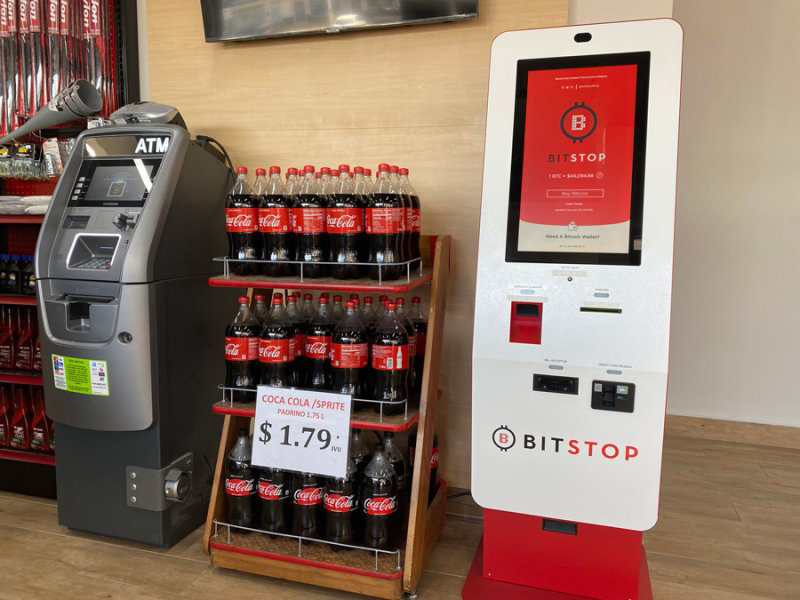
Header image source: Wikimedia Commons · PuertoCrypto · CC0.
