
As of about 8:10 a.m. ET on Friday, April 17, the market is entering the weekend with two messages that do not fully agree. Reuters reported that world stocks were holding near record highs and that benchmark oil prices were staying below $100 ahead of a potentially crucial weekend meeting between U.S. and Iranian negotiators. AP separately reported that the S&P 500 closed at another record on Thursday, ending at 7,041.28 after its 11th gain in 12 sessions. CNBC then added that oil kept drifting lower early Friday, with Brent near $98 and investors leaning into hopes that the Iran war may move closer to a negotiated off-ramp. That combination leaves traders with a classic relief-rally problem: price action is bullish, but the next big move may still depend on geopolitics rather than charts alone. This is market analysis for educational purposes, not financial advice.
TL;DR
- Reuters said world stocks held near record highs on Friday as traders positioned for a possible weekend U.S.-Iran meeting.
- AP said the S&P 500 closed at a fresh record on Thursday at 7,041.28, while the Dow and Nasdaq also pushed higher.
- CNBC reported Brent stayed below $100 early Friday, reinforcing the market's relief trade even though Hormuz disruption risk has not disappeared.
- The bullish case is strong earnings plus lower oil. The bearish case is that markets may be pricing peace faster than diplomacy can actually deliver it.
- For the next 24 to 72 hours, the key tells are weekend Iran headlines, whether Brent stays below $100, and whether the S&P 500 can hold above the 7,000 area once cash trading resumes.
What happened
This is no longer just a rebound story. It is now a validation test. AP said U.S. stocks ticked to another record high Thursday, with the S&P 500 up 0.3%, the Dow adding 115 points, and the Nasdaq rising 0.4%. That extended a run that has taken U.S. stocks more than 10% above their late-March lows.
At the same time, Reuters said investors were carrying that optimism into Friday, keeping world stocks near records while oil remained under the psychologically important $100 level. The key reason is simple: the market still believes some form of diplomatic progress is possible in the Iran conflict, even with the Strait of Hormuz not fully normalized.
But relief is not the same thing as resolution. CNBC reported that oil slipped again Friday after President Donald Trump said the war in Iran "should" end soon and after a 10-day Israel-Lebanon truce raised hopes for broader de-escalation. Even so, ING warned in the same CNBC report that the physical oil market is tightening every day that normal flows do not resume, and that the main upside risk is a breakdown in talks.
So the setup going into the weekend is clear. Stocks have acted as if the worst-case economic scenario may be avoided. Oil has backed off enough to support that view. But neither market is yet saying the risk is gone.
Why markets moved
Stocks at record highs: why oil, Iran talks and earnings still matter
The first driver is geopolitical relief. Reuters said investors remain forward-looking and are willing to look through current disruption if they believe diplomacy can reopen the path to lower energy prices. That helps explain why stocks can rally even while the underlying conflict is not fully settled.
The second driver is earnings. AP said several U.S. companies continued to beat expectations, and Reuters noted that investors still need first-quarter results to validate how far equities have run in a short period. In other words, diplomacy may have triggered the rally, but earnings still need to keep it alive.
The third driver is oil itself. Brent below $100 is not just a commodity story. It is a macro signal. Lower oil eases some of the inflation and margin pressure that would otherwise threaten stocks, bond sentiment, and expectations for central banks. If crude stays capped, equities get room to keep digesting gains. If crude snaps back higher, the market may suddenly revisit risks it has been happy to ignore all week.
Implications for the most impacted trader cohorts
Index traders: The big picture remains supportive, but this is a less comfortable chase than a clean breakout on purely economic data. The S&P 500 is above 7,000, yet much of the near-term narrative still rests on weekend diplomacy that traders cannot hedge in real time while markets are closed.
Oil and futures traders: Brent below $100 matters, but the move lower is only convincing if it is followed by clearer evidence that talks are real and supply disruption risk is easing. If not, oil can reverse quickly and drag cross-asset sentiment with it.
Cross-asset macro traders: This is a classic correlation test. Stocks are saying growth risk may be manageable. Oil is saying the market still sees disruption, just less of it. If those two signals converge further, trend-following can continue. If they diverge again, volatility likely returns fast.
Potential positives vs negatives
Potential positives
- Reuters said world stocks are near record highs, showing broad risk appetite rather than a narrow U.S.-only bounce.
- AP said the S&P 500 has now posted 11 gains in 12 sessions, a sign that buyers still have momentum.
- CNBC showed oil moving lower again Friday, which supports the idea that energy panic is cooling.
- Early earnings have been solid enough to give the rally a fundamental backbone, not just a geopolitical headline boost.
Potential negatives
- CNBC cited ING's warning that peace talks could still break down because U.S. and Iranian demands remain wide apart.
- Reuters noted that investors may need more validation from de-escalation steps and earnings to justify how fast stocks have run.
- The Strait of Hormuz is still not fully normal, which means the oil relief trade can reverse if weekend headlines disappoint.
- Reuters also flagged Netflix as a weak premarket earnings read, a reminder that expectations are high and misses can still punish crowded longs.
What could happen from here
Base case: Stocks pause near record highs, Brent stays below but near $100, and the market waits for clearer evidence after the weekend. This view is confirmed if the S&P 500 holds the 7,000 area while oil fails to reclaim triple digits. It is invalidated if either diplomacy clearly improves or talks break down hard enough to cause a sharp gap move on Monday.
Upside case: Weekend Iran talks produce a credible sign of progress, oil extends lower, and traders treat the recent record highs as the start of a new leg rather than the end of a relief rally. This path is confirmed if Brent keeps easing and equities reopen with broad participation rather than a narrow megacap lift. It is invalidated if positive headlines fail to generate follow-through in stocks.
Downside case: Talks disappoint, oil snaps back toward or above $100, and traders decide the market had priced too much good news too quickly. This path is confirmed if energy jumps, safe-haven demand returns, and U.S. index futures reopen weaker. It is invalidated if oil cannot hold a rebound and earnings keep absorbing the geopolitical stress.
What traders should watch next
- Any confirmed timing or outcome details around the expected weekend U.S.-Iran meeting.
- Whether Brent crude stays below $100 or quickly retests that level.
- Whether the S&P 500 can keep the psychological 7,000 area in focus after Thursday's record close.
- Whether earnings continue to beat strongly enough to offset geopolitical headline fatigue.
- Whether the market starts pricing more caution into the dollar, yields, and index futures before Monday's open.
Quick FAQ
Why publish another stocks risk map after Thursday's setup piece?
Because the market moved from anticipation to confirmation. Thursday delivered the actual record close, and Friday added a new weekend event-risk layer that changes how traders need to think about holding exposure.
Why does Brent below $100 matter so much?
Because it is the cleanest live read on whether the market believes Middle East disruption is getting better or worse. Stocks can stay resilient while oil cools. If oil surges again, that balance gets much harder to maintain.
Related reading on ChartDojo: US Stocks Friday Setup: Oil, Chips and S&P 500 Levels to Watch and Oil Risk Watch: Brent Jumps as U.S.-Iran Talks Narrow and Hormuz Flows Stay Strained.
Build real skills, not bad habits. ChartDojo gives traders AI-powered feedback on execution, decision quality, and risk patterns, with a free trial to get started: https://chartdojo.io/register.
Sources
- Reuters: World stocks hold near record highs, oil keeps below $100 on peace deal hopes
- AP: Wall Street sets another record after US stocks tick higher
- CNBC: Oil falls as Trump reiterates Iran war should end soon and Israel-Lebanon truce lifts hopes
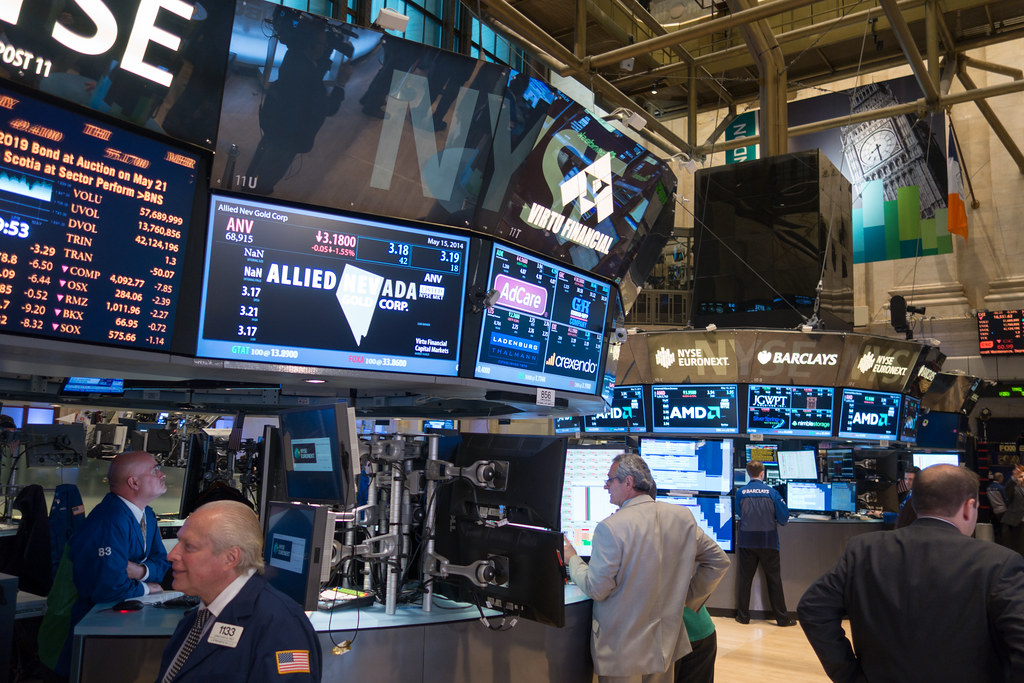
Header image source: Wikimedia Commons, photo by Scott Beale. License: CC BY-SA 4.0.
