
Reporting checked as of October 23, 2026, 9:47 a.m. ET. Educational analysis, not legal or financial advice.
Direct answer: Phantom Kalshi prediction markets are now appearing for US users inside Phantom's mobile app. The integration changes where users discover and submit event-contract orders. It does not change who lists the contracts, resolves the outcomes, or sets the trading rules. Those functions remain with Kalshi.
TL;DR
- Phantom has begun rolling out a Predict tab that gives US users access to Kalshi event contracts.
- Users must create or link a Kalshi account and complete Kalshi identity verification before trading.
- Phantom documents a $0.02 fee per contract traded, split equally between Phantom and Kalshi, plus possible network costs.
- Liquidity still controls whether a position can be sold before resolution. A displayed profit does not guarantee an immediate cash-out.
- The main trader task is to verify rules, total costs, available buyers, and settlement responsibility before submitting an order.
What happened with Phantom Kalshi prediction markets?
Phantom's live help documentation says US users can browse event contracts across sports, politics, economics, and culture in the Phantom mobile app. The markets are offered through Kalshi, a US-regulated exchange. Users can review current prices and rules, choose Yes or No, enter an amount, and select a payment source.
The Block reported that the rollout began on October 23 and would expand over the following weeks. Prediction News separately documented the new identity-verification flow on October 22 and identified Phantom's help center as the primary source.
Before a first trade, a user must create or link a Kalshi account. Phantom's verification guide says Kalshi may request a legal name, residential address, Social Security number, verified phone number, and government-issued identification. Kalshi can request additional checks after trading begins.
Why this platform-access change matters
The change places regulated event contracts inside a widely used crypto wallet. That can reduce the number of steps between seeing a market and submitting an order. It can also blur important boundaries for users who assume the app showing a position controls every part of the trade.
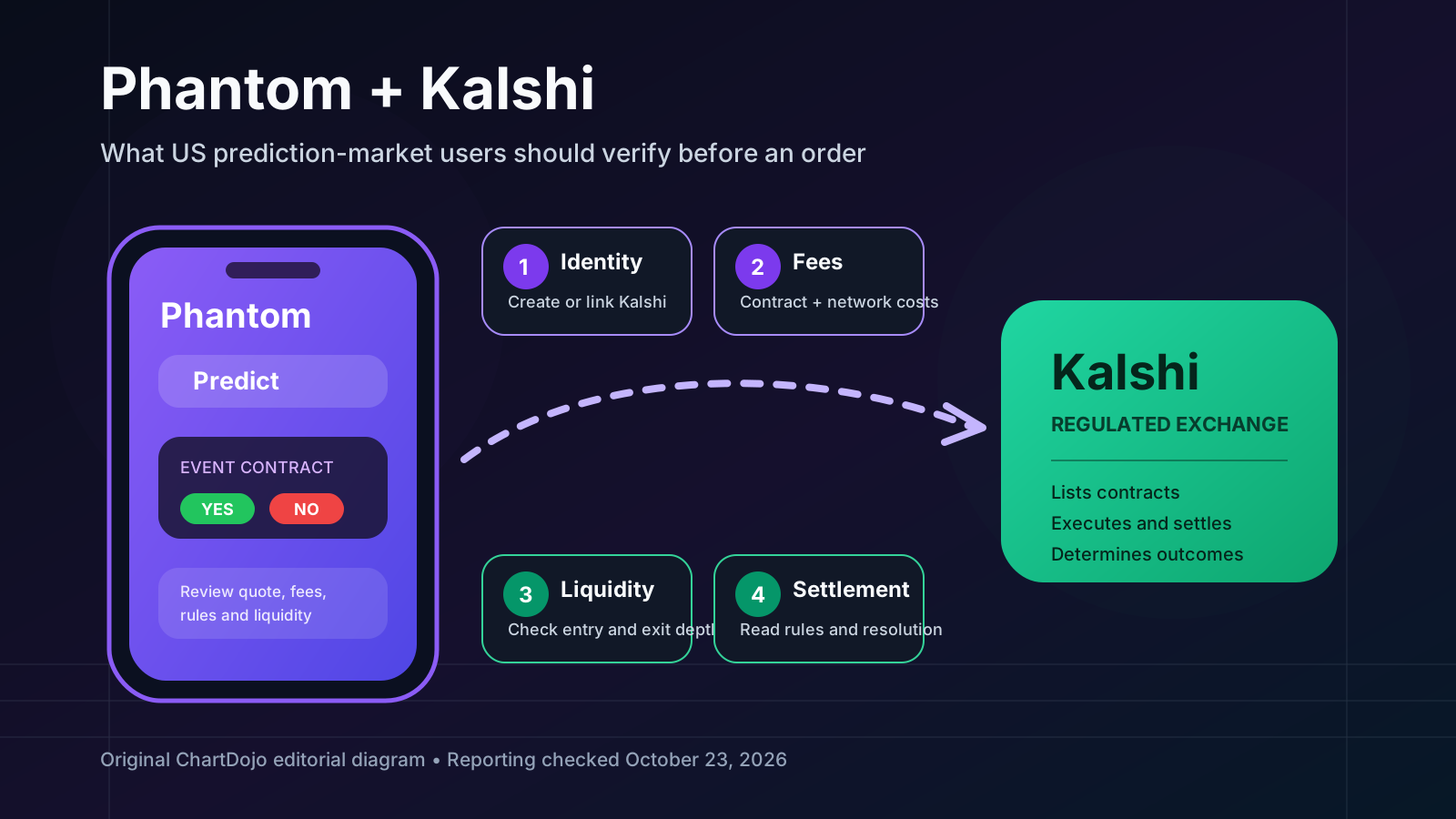
Phantom provides the interface, account setup flow, position display, and movement of funds. Kalshi creates and lists the contracts, defines the rules, executes trades, determines outcomes, settles positions, and applies eligibility requirements. That division matters when a market is disputed or a payout is delayed.
The funding route also changes the execution checklist. Phantom says users can pay from a Cash balance or with a token on Solana. Cash-funded orders are gasless. Other portfolio funding requires a small amount of SOL for network fees. Proceeds from a sale or winning payout move from Kalshi back to Phantom Cash through Stripe.
Implications for prediction-market and crypto users
Prediction-market participants: Distribution is broader, but contract wording still governs the trade. Read the event definition, source of resolution, cutoff time, and edge cases before treating the displayed chance as a complete description.
Phantom users: The wallet interface may feel familiar, yet the position is a Kalshi event contract. Identity checks and jurisdiction limits still apply. A linked Kalshi balance is also separate from the Cash balance shown in Phantom.
Execution-focused traders: Phantom lists a $0.02 prediction fee per contract traded. One cent goes to Phantom and one cent goes to Kalshi. The bid-ask spread and network costs can add to that amount. Review the final quote rather than comparing headline probabilities alone.
Potential positives vs negatives
Potential positives
- In-app discovery can make regulated event contracts easier for eligible US users to find.
- Existing Kalshi users can link an account instead of repeating the full signup process.
- Phantom shows estimated fees, position value, payout, and contract count before confirmation.
- Cash-funded orders remove the need for a separate gas payment at submission.
Potential negatives
- A familiar wallet interface can make complex contract rules look simpler than they are.
- Early cash-out depends on buyers being available at an acceptable price.
- Separate Kalshi and Phantom balances can create confusion about where funds are held.
- Regulatory and jurisdiction changes can affect availability after the initial rollout.
A four-check Phantom Kalshi execution worksheet
Use this exercise before the next order. First, write down the exact Kalshi contract and the sentence that controls resolution. Second, record the quoted contract price, displayed fees, expected spread cost, and any network fee. Third, inspect whether the order book has enough liquidity for both entry and an early exit. Fourth, identify which provider handles identity review, trade execution, dispute resolution, and fund return.
Then pause the replay just before confirmation. State the maximum loss in dollars and the condition that would make the trade invalid for your plan. After the market resolves, compare the result with the published rule rather than the news headline. This separates a good decision process from a lucky outcome.
ChartDojo's recent guide to the Utah Kalshi lawsuit explains why access can differ by jurisdiction. Its Pentagon prediction-market rule covers the separate risk of trading with nonpublic information.
What could happen from here
Base scenario: access expands gradually
More eligible Phantom users receive the Predict tab while the account-linking and funding flow remains stable. Confirmation would come from wider documented availability and consistent help-center guidance. Repeated onboarding failures or new restrictions would weaken this path.
Upside scenario: distribution improves market depth
New users add orders to active contracts, narrowing spreads and making exits easier. Confirmation requires better visible liquidity across multiple markets, not download counts or signup claims. Thin books would invalidate the scenario.
Downside scenario: access fragments
State disputes, compliance changes, or product restrictions reduce the set of contracts available to some users. Confirmation would come from formal notices or verified changes in the app. General political criticism without a product change would not confirm it.
What to watch next over the next 24 hours
- Whether Phantom publishes a jurisdiction list for the rollout.
- Any changes to displayed contract categories or eligibility notices.
- Observed spreads and available depth in heavily traded Kalshi markets.
- Updates to fee, identity, settlement, or maintenance documentation.
FAQ
Does Phantom operate these prediction markets?
No. Phantom provides the app interface and fund-movement flow. Kalshi operates the exchange, lists contracts, executes trades, determines outcomes, and settles positions.
Can a user always cash out early?
No. Phantom says an early sale requires a buyer. Limited liquidity can prevent a sale at the preferred price or prevent a sale entirely.
Sources
Primary documentation: Phantom trade guide and Phantom verification guide. Independent reporting: The Block and Prediction News. Feature-image licensing and attribution appear in the image caption.
Build real skills, not bad habits. Practice rule reading, execution planning, and post-trade review with AI-powered feedback. Start your free ChartDojo trial.
Header image: Original ChartDojo editorial diagram showing the Phantom-to-Kalshi access and execution flow.