
TL;DR
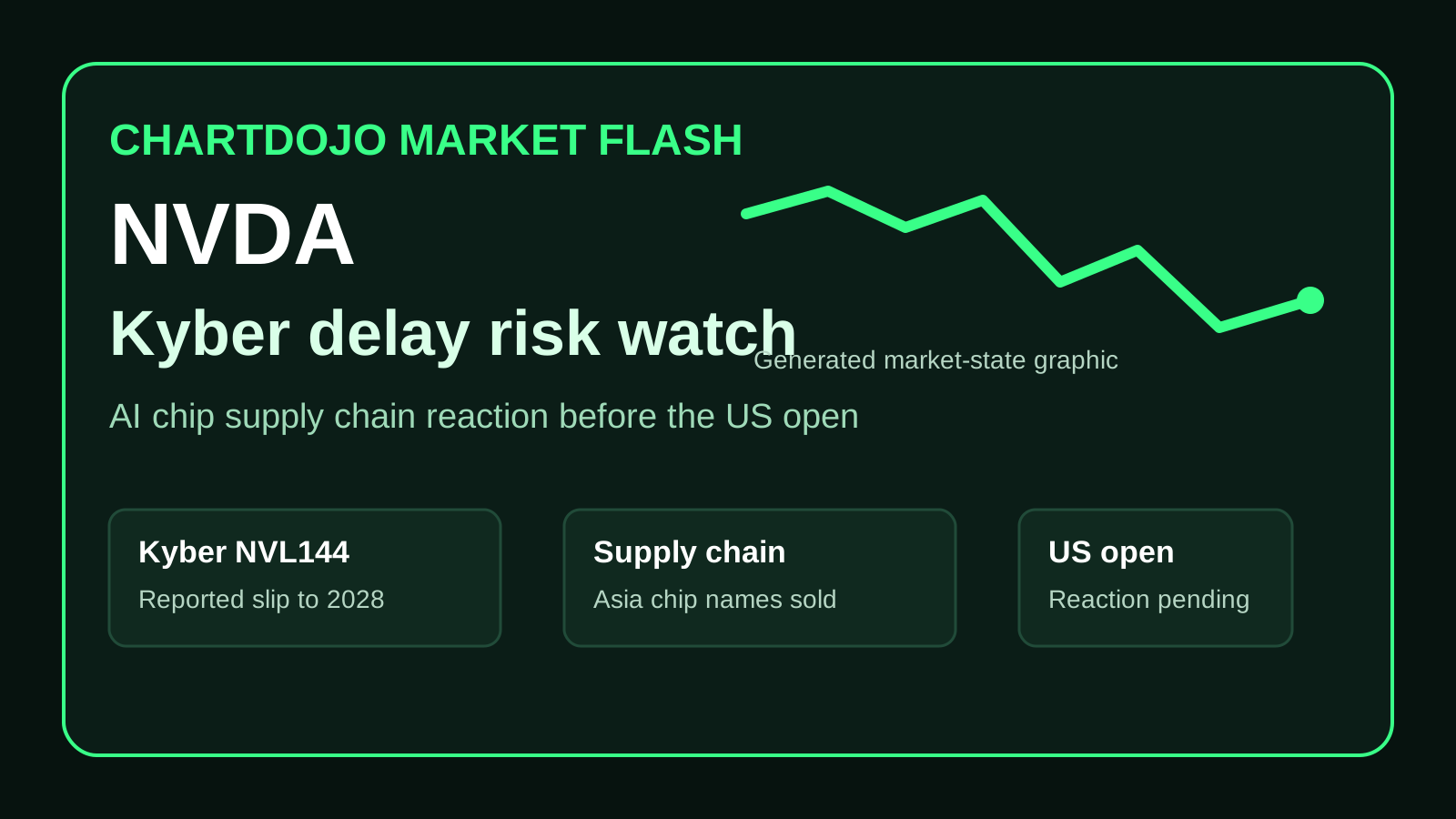
- Nvidia Kyber delay is the fresh catalyst after CNBC reported, citing SemiAnalysis, that the rack-scale AI system tied to Rubin Ultra chips has slipped to 2028.
- The claim is not company-confirmed. Treat this as a Risk Watch, not a settled roadmap update from Nvidia.
- Asia-listed AI supply-chain stocks reacted first, with Omni/TT reporting double-digit drops in several names before the US cash session.
- The US test is whether NVDA, semiconductor ETFs, and Nasdaq futures shrug off the report or start pricing a longer AI infrastructure delivery cycle.
What happened: Nvidia Kyber delay
As of 4:00 a.m. ET on Monday, July 6, 2026, the Nvidia Kyber delay story had become the cleanest same-day AI-chip catalyst in the high-priority feeds. CNBC reported that Nvidia's next-generation Kyber rack-scale architecture, designed for its 2027 Rubin Ultra chips, has been delayed to 2028 because of manufacturing problems. CNBC attributed the report to semiconductor research firm SemiAnalysis.
SemiAnalysis also posted on X that Kyber NVL144 had been delayed by more than 12 months after being shown at GTC. The stated problem was the PCB midplane, the dense circuit-board layer that connects the system inside the rack. That detail matters because this is a system-level issue, not simply a single-chip delay.
Seeking Alpha repeated the CNBC/SemiAnalysis report and added two trader-relevant details. First, cloud customers reportedly rejected a backup rack-scale design. Second, SemiAnalysis still expected Nvidia data-center compute revenue to beat Wall Street consensus by 20% in the second half of fiscal 2027, so the read-through is not one-sided bearish.
The market reaction started outside the US. Omni, citing TT, reported that several AI-related stocks in Asia sold off sharply after the report, including Ibiden in Tokyo, Kingboard Laminates Holdings in Hong Kong, and Samsung Electro-Mechanics in Seoul. The same report said Nvidia had not confirmed the claim.
Why markets moved
AI infrastructure stocks have been priced for a fast product cadence. When the market hears that a rack-scale Nvidia system could slip by more than a year, it has to question timing across the supply chain: PCB makers, optical component suppliers, memory vendors, server assemblers, cloud buyers, and competing accelerator platforms.
That does not mean every AI stock should fall for the same reason. The story is more specific. Kyber is tied to the high-density rack systems that make future training and inference clusters easier to scale. If the bottleneck is real, the pressure lands first on companies whose earnings expectations depend on rapid buildouts of next-generation AI racks.
There is also a second-order question for NVDA itself. Nvidia has often turned system complexity into pricing power. A delay may worry traders, but it may also remind investors how hard the company's full-stack lead is to copy. That is why this setup deserves a watchlist, not a reflexive sell signal.
In our internal ChartDojo logs, semiconductor headline shocks tend to create the worst practice behavior when traders chase the first candle without separating confirmed facts from disputed claims. This is exactly the kind of tape where a written scenario map beats impulse trading.
Implications for the most impacted trader cohorts
For stock traders, the immediate focus is NVDA and the broader semiconductor complex. Watch whether the stock opens weak on the report, then stabilizes, or whether selling broadens into chip suppliers and AI infrastructure peers. A contained NVDA dip with relative strength in the Nasdaq would say traders still view the delay as manageable.
For futures traders, Nasdaq 100 futures matter more than the headline itself. If the report starts to weigh on mega-cap technology and chip beta, NQ could become the cleaner expression than single-name chasing. If futures stay firm while Asia suppliers remain under pressure, the market may be treating this as a supplier-specific repricing rather than a US index shock.
For options traders, implied volatility is the part to respect. A Monday premarket report with an unconfirmed company angle can widen spreads and punish late entries. Traders should compare front-week NVDA implied volatility with actual price movement after the open. Expensive premium needs follow-through.
For crypto traders, the connection is indirect. Bitcoin and Ethereum can react when Nasdaq risk appetite shifts, but this is not a crypto-native catalyst. Crypto exposure should be read through the risk-asset channel, especially if chip weakness starts pulling down QQQ or high-beta growth names.
Potential positives vs negatives
The negative case is straightforward. If the SemiAnalysis report is accurate and the Kyber rack slips into 2028, some AI infrastructure revenue assumptions could move out in time. Suppliers tied to advanced PCB, optical interconnects, high-density servers, and related components may face a tougher near-term narrative.
The positive case is less obvious but still real. The report may reinforce how technically hard Nvidia's roadmap is, which can protect the company's lead if rivals face similar scaling problems. It may also shift attention toward interim systems that still support data-center revenue before Kyber volumes arrive.
There is a competition angle too. AMD, Alphabet's Google TPU roadmap, Marvell, Broadcom, and other AI infrastructure names could draw fresh interest if traders decide a delay opens room for alternatives. That view needs confirmation from price action, customer commentary, or supplier orders. A headline alone is not enough.
The balance is mixed. This catalyst can hurt sentiment around the most crowded AI hardware trade, while still leaving the long-term compute-demand story intact. That mix is why the first US session after the report matters.
What could happen from here
Base case: NVDA opens under pressure, suppliers stay weaker, and Nasdaq futures absorb the story without a disorderly move. This path is confirmed if NVDA underperforms chips but QQQ holds near premarket levels. It is invalidated if selling spreads into mega-cap tech and the Nasdaq 100 breaks lower through the first hour.
Upside case: Nvidia or channel checks calm the market, and traders focus on continuing data-center demand rather than the reported Kyber slip. This path is confirmed by NVDA reclaiming premarket losses and chip ETFs turning positive. It is invalidated if supplier names remain deeply offered and analysts begin cutting delivery assumptions.
Downside case: The report becomes a broader AI-capex scare. In that version, traders start questioning whether future rack complexity is rising faster than the supply chain can handle. This path is confirmed if NVDA, SOXX, QQQ, and AI suppliers all weaken together with volume. It is invalidated if weakness stays isolated to a narrow supplier group.
None of these paths should be treated as investment advice. They are decision frameworks for traders trying to avoid reacting to a half-formed tape.
What to watch next
- Nvidia's response, if any, to the SemiAnalysis report.
- NVDA premarket and opening-hour volume compared with the prior five sessions.
- SOXX and SMH relative strength against QQQ.
- Asia supplier follow-through after the first US reaction.
- Analyst notes on Rubin Ultra timing, PCB midplane yield, and cloud-customer acceptance.
- Whether AMD, Marvell, Broadcom, or Alphabet trade as beneficiaries or simply follow chip beta lower.
Sources
- CNBC: Nvidia Kyber rack system delay report
- SemiAnalysis on X: Kyber delay claim
- Seeking Alpha: Nvidia Kyber delayed to 2028 report
- Omni/TT: AI-related shares fall in Asia
- Tom's Hardware: Kyber rack background from GTC
For related market context, see ChartDojo's earlier coverage of the KOSPI chip selloff in Samsung and SK Hynix and the June AI chip selloff in Korea.
Build real skills, not bad habits. Use ChartDojo to practice trade plans, review your reasoning, and get AI-powered feedback before the market forces the lesson. Start a free trial at chartdojo.io/register.