
By Ulysses Cornelius
Market education, not financial advice. Figures and source context are current as of 2:30 p.m. ET on Wednesday, June 17, 2026.
The June Fed decision was not a quiet hold. The Federal Open Market Committee kept the federal funds target range at 3.50% to 3.75%, yet the statement and projections pushed traders back toward higher-rate risk. For an event that began with no change in the policy rate, the bond-market reaction was the story.
TL;DR
- The Fed held rates at 3.50% to 3.75% on June 17 in a unanimous 12-0 vote.
- CNBC's feed said the Fed removed cutting bias from the statement.
- The median 2026 PCE inflation forecast rose to 3.6% from 2.7% in March.
- Bloomberg reported that US Treasury yields jumped as traders priced higher 2026 borrowing costs.
What happened
The Federal Reserve released its June FOMC statement at 2 p.m. ET. The committee held the target range for the federal funds rate at 3.50% to 3.75% and said the decision passed by a 12-0 vote.
The statement described economic activity as expanding at a solid pace despite lift uncertainty tied partly to the Middle East conflict. It also said inflation remains above the Fed's 2% goal, with supply shocks driving price increases in sectors including energy.
The new projections made the hold feel more hawkish. The Fed's median 2026 PCE inflation forecast rose to 3.6% from 2.7% in March. Core PCE inflation, which strips out food and energy, rose to 3.3% from 2.7%. The median end-2026 federal funds rate projection moved to 3.8% from 3.4%.
Why markets moved after Fed removes cutting bias
Traders had little reason to be surprised by the rate hold itself. The surprise was the signal around the next step. CNBC's market feed framed the statement change as the Fed removing cutting bias, while Bloomberg reported that US Treasury yields leaped as officials signaled a possible rate hike in the coming months.
That combination matters because the two-year Treasury yield is highly sensitive to the expected policy path. When the front end of the curve rises after a Fed statement, traders are usually saying that cuts look less likely, a later hike looks more plausible, or both.
Higher short-term yields can pressure stock multiples, especially for growth shares where investors are discounting cash flows far into the future. They can also tighten conditions for futures traders because index moves become more dependent on each sentence from the press conference.
The energy reference in the statement added another layer. If oil-linked inflation stays lift, the Fed has less room to sound relaxed even when a rate hike cannot solve the supply problem directly.
Implications for the most impacted trader cohorts
Stock traders: The immediate risk is multiple compression in rate-sensitive groups. Nasdaq breadth and S&P 500 sector rotation matter more than the first headline print because the pressure is coming through yields.
Futures traders: The clean read is whether S&P 500 futures can reclaim the post-statement range. If two-year yields keep rising while equity futures fade, the market is treating the Fed message as a tightening signal.
Bond traders: The front end carries the clearest information. A jump in two-year yields says traders are repricing the policy path, while the long end may trade more on growth fear if equities weaken into the close.
In our internal ChartDojo logs, Fed-day mistakes often come from treating the first candle as the full event. The better review is slower: mark the first reaction, listen for the press conference tone, then compare yields with equity breadth before judging whether the move has follow-through.
For related context, see today's Iran risk watch for oil, futures, and gold and the earlier Hormuz and energy risk map.
Potential positives vs negatives
Potential positives:
- The unanimous vote reduces confusion about committee alignment at this meeting.
- The Fed still sees solid economic activity and job gains keeping pace with the workforce.
- The hold gives markets time to test whether energy pressure fades before officials act again.
Potential negatives:
- The inflation forecast moved sharply higher, which makes a quick return to cuts harder.
- The higher 2026 rate projection gives traders a reason to price another tightening step.
- If oil rises again, the Fed may face inflation pressure while risk appetite weakens.
What could happen from here
Base case
Chair Kevin Warsh keeps the press conference focused on data dependence. Stocks remain choppy, two-year yields stay firm, and traders wait for Thursday follow-through. Confirmation would be two-year yields holding near post-Fed highs while S&P 500 futures fail to regain the first reaction range. Invalidation would be yields fading and breadth improving into the close.
Upside case
Warsh acknowledges hotter inflation projections but avoids sounding eager to hike. That could help equities stabilize if yields stop rising. Confirmation would come from Nasdaq breadth improving and growth sectors closing above their post-statement lows. Invalidation would be a renewed front-end yield jump during the press conference.
Downside case
The press conference reinforces the idea that another hike is live if inflation stays hot. Bond yields could extend higher and stocks could see another leg lower. Confirmation would be S&P 500 futures losing the post-decision low while two-year yields climb. Invalidation would be a strong equity recovery despite the higher inflation path.
What to watch next (next 24h)
- Warsh's 2:30 p.m. ET press conference language on future hikes and cuts.
- Two-year Treasury yield reaction, the cleanest read on Fed path repricing.
- S&P 500 and Nasdaq breadth after the first statement move fades.
- Oil headlines tied to the Middle East, because energy is now explicit in the Fed's inflation problem.
- Thursday morning follow-through in futures if overnight traders extend the bond-market reaction.
FAQ
Why did yields jump if the Fed held rates?
The hold was expected. Yields reacted to the statement tone, the higher inflation forecast, and the higher projected policy rate for the end of 2026.
Why does the two-year yield matter on Fed day?
The two-year Treasury yield tracks the expected policy path more closely than longer maturities. A sharp move there can show whether traders are pricing cuts, patience, or renewed hike risk.
Sources
- Federal Reserve: June 17, 2026 FOMC statement
- Federal Reserve: June 2026 economic projections
- Bloomberg: US yields jump after Fed projections
- CNBC: Fed holds rates steady
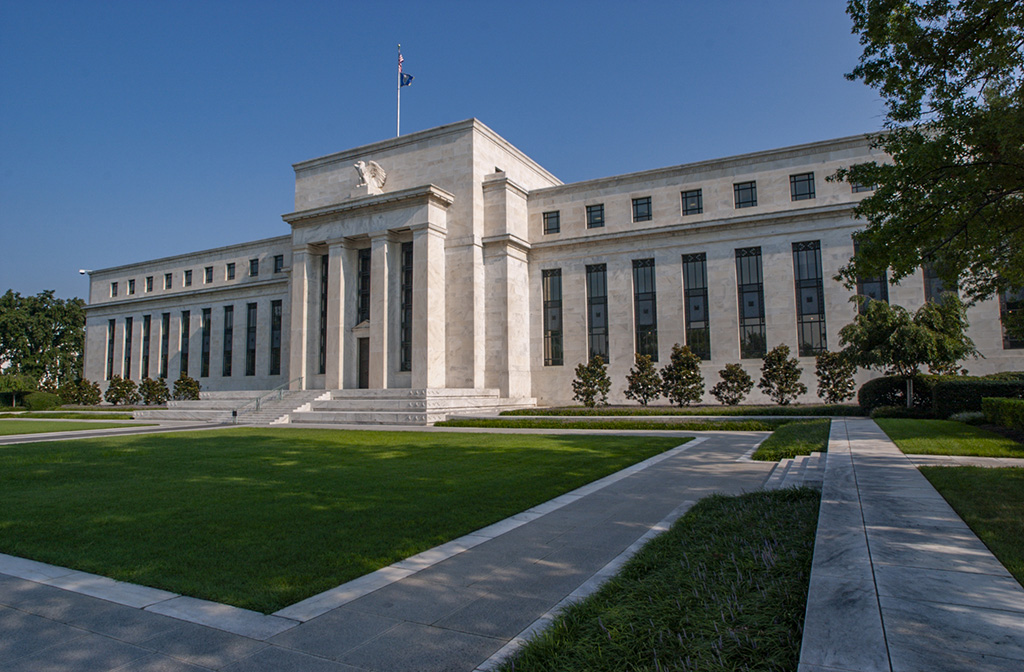
- Feature image: Marriner S. Eccles Building, photograph by the Federal Reserve Board.
Build real skills, not bad habits. ChartDojo helps traders turn Fed days into structured practice with AI-powered feedback, so you can review your plan and decision quality after the market noise fades. Start a free trial at chartdojo.io/register.