
By Ulysses Cornelius. As of 1:30 p.m. ET on Tuesday, June 23, 2026, the dollar breakout is the freshest cross-asset catalyst from the latest market scan. Bloomberg's high-priority markets feed reported that the dollar jumped to its highest level since November on Fed rate hike bets, while MarketWatch showed the U.S. Dollar Index at 101.40, up 0.38%, with the intraday high matching the top of its 52-week range.
This is market education, not financial advice. Rate repricing is no longer just a bond-market story. It is showing up in the dollar, gold, equity indices and the way traders are discounting crowded growth trades.
In our internal ChartDojo review logs, dollar-led sessions often punish traders who only watch one chart. One catalyst can weaken a long stock setup, turn a gold dip into a trend test and tighten conditions for crypto.
TL;DR
- The U.S. Dollar Index traded at 101.40 around 1:07 p.m. ET, up 0.38%, and touched 101.42, the top of its 52-week range on MarketWatch data.
- Bloomberg's markets feed reported that the dollar reached its highest level since November as Fed rate hike bets increased.
- The Guardian reported gold down 2% as traders priced an 86% chance of a Fed hike by December, up from 61% before last week's Fed meeting.
- Nasdaq and S&P 500 weakness made the dollar move relevant beyond currency desks.
Dollar breakout and Fed hike bets: What happened
The fresh development is a stronger dollar move tied to rate expectations. Bloomberg's high-priority markets feed flagged the dollar at its highest level since November on June 23. MarketWatch's U.S. Dollar Index page showed DXY at 101.40 at 1:07 p.m. ET, up 0.38% on the day. Its 101.42 intraday high also matched the top of its 52-week range.
A dollar breakout changes the pressure points across markets. A stronger dollar can weigh on commodities priced in dollars, tighten global financial conditions and create headwinds for multinational earnings translation.
The move came as traders raised the odds of another Federal Reserve rate increase. The Guardian's markets liveblog said gold prices fell 2% as the dollar hit a one-year high and rate hike expectations rose. It also reported that traders saw an 86% chance of a Fed hike by December, compared with 61% before last week's Fed meeting.
MarketWatch separately cited Deutsche Bank's view that gold's recent retreat is being driven more by Fed rate fears than by energy prices. The same report said gold futures had slipped from a late-January record close near $5,320 an ounce to around $4,140.
Why markets moved
The dollar tends to respond to relative interest-rate expectations. If traders believe U.S. rates may stay higher or move higher while other central banks pause or cut, dollar cash and dollar assets can look more attractive.
That repricing can hit gold quickly. Gold does not pay interest, so higher expected real yields can raise the opportunity cost of holding it. A stronger dollar also makes gold more expensive for non-U.S. buyers.
Stocks feel the pressure through a different channel. Higher rate expectations can lift discount rates, which lowers the present value of future earnings. That is especially important for long-duration growth stocks.
The Guardian's liveblog showed that pressure in real time, with the Nasdaq down just over 2% and the S&P 500 at a more than one-week low. The article tied the weakness to concerns about interest-rate hikes and heavy AI infrastructure spending.
For futures traders, DXY, gold and equity index futures are now part of the same risk map. A higher dollar can validate defensive positioning. A failed dollar breakout can quickly relieve pressure on gold and risk assets.
Implications for the most impacted trader cohorts
Currency traders: DXY is testing whether the move above the upper end of its recent range can hold. A clean hold above the 101 area would keep dollar longs in control. A quick reversal would warn that the breakout is crowded.
Gold traders: the metal is trading as a rates-sensitive asset again. The first question is whether gold can stabilize near the current zone or whether higher Fed hike odds keep forcing liquidation from trend followers and ETF-linked holders.
Stock and index futures traders: the dollar move adds another headwind to Nasdaq and S&P 500 setups. If DXY keeps rising while yields stay firm, intraday rallies in growth stocks may need stronger confirmation before traders treat them as durable reversals.
Crypto traders: Bitcoin and Ether are secondary markets in this catalyst, but they can still react to the dollar and liquidity channel. A stronger dollar often reduces the appeal of higher-beta risk trades when macro stress is rising.
Potential positives vs negatives
Potential positives:
- A stronger dollar can help import-heavy businesses by lowering the local-currency cost of some goods.
- Clearer rate repricing can reduce uncertainty for traders who need a cleaner macro anchor.
- If the dollar move cools inflation-sensitive commodities, it may eventually reduce pressure on consumers and some transport costs.
Potential negatives:
- A sustained dollar breakout can pressure gold, oil, emerging-market assets and crypto through liquidity channels.
- U.S. multinationals may face earnings translation headwinds if overseas revenue converts back into fewer dollars.
- Higher Fed hike odds can keep valuation pressure on growth stocks and crowded AI-related trades.
What could happen from here
Base case: DXY holds near its breakout area while traders wait for new inflation, labor-market or Fed-speaker confirmation. Confirmation would be DXY staying near the 101 area and gold failing to reclaim lost ground. Invalidation would be a fast dollar reversal with gold and Nasdaq futures recovering together.
Upside case for risk assets: traders decide the Fed hike pricing moved too far too fast. Confirmation would be lower short-term yields, softer DXY and stabilization in gold. Invalidation would be a fresh dollar high alongside another leg lower in equity indices.
Downside case for stocks and gold: the dollar breakout extends and traders increase the probability of a 2026 hike. Confirmation would be DXY pushing through its 52-week high while Nasdaq and S&P 500 futures fail at intraday resistance. Invalidation would be dovish Fed communication or weaker data that pulls hike odds lower.
What to watch next (next 24h)
- DXY reaction around the 101.40 to 101.50 zone after the U.S. cash close.
- Gold futures around the $4,140 area cited by MarketWatch and Deutsche Bank.
- Two-year Treasury yields, which are usually sensitive to Fed policy expectations.
- Nasdaq 100 and S&P 500 futures into the Asia open.
- Any Fed-speaker comments that confirm or push back against December hike pricing.
Sources
- Bloomberg: dollar jumps to highest since November on Fed hike bets.
- MarketWatch DXY: U.S. Dollar Index intraday level and 52-week range.
- The Guardian: gold, dollar, Fed hike odds and equity-market context.
- MarketWatch: Deutsche Bank view on gold and Fed rate-hike fears.
Related ChartDojo coverage: Nasdaq Selloff Deepens as AI Chip Rout Spreads and Bitcoin Risk Map: Rally Fades Near $65K.
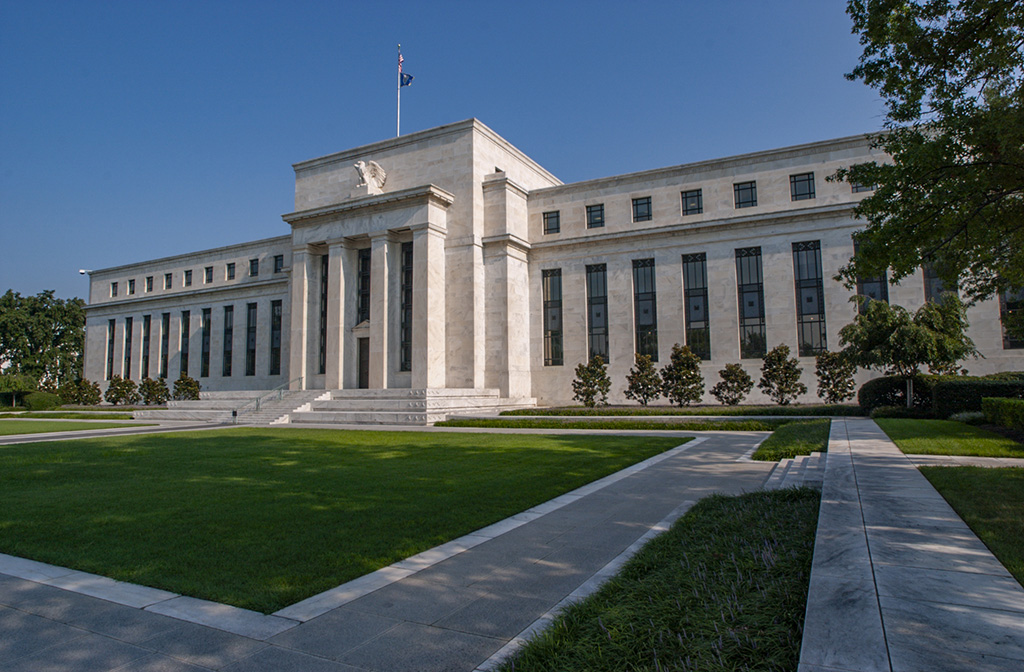
Header image source: Board of Governors of the Federal Reserve System, Marriner S. Eccles Federal Reserve Board Building, public source.
Build real skills, not bad habits. If you want to practice reading dollar, gold and index-futures catalysts with AI-powered feedback on entries, risk and review discipline, start a free trial at ChartDojo.