
TL;DR
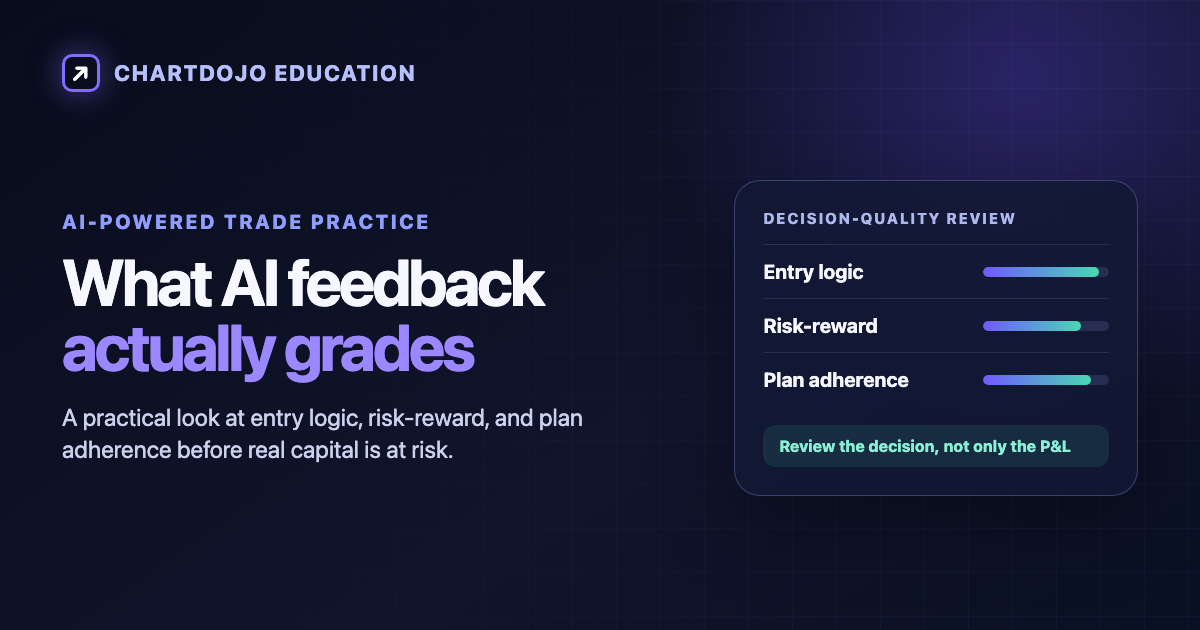
- AI feedback is most useful when it grades the quality of a trading decision, not whether the trade made money.
- A useful review can test entry logic, stop placement, position size, risk-reward, plan adherence, and setup fit.
- The model needs a written plan and enough chart context. If the input is vague, the grade will be vague too.
- AI is weak at reading private emotions, handling a market regime it has not seen, and interpreting breaking news without reliable context.
- Treat the score as a coaching prompt. Validate it against your rules, replay the chart, and keep final judgment with the trader.
AI feedback for traders sounds more mysterious than it is. A useful system does not predict the next candle or hand out a magical buy signal. It compares a decision with a stated plan and the market information available when that decision was made. The output should answer a practical question: did the trader follow a defensible process before risking capital?
That distinction matters because profit and decision quality often disagree in the short run. A careless entry can make money when price happens to move in the trader's favor. A well-planned trade can lose because losses are part of any probabilistic method. If software praises the first trade and condemns the second, it is teaching the wrong lesson. Good AI trade grading separates the decision from the outcome.
What an AI trade grade is measuring
A trade grade is a structured comparison. On one side sits the trader's plan: the setup definition and entry trigger. It also states the invalidation point and management rules. Allowed risk is recorded separately. On the other side sits the actual choice made on the chart. The system checks the distance between them. A small distance suggests discipline. A large distance reveals where the process changed under pressure.
The grade becomes more useful when each category has evidence. Entry logic might reference a breakout close or a pullback into support. A separate volume condition may confirm the trigger. Stop placement might reference the price level that disproves the setup. Position sizing can be checked with arithmetic. Plan adherence can be checked by comparing the submitted plan with the order sequence. These are observable facts, so a model can discuss them without pretending to know the future.
Consider a trader who plans to enter only after a five-minute candle closes above resistance. The trader enters halfway through the candle because price is moving quickly. The trade later wins. A P&L-only review labels it a success. A decision-quality review flags an early entry and explains that the trader accepted unplanned confirmation risk. That is the sort of correction that can transfer to the next hundred practice trades.
Six parts of a trading decision that AI can grade
1. Entry logic
The first question is whether the entry matched a defined trigger. A model can compare the selected candle and price with the setup rules supplied by the trader. It can point out an entry before confirmation or a chase far above the planned level. It can flag orders placed after the setup has changed. It can also recognize that two valid entry styles may exist. The grade should test consistency with the chosen style, not insist that one technique is universally correct.
2. Stop placement and invalidation
A stop should connect to the reason for taking the trade. If a long setup depends on a higher low holding, a stop below that structure has a clear purpose. A random fixed distance may have no relation to the chart. AI can compare the planned invalidation level with nearby structure and ask whether normal price noise is likely to touch the stop before the thesis is disproved. It cannot promise that a wider or tighter stop will win, but it can expose a mismatch between the setup and the exit rule.
3. Position sizing
Sizing is the cleanest category because much of it is arithmetic. Suppose a practice account is $20,000 and allowed risk is 0.5%. The entry-to-stop distance is $0.80. The risk budget is $100, so the maximum size before fees and slippage is 125 shares. If the submitted order is 200 shares, the planned loss is $160, or 0.8% of the account. The software can show the calculation and identify the rule breach without making a market forecast.
4. Risk-reward quality
AI can calculate the distance from entry to stop and compare it with the distance to a planned target. A trade risking $1.00 to pursue $2.00 has a planned reward-to-risk ratio of 2:1. That number alone does not make the trade good. The target must still relate to plausible market structure and the setup's historical behavior. Liquidity matters as well. A solid grade treats the ratio as one input and asks whether the target has a reason grounded in the chart.
5. Plan adherence
Plan adherence asks a blunt question: did the trader do what they said they would do? The review can identify a skipped trigger or a moved stop. It can also flag sizing-rule breaches and exits caused by impatience. This category is valuable because the evidence is personal and immediate. The trader is not being measured against an internet guru. The measurement is against their own written rule.
6. Setup-pattern match
Here is a sample 100-point rubric for practice review. The weights are not universal. They make the model's priorities visible, which lets the trader challenge the score instead of accepting a black box.
| Decision category | Maximum points | Example result |
|---|---|---|
| Entry logic | 25 | 18 |
| Stop and invalidation | 20 | 16 |
| Position sizing | 20 | 20 |
| Risk-reward | 15 | 9 |
| Plan adherence | 15 | 6 |
| Setup-pattern match | 5 | 3 |
| Total | 100 | 72 |
In this example, the 72/100 score is less useful than the distribution behind it. Full sizing points show that the loss was controlled. The weak plan-adherence result reveals the coaching priority. A trader who studies only the total might chase a higher number next time. A trader who studies the categories can focus the next replay session on waiting for the trigger and following the exit rule.
What AI feedback cannot grade reliably
The largest blind spot is private psychology. A model can read a note that says, "I felt rushed," or infer hesitation from repeated order changes. It cannot directly know whether the trader felt fear or boredom. Anger and outside pressure are also private. Even accurate language may hide the real cause. Feedback about emotion should be framed as a question for reflection, not a diagnosis.
Novel market regimes create another limit. A model trained or prompted with ordinary price action may apply old assumptions during an unusual volatility shock or a market closure. A structural change in liquidity can cause the same problem. The setup can look familiar while the conditions underneath it are different. Traders should lower confidence when the current environment falls outside the examples used to define the grading rules.
Breaking news is difficult for a different reason. A chart image does not explain why price jumped. Without a timestamped, trustworthy news feed, the model may invent a clean technical explanation for a move driven by an earnings release or a central-bank comment. An unexpected filing can be just as disruptive. Even with a feed, the first headline can be incomplete. The SEC's investor guidance on day trading warns that fast-moving conditions can make execution and losses harder to control. In that setting, an AI explanation should be treated as provisional.
AI also cannot prove that a setup has an edge from one chart. A sound claim about expectancy requires a large enough sample and consistent rules. The test must also include spread and slippage. Fees and other trading costs belong in the test as well. The grade can say that one decision followed the plan. It cannot turn that observation into evidence that the plan is profitable. That requires testing.
Finally, the model may disagree with the trader for a perfectly ordinary reason: the rule was underspecified. "Enter on strength" is not a testable instruction. "Enter after a five-minute close above the prior session high, provided volume exceeds the 20-bar average" gives the system something concrete to compare. Better feedback begins with clearer rules.
How to use AI feedback without giving up judgment
Start in a simulator. Tools such as thinkorswim paperMoney and Webull paper trading, as well as TradingView Bar Replay, let traders rehearse execution without putting real capital at risk. Their purpose is execution practice. An AI grading layer adds a separate review of why the decision was made and whether it followed the stated plan. For a direct comparison of those roles, see ChartDojo versus thinkorswim paperMoney.
Submit the plan before revealing the outcome whenever the tool allows it. Include the setup name and trigger. State the invalidation point and maximum account risk in separate fields. Give the target logic its own field. Add any condition that cancels the idea. This prevents the review from quietly rewriting the plan around what happened. It also makes disagreements easier to resolve because both the rule and the action are visible.
Read the explanation before the score. If a category loses points, ask which evidence caused the deduction. The answer should point to chart evidence or a stated rule. For numerical criticism, it should show the calculation. If it cannot, the criticism is too vague to use. A score with no traceable reason belongs in the same bucket as a social-media opinion: interesting, perhaps, but not a rule.
Then replay the same setup with one deliberate correction. Do not try to repair six habits at once. If the issue was early entry, the next session can focus on waiting for the closing trigger. Keep the stop and sizing rules stable. A narrow practice goal makes it easier to tell whether the feedback changed behavior.
Where ChartDojo fits
ChartDojo sits between paper trading and live trading. Paper simulators help you place pretend orders and observe results. ChartDojo adds chart practice with AI grading on decision quality, so the review focuses on entry logic and risk. It also tests plan adherence before real capital is involved. It is not a promise that a setup will win, and it should not replace independent testing.
The practical use is repetition with a tighter feedback loop. You study a chart and state the trade idea before making the decision. The AI-powered feedback is tied to the information you submitted. You can accept the grade or dispute it with evidence. You can also refine a vague rule. The point is to make the next practice attempt more deliberate.
Build real skills, not bad habits. If that approach matches how you want to learn, start a free trial and use the first sessions to test one setup with fixed risk rules. Keep the feedback that is specific and defensible. Question anything that asks for trust without showing its work.
FAQ
Can AI tell me whether a trade will win?
No. It can evaluate whether a decision matches supplied rules and whether the risk is coherent. It cannot know the next market outcome. Any tool that turns a process grade into a guaranteed forecast is overstating what the technology can do.
Is an AI trade score objective?
Only parts of it are objective. Position-size math and stated-rule comparisons can be checked directly. Pattern quality depends on the rubric and examples provided. Contextual judgments also depend on the available data. Ask to see the reasons behind each category.
How many practice trades should I review?
There is no universal number. Begin with a batch large enough to expose repetition, such as ten examples of the same setup, then examine which category fails most often. Do not combine unrelated setups and treat the average as one meaningful result.
Should I change my strategy when AI gives a low grade?
Not from one grade. Check whether the feedback points to valid evidence and whether the rubric matches your rules. Strategy changes should come from a tested sample, while execution corrections can be practiced as soon as a clear rule breach appears.
Does AI feedback replace a mentor or risk controls?
No. It can provide frequent structured review, but it cannot understand every personal circumstance or market exception. Use fixed risk limits and simulator practice. Keep broker safeguards active, and seek qualified human guidance where appropriate.